



Explore this content with AI:
Most agencies lose deals not because their strategy is weak, but because their proposal is. It’s generic. It leads with credentials rather than the client’s problem. It promises “engagement” and “brand awareness” without explaining what either means in revenue terms. And it looks like a Word document that could have been sent to any brand in any industry.
Clients are more sophisticated, more skeptical, and more time-poor than ever. They’ve been burned by vanity metrics. They’ve read the same proposal language from twelve different agencies. What they’re looking for isn’t a vendor. They’re looking for a strategic partner who already understands their problem before the contract is signed. And by the end of this guide, you will be able to write a proposal that reflects that you are that partner.
What Is a Social Media Proposal?
A social media proposal is a tool that freelancers and marketing agencies use to communicate their services to prospective customers. It shows how your offerings and expertise can add value to their business, and it outlines exactly how you’ll meet their unique business goals and objectives.
But the best proposals go beyond function. Think of it less as a contract preamble and more as a vision document — a bridge between the client’s current problem and the future you’re offering to build with them. It should make the client feel, before a single deliverable is produced, that you already understand their business better than they expected anyone to.
When Do You Need a Social Media Proposal?
1. New client pitches
The most common scenario — a prospective client has expressed interest and wants to see your approach, your pricing, and your proof that you can deliver. This is where the proposal earns or loses the deal.
2. Contract renewals
An existing client relationship is also an opportunity to reframe the scope. A well-structured renewal proposal shows what’s been achieved, what’s changed in the landscape, and why expanding the engagement makes strategic sense. It’s not a formality — it’s a re-pitch.
3. Internal buy-in
In-house social media managers increasingly need proposals too — not for external clients, but for executive sign-off on new initiatives. A TikTok Shop launch, an AI content automation rollout, or a LinkedIn thought leadership programme all require the same rigour: a clear problem statement, a proposed solution, measurable outcomes, and a budget justification.
Steps to Take BEFORE Writing the Proposal
The research phase is where winning proposals are built. The best pitch decks are always personalized to each prospective client.
A personalised agency sales pitch is more likely to determine your success than factors like price, value propositions, case studies, or benchmarks. You can’t personalise without doing the work first.
1. Run a discovery call
Before you write a word, get on a call. Ask the questions that surface the real pain — not just the stated goal.
“What’s your current lead-to-close ratio from social?” is a better question than “What are your social media goals?” The first one identifies a business problem; the second reads like a wish list. Listen for the language they use to describe their challenges and mirror it back in your proposal.
2. Conduct a social media audit
Pull their current numbers:
- follower growth rate
- Engagement rate
- Post frequency
- Content mix
- Platform performance
Use platform data to tie your social media strategy proposal to business objectives, such as increasing brand awareness, generating web traffic, or increasing sales.
Compare their performance to two or three competitors — not to embarrass them, but to show you understand the competitive context.
3. Research where their audience lives
The platform landscape has shifted.
Threads has crossed 400 million monthly active users.
LinkedIn video is outperforming text posts.
Niche AI communities are becoming acquisition channels for B2B brands.
Understanding where your client’s specific demographic actually spends time — not where they spent time two years ago — makes your platform recommendations feel considered rather than generic.
4. Uncover budget, deadlines, and brand guidelines
Three pieces of information most agencies are too timid to ask for directly — and too often pay for later.
Ask about the budget range on the discovery call, not after you’ve written the proposal. A client with a £1,500/month budget needs a different strategy than one with £8,000/month, and writing to the wrong number wastes everyone’s time.
Get clarity on their decision timeline too — “when are you hoping to start?” tells you whether you’re in an active evaluation or a speculative exploration.
And pull their brand guidelines before you write a word: fonts, colour palette, tone of voice, logo usage rules. Using their brand language and visual identity inside the proposal itself is one of the fastest signals that you pay attention to detail — exactly the quality they’re hiring you for.
The Core Anatomy of a Winning Proposal
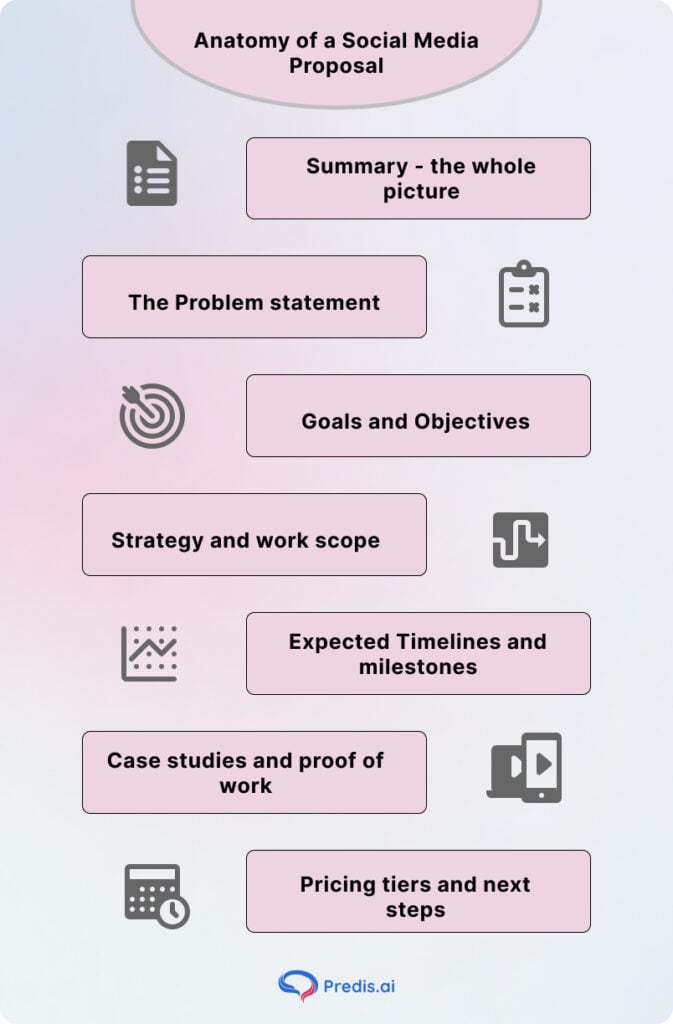
1. Executive Summary
One page. The “big idea” in plain language.
- What is the client’s core problem?
- What is your proposed solution?
- What does success look like in 90 days?
This section is often the only part a busy executive reads in full — make it do the work of the entire document.
2. The Problem Statement
Mirror the client’s own language back to them here. If they said “we’re not converting our Instagram followers into actual customers” on the discovery call, that phrase belongs in the Problem Statement verbatim. It signals that you listened, and that the strategy you’re about to propose is a response to their specific situation — not a template with their logo dropped in.
Transform deliverable descriptions into benefit statements.
Instead of “We’ll post 20 times per month,” write “Our content calendar will drive top-of-mind awareness with your target audience through 20 posts that drive engagement and website traffic.” Every feature should answer the client’s underlying question: “So what?”
3. Goals and SMART Objectives
Vague goals lose deals. Specific, measurable ones build confidence.
Instead of “increase engagement,” write: “Increase Instagram share-rate by 15% in Q3 by shifting the content mix toward problem-focused Reels and reducing promotional post frequency from 40% to 20%.” Every objective should have a metric, a timeframe, and a tactic attached to it.
4. Strategy and Scope of Work
This is the largest section and the one most agencies get wrong by being either too vague (“we’ll create great content”) or too granular (“we’ll post 4 Reels, 3 carousels, and 2 Stories per week on Tuesdays, Thursdays, and Saturdays”). The right level is strategic with specific logic:
- Platform selection: Why these two or three platforms, and not others? Make the argument. If you’re recommending Threads over X, explain why your client’s audience has migrated there.
- Content pillars: A clear framework — Educational, Promotional, Community — gives the client a mental model for the content they’ll be approving. It also signals that you think in systems, not one-off posts.
- Frequency and cadence: Managing two channels is not the same as managing five. Even when content can be repurposed, every platform has its own format rules, audience expectations, posting rhythm, and reporting context. State explicitly what you’re managing and at what volume.
5. The AI Edge
This is the section that separates modern agencies from legacy ones. In this AI era, clients expect you to be in par with the latest technology — the question is whether you can explain how they benefit the client, not just name-drop the technology.
Mention your use of AI for content generation and scheduling efficiency (tools like Predis.ai for Shorts and social video), Social SEO for discoverability in both platform and AI search, and data-led content testing to replace guesswork with evidence.
In an AI world, also emphasise what AI can’t do: the strategic oversight, the brand empathy, the human judgment that decides which content direction is right for this client at this moment. That’s your irreplaceable value.
6. Timeline and Milestones
Break the engagement into three phases:
- onboarding (weeks 1–2)
- First campaign launch (weeks 3–4)
- First reporting cycle (end of month one)
Clients who can visualise the process feel less risk. A clear milestone structure also protects you — it sets expectations before the retainer begins, not after.
7. Budget and Pricing Tiers
A strong agency proposal separates the base retainer from optional services. That improves clarity and helps protect profitability.
Offer three tiers — Standard, Growth, and Premium — so the client feels they’re making a choice rather than accepting or rejecting a single price. Each tier should have a clearly defined scope, not just a price increase. Standard covers the core; Growth adds video production or paid media management; Premium adds full-funnel strategy, creative direction, and reporting.
Transparency on pricing builds trust earlier than anything else in the document.
8. Case Studies and Proof
Always substantiate your claims with data. It’s not enough to simply state that you helped customer X significantly increase conversions. You’ll need to back up your assertions with an overview of your timeline, key metrics, how you measured them, and what they mean.
One relevant case study, done well, outperforms five generic ones. Choose the client whose situation most closely mirrors the prospect’s — same industry, same problem, or same platform — and walk through the before, the strategy, and the measurable after.
Best Practices for writing a social media proposal
1. Keep it visual
Studies show that almost 80% of people remember what they see, compared to 20% of what they read, and just 10% of what they hear.
A professional deck format — with charts, platform screenshots, and clear visual hierarchy — will outperform a wall of text every time. Use the client’s brand colours and fonts throughout if possible.
2. Make it about “you,” not “we.”
Count how many times your proposal says “we” or “I” versus “your brand” or “your audience.” The ratio should heavily favour the client. A proposal that reads like a company brochure signals the wrong priorities.
3. Clarity over jargon
Every buzzword you use is a trust withdrawal. “Synergy,” “holistic approach,” “360-degree strategy” — these phrases mean nothing and signal that you’re hiding behind language rather than making a real argument.
Explain the actual value in plain terms. If you can’t explain it simply, you probably don’t understand it well enough yet.
4. Video-first thinking
Every proposal should lead with a video-first content strategy. Reels, TikTok, and YouTube Shorts are the primary discovery engines for most audiences. If your proposed content mix doesn’t have short-form video as its largest single component, expect pushback.
5. Transparent reporting
Explain exactly how you’ll measure success — and make sure the metrics you propose go beyond followers and likes.
Share rate, saves, profile visits from non-followers, DM conversions, and link-in-bio click attribution are the metrics that tell the real story. Clients who’ve been burned by vanity metric reporting will appreciate seeing that you already know the difference.
6. The human touch
Your AI tools are a feature, not the product. The proposal should make clear that the creative direction, strategic judgment, and client relationship are irreducibly human — and that the AI handles the labour so you can focus on the thinking.
For example, AI can handle scheduling and auto-posting your content, but what goes out should be decided by a human.
7. A clear next step
End with a “Next Steps” section that removes friction from the decision.
- “Book a 15-minute walkthrough here.”
- “Reply to confirm your preferred start date.”
- “Sign and return the attached agreement to begin onboarding” — specific, low-effort, and time-bound.
A Winning Proposal Makes the Client Feel Found
The research is the proposal. Everything else is presentation. If you’ve done the discovery call properly, run the audit, found the white space, and understood what the client actually needs versus what they said they wanted, the writing is the easy part.
The promises you make in your social media proposal are only as strong as your ability to deliver them consistently and efficiently. A proposal that overpromises and underdelivers destroys a relationship faster than losing a pitch. Write what you can actually execute, price it properly, and let the depth of your research be the thing that sets you apart.
When the client finishes reading and thinks, “they already understand my brand better than my last agency did after six months” — that’s the proposal that wins.
FAQ
Aim for 10–15 slides or pages. Decision-makers value efficiency — keep your sections concise and use punchy headlines to guide the reader through your vision for their brand’s growth without overwhelming them with text. Longer than 15 pages signals that you haven’t done the editorial work of knowing what matters most.
Yes. Transparency on pricing builds trust earlier than anything else in the document and prevents the awkward negotiation that comes from vague “pricing available on request” language. Offer tiered options so the client feels they’re making a choice, not accepting or rejecting a single number.
Yes — with one firm rule: the Problem Statement and Strategy sections must be written from scratch for every client. Templates are useful for structure, formatting, and the boilerplate sections (About Us, Terms, Pricing Framework).