


Explore this content with AI:
The advertising platform that Facebook provides is among the most effective tools available to companies that want to communicate with their intended audience. But with millions of marketers vying for space on Facebook, how does the social media platform choose which advertisements to display? In its advertising auction system, the answer can be found. By gaining an understanding of the operation of this auction, you will be able to improve your return on investment (ROI), make your advertising plan more effective, and cut costs. Within this tutorial, we will learn how the Facebook ad auction works, dissect the process of bidding, discuss various techniques, and explain how you can increase the number of ad placements without going over your budget.
How Facebook’s Ad Auction Works?
In most auctions, the top bidder wins. But the Facebook ad auction takes more than that into account. How it works:
- Facebook runs an auction to determine which ads will show up in a user’s feed or stories every time they log in.
- Bids are made by advertisers to get their ads shown to certain groups of people.
- Facebook looks at ads based on three main criteria, which we will talk about next.
- The ad that has the most worth overall wins and is shown to the user.
This means that putting in a big bid doesn’t mean you’ll win. Facebook gives more weight to ads that are useful, interesting, and pay well.

Key Factors That Influence Facebook Ad Auction
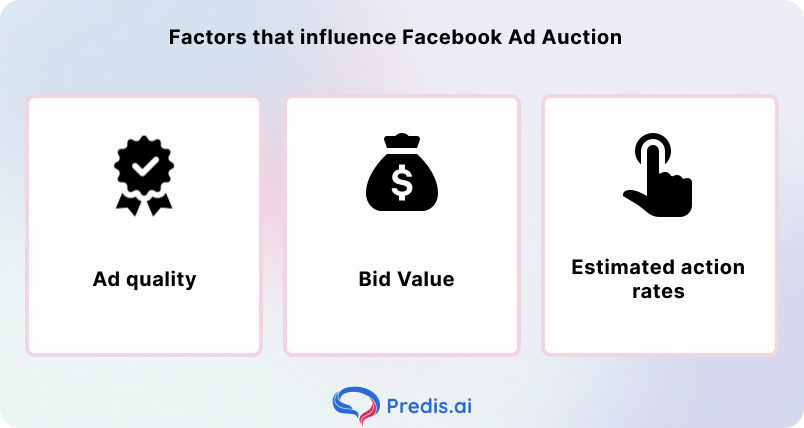
Facebook bases its choice of the winning advertisement on three primary criteria:
1. Bid Value
This is how much you are ready to pay for a particular action, such as a click, impression, conversion, etc. Higher bids are not the only determinant, even if they raise your chances of winning.
2. Projected Rate of Action
Facebook estimates a user’s likelihood of interacting with your advertisement. Past behavior of the user forms the foundation of this forecast.
- The contents and interaction record of the advertisement.
- The AI-driven research of Facebook.
- Should the anticipated action rate of your advertisement be high, you can still win the auction even with a smaller bid.
3. Ad Relevance and Quality
Facebook grades advertising according to user comments, relevancy, and quality. Among the elements are engagement rate—likes, shares, and comments.
- Negative feedback is when users either hide or report the advertisement.
- Landing page experience should be good. False content or slow-loading pages can lower your score.
- Facebook gives lower-cost, better-placed, high-quality ads awards.
How does Ad relevance diagnostics affect auction performance?
Ad releance diagnostics helps you take a peek into what Meta thinks about your ad and how it evaluates your campaign. It takes into consideration, 3 important factors such as:
- Quality ranking: How good your ad is when compared to other ads that are competing for the same audience?
- Engagement rate ranking: Can your ads get better engagement than other competitor ads?
- Conversion rate ranking: Is your ad good enough when it comes to conversions when compared to other competitors?
If your campaigns don’t get good ratings in this diagnosis, then it may be high time that you give it a refresh.
Some of the things you can do to improve ad relevance are:
- Targeting factors
- Visuals and ad copy
- Compelling offer
Types of Bidding Strategies in Facebook Ad Auction
Here is a quick glance at the different bidding strategies and when you should use these:
| Bidding strategy | How it works | When to use it |
| Automated bidding | Focusses on winning the auction at the lowest cost possible | 1. When you have a limited budget 2. You are new advertiser and have no clue about betting 3. Get maximum results within your set budget |
| Bid cap | You have to set the maximum amount you will pay for each result | 1. When you are strictly conscious about your budget 2. You are okay with limiting reach to stay in budget |
| Cost cap bidding | You should set the maximum average cost per result | 1. You have a budget but you are flexible with it 2. You need a balance between ad delivery and cost maintenance |
| Target cost bidding | Maintains a consistent average cost per result | You want to optimize for profitability |
1. Lowest Cost (Automatic Bidding)
- To get the lowest cost per action, you can use the automatic bidding that Facebook offers.
- This type of bidding strategy is best for new advertisers or those with a limited budget.
- The only drawback is that you have less control over individual bid amounts.
2. Bid Cap
- You set a maximum bid for each auction.
- Bid cap makes sure that you never pay more than your budget allows.
- This is best for cost-conscious advertisers, but this can limit reach.
3. Cost Cap
- Facebook aims to keep your average cost per action below a set threshold.
- Cost cap helps to balance cost control and ad delivery.
- This type is best for businesses that have a specific profitability target.
4. Target ROAS (Return on Ad Spend)
- Facebook optimizes bids to achieve a specific return on ad spend.
- Best for eCommerce and businesses tracking direct revenue.
5. Minimum ROAS Bidding
- You set a minimum return Facebook must achieve before spending your budget.
- Helps optimize profitability while ensuring steady ad delivery.
How to Choose the Right Bidding Strategy?
To find the best plan, you need to ask yourself the following questions:
- “What’s my main goal?” Is it brand awareness, online visits, and sales?
- How much do I want to be in charge of my bids?
- How much can I spend?
- Are my buying habits flexible, or do I need to know what my costs will be?
Lowest Cost is a great place to start for newbies. Try out Bid Cap or Cost Cap if you need more control over your bidding strategy.
Some additional tips to keep in mind is to not change bidding strategies mid-flight. Instead, check your performance for several days, understand its performance well before switching to something else.
Tips for Winning Facebook Ad Auction
To win the advertising auction, it is not enough to just place a high price. If you want to improve your odds without going over your budget, here is how:
- Enhance the Relevance Score of Your Advertisement
- Use images of high quality and copy that is interesting.
- Focus on the appropriate audience in order to increase engagement.
- Deceptive ads or clickbait-style should be avoided.
- Refine the targeting of the audience
- The Custom Audiences feature of Facebook can be utilized to target individuals who have already engaged with your brand.
- Make use of Lookalike Audiences to locate new consumers who are comparable to your most valuable customers.
- If you want to prevent wasting money on advertisements, exclude users who are irrelevant.
- Give Your Ads an A/B Test
- Try out a few different iterations of your advertisement to determine which one is the most successful.
- Experiment with different headlines, graphics, ad copy, and calls to action (CTAs).
- Optimize on the basis of the results received.
- Regularly monitor and adjust the bids
- Always keep an eye on the cost per result as well as the success of the advertisement.
- Raise your highest bids on campaigns that are performing well.
- Reduce or pause low-performing advertisements.
Common Mistakes to Avoid in Facebook Ad Bidding
1. Overbidding or underbidding
- Overbidding might deplete your funds quickly.
- Underbidding may limit your audience and ad delivery.
2. Ignoring Ad Relevance
- Even with a large bid, low-quality ads will not win auctions.
- Make sure your advertising is relevant to the user’s intent and delivers value.
3. Poor targeting
- Broad targeting can squander money on uninterested customers.
- Overly narrow targeting reduces reach and raises costs.
4. Failing to test different strategies
- A single plan will not be enough for all campaigns.
- Experiment with several bidding strategies to determine the most cost-effective choice.

Conclusion
Learning Facebook’s ad auction is about spending smarter rather than spending more. The main conclusion is that one should know how the auction mechanism works and then, based on one’s objectives, choose a suitable bidding approach. You also need to streamline your ad relevancy to cut out the expenses. Always A/B test your Facebook ads and change your bids often. Without busting your budget, these guidelines will help you maximize ad performance, cut expenses, and obtain better results.
Ready to start making content for your Facebook ads? Sign up for Predis AI and get started today!
FAQ
Facebook’s ad auction determines which ad to place in front of a user based on factors like your bid, ad quality, action rate and so on. The ads get chosen based on which one offers the most overall value.
Not necessarily. Your ad quality should be high as well as estimated action rate to ensure your performance will be high. Keeping a balance of all these factors can help improve your chances.
High-quality ads score better on the relevance diagnostics and thus does not cost too much, which means you can win with even lower bids. For spammy, low-quality ads, you might need to spend a lot to get it delivered.