

The normal, human approach to learning something is to try it, find out you are bad at it, attempt it differently, and eventually understand it. Machines are no different from us in this aspect. Every time you run an Instagram ad, Facebook undergoes a curve where it figures out how to deliver your ads the best way possible. And this is, in short, what a learning phase is.
When you run Instagram ads, there’s a moment where everything feels unstable — costs jump, results fluctuate, and nothing looks predictable. That’s the learning phase. It’s not a problem. It’s simply the system gathering data so it can deliver your ads to the right people at the lowest cost.
Most advertisers get worried during this phase and make the exact edits that push them back to square one. Let’s break down how the learning phase actually works in 2025, why it matters, and what you should do to move past it faster.
What the Learning Phase Actually Is?
When an ad set goes live, Instagram’s delivery system has a job: figure out who is most likely to take the action you’re optimizing for. That could be a purchase, lead, add-to-cart, landing page view, or any other conversion event.
During the learning phase, the system:
- Tests different audience segments
- Experiments with placements
- Studies early engagement patterns
- Identifies who responds best
- Optimizes bidding and delivery
Because it’s testing, your CPC, CPM, and CPA may look unstable. That’s normal. The algorithm hasn’t locked onto your ideal buyers yet.
When the Learning Phase Ends?
Instagram usually needs around 50 optimization events within a seven-day period for an ad set to exit the learning phase.
These “events” depend on what you’re optimizing for:
- Optimizing for purchases → 50 purchases
- Optimizing for leads → 50 leads
- Optimizing for add-to-cart → 50 add-to-carts
Once the system hits this threshold, it understands enough about your audience to stabilize performance
Why Should You Be Concerned About the Learning Phase?
Facebook exclusively uses Machine Learning to figure out how best to deliver a particular ad to the audience to get the most engagement. Unfortunately, since all ad creatives are not created equal, some take time to get out while others get out of the learning phase in a jiffy.
But why are people terrified of the learning phase?
Because during the learning phase, the results and cost per click average are generally lower than when in regular circulation. Every day is unpredictable: some days your ads might bring more clients, and other days they just won’t.
And the reason behind this is, Facebook is testing different placements, creatives, and audiences. As a result, it is trying to find out the combination that works best. While some combinations can bring in more leads, some may not.
But keep in mind that this short-term pain can bring you long-term gains!
How Long Will Your Ad Be In the Learning Phase?
Depends!
Some ads could exit this phase within a few weeks. Some might take up to one week. The ads typically exit the learning phase once they achieve 50 conversions within a 7-day window.
But the real kicker is that your ads can re-enter the learning phase at any point in time, after a week or even a month. Why does this happen? This happens because Facebook has detected that you made a major edit to your Instagram ad and wants to recheck everything with a second learning phase.
Now, this can get pretty exhausting, because not only do you have to sit through a learning phase, but you also have to spend money on it.
Now you know why advertisers are irritated with Learning phases. But there is a way to bypass this. Read on to know more.
What Sends an Ad Back Into Learning?
Here’s where most advertisers get stuck. You exit learning… and then suddenly you’re back in it.
Your ad re-enters the learning phase when you make major edits, such as:
- Changing the target audience
- Switching the placement strategy
- Updating the creative (new image/video)
- Changing the optimization event
- Adjusting your budget too drastically
- Editing the bidding strategy
- Pausing and restarting an ad set
Some edits are unavoidable, but unnecessary tweaks delay optimization.
Sell More via Instagram 💰
TRY FOR FREE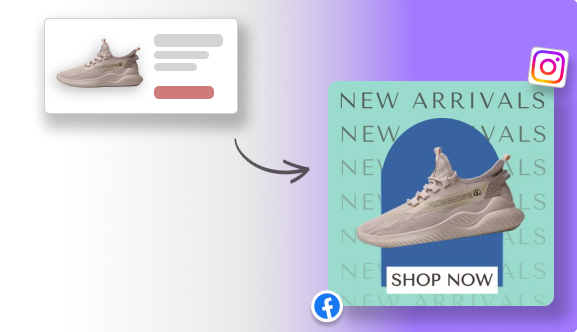
Why am I Back In the Learning Phase?
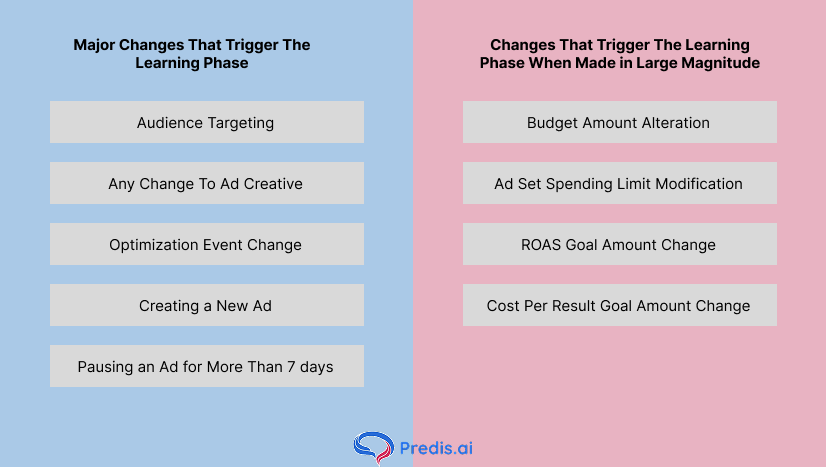
Now that you are out of the Learning phase, the last thing you want is your ad to go back in. To know why you made it back to the Learning phase, check out the infographic above. So, how do you avoid this? This is how:
1. Creating a New Ad or Creative
If you are someone who created your first-ever Instagram ad and want your ad to skip the learning phase altogether, then no, you cannot.
All new ads must enter the learning phase to help Facebook understand how it will perform when placed under different conditions. So there is no way to bypass this (and honestly, you shouldn’t!).
2. Made Drastic Changes
Here is another example of when ads will be sent to the learning phase. This happens when you make big, drastic changes to your ad.
But what is considered a significant change? Some examples of such changes are as follows:
- A budget or bid change of more than 20% (sometimes might happen for lower amounts).
- Any changes that are made to your ad creative. (Yep! Even the small ones.)
- Auditing the target audience for your ad
- Choosing different ad placements
- Changing the final objective of your ad, such as Awareness to Conversion, and so on.
If you have made any of these changes, then your ad is back in confinement for that very reason.
How To Make Change And Still Stay Out of the Learning Phase?
Ever since you went through the first learning phase, you have been wanting to make a change. And the change is so important that you practically cannot stop thinking about it. But how do you get it done without making your ad go back into the learning phase? Here are some sneaky tips to help you navigate:
- Make all changes within a single batch so as to avoid drifting back and forth into the learning phase.
- Based on your understanding of the audience, make changes that will bring an output of 50 conversions within 7 days (since this is what will get your ad out of the learning phase). This way, even if you happen to enter the phase, you will get out of it sooner.
- Make sure to never pause the ad for an extended period.
- Have a large enough budget and audience, so that you can achieve the conversion goal without a hitch.
That being said, a successful learning phase process can reduce your Cost Per Acquisition (CPA) and improve your bottom line. So, try not to avoid getting into the learning phase to utilize your budget efficiently.
How Can I Make the Learning Phase Less Painful?
Even during the learning phase, your ad budget gets spent. Although some days the results are good, some days might be brutal. To avoid spending too much during this learning phase, there are a few tips you can follow.
1. Consolidate ad sets
Running multiple ads simultaneously can reduce your chances of getting accurate and quick results. To avoid your learning phase from getting extended unnecessarily, you can think about consolidating your ads that are similar.
2. Batch your edits
Even though it is tempting to make edits the minute you see them, this may not be a wise option. Because when you make edits frequently, your ads will drift in and out of the learning phase. To ensure this does not happen, you can note them down and make a bunch of changes in one go.
3. Allocate sufficient budget and audience
The goal is to get 50 conversions within a 7-day window to ensure the ad is sent out of the learning phase. And the two biggest parameters that decide this conversion rate are the budget allocated and the audience you selected. With these obstacles out of the way, your ad will coast out of the learning phase quickly.
To ensure your ad has an adequate budget, here is a simple math for you:
Take your CPA and multiply it by 50 for the number of conversions (EG, 25 x 50 = 1250). Now divide it by 7 for the number of days within which these conversions need to happen (EG, 1250 / 7 = 178). Now, allocate this or more as your daily budget to achieve conversions sooner.
What is Learning Limited?
There is this less common scenario where your ad never leaves the learning phase and is branded as “Learning Limited”. What happened here?
For some reason, Facebook could only learn limited information on how best to promote your ad. This may be because of various factors such as a lower budget or an over-segmented audience. In such cases, letting your ads stay in the learning phase may not necessarily provide you with more value. In some cases, it might perform worse than before.
This usually happens because:
- The audience is too small
- The budget is too low
- The conversion event is too rare
- You’re running too many ad sets with split budgets
- The funnel requires high-intent actions that don’t happen often
To get out of this, try allocating a bigger budget, adjusting over-segmented ads and audiences by making it broad, making good creatives, and so on.,
How to Exit the Learning Phase Faster?
You can’t skip the learning phase, but you can make it shorter and more efficient with a smart setup.
1. Use a Budget That Matches Your Goal
If your budget is too small to hit 50 events a week, the learning phase will drag on forever.
A simple guideline:
Choose a daily budget that can realistically support the event you’re optimizing for.
2. Pick Conversion Events That Actually Happen
If purchases are too rare at your current budget level, start with:
- Add-to-cart
- View content
- Lead
- Landing page view
Once you gather enough data and performance stabilizes, shift to deeper conversion goals.
3. Avoid Constant Edits
Every big change restarts learning.
Plan your campaigns well enough so you don’t feel the urge to tweak them daily.
4. Use Broader Targeting (Not Overspecific)
Ultra-narrow audiences slow learning because the system can’t find enough conversions.
Broader doesn’t mean random — it means giving the algorithm room to identify your ideal buyers.
5. Consolidate Ad Sets
Running too many similar ad sets spreads your budget thin and weakens data flow.
One strong ad set works far better than five weak ones.
6. Use Creatives That Generate Strong, Clear Actions
Good creatives lead to faster, more consistent events, which helps the system learn quicker.
Focus on:
- Clear messaging
- Strong hooks
- Mobile-first design
- Fast-loading landing pages
The more people convert early, the sooner you exit learning.
Final Thoughts
When creating ads for Instagram, it is very important to be aware of the extensive ad parameters that Facebook offers. Because with this understanding, you will be able to make the most efficient use of your budget while reaping the maximum benefits.
Another important thing that needs to be perfect in an Instagram ad is the creative. Because, as visually focused as Instagram is, with a bad creative, your ad is going nowhere. Even if you are a whiz at targeting, with a bad creative, results will never come.
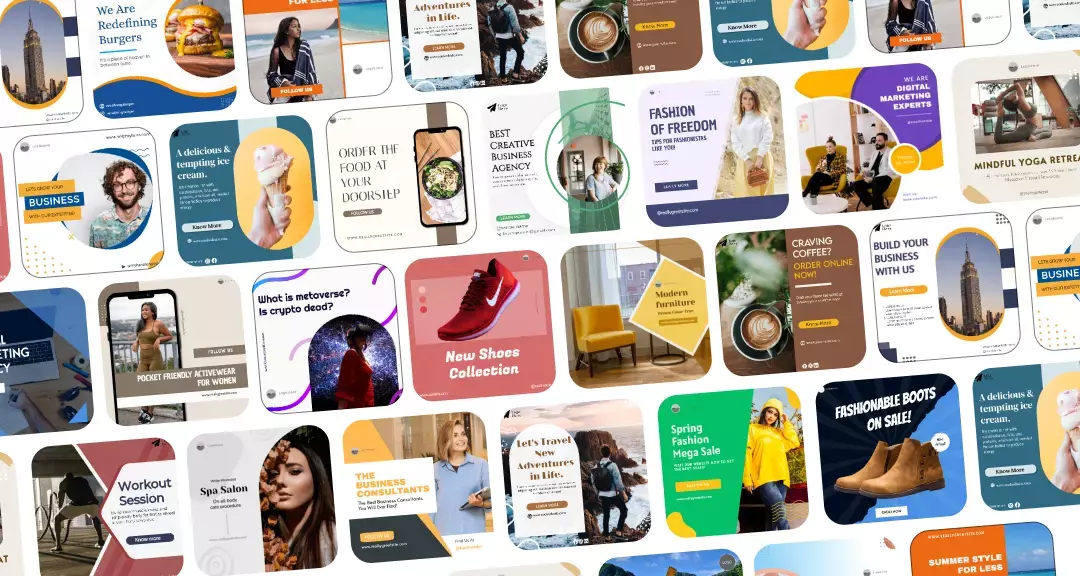
But, thankfully, Predis AI makes creating an ad a breeze. All you have to do is sign up, give a prompt, and download your own ad in a matter of seconds. Predis AI also has a library of templates for some of you who want a more hands-on ad-making experience.
So, what are you waiting for? Sign up today to get your free account and start creating your Instagram ad now!
FAQ:
The Learning phase in Instagram is launched after a new ad is uploaded or when a major update is made to an existing ad. This phase is where the ad delivery system tests out multiple combinations to find the best-performing ones.
Typically, the learning phase lasts for a few days to a week, and it depends on the ad. If your ad achieves 50 conversion events within 7 days, then your ad will be out of the learning phase.
To exit the learning phase faster, you can set a sufficient budget, target a bigger audience group, and make sure your creative converts.