

Explore this content with AI:
Most brands are still treating social media like a broadcast channel — post content, measure reach, repeat. Meanwhile, their customers are leaving a real-time trail of frustrations, feature requests, buying signals, and competitive intel across every platform imaginable. The brands pulling ahead aren’t posting more. They’re listening better.
Social listening has become one of the highest-ROI activities a marketing or product team can invest in — and most companies are still barely scratching the surface.
Social Listening vs. Social Monitoring: Why the Difference Actually Matters
These two terms get used interchangeably, but they describe fundamentally different activities.
Social monitoring tells you what is being said: how many times your brand was mentioned, which posts got flagged, and what your response time looks like. It’s reactive by nature.
Social listening tells you why it matters: the patterns behind the mentions, the sentiment trends over time, the unmet needs hiding inside the complaints. It’s strategic by nature.
A brand that monitors sees a spike in negative mentions and responds to each one. A brand that listens sees the same spike, identifies that 70% of complaints trace back to a specific product issue, and fixes the root cause before it becomes a PR crisis.
The distinction matters because most teams are set up for monitoring — dashboards, alert thresholds, response queues — without ever doing the actual listening.
What’s Changed in 2026 (And Why Your Old Approach No Longer Works)
The social listening landscape has shifted in three meaningful ways.
- AI-powered sentiment analysis has gotten sharper — but not infallible. Sentiment analysis tools can now detect sarcasm, emotional nuance, and context that earlier systems completely missed. But they still struggle with niche slang, regional language, and intent signals in short-form video comments. Human review still matters for high-stakes decisions.
- Conversations have migrated to harder-to-track spaces. Discord servers, private Telegram groups, and WhatsApp communities are where your most engaged customers talk about you most honestly. These conversations are largely invisible to standard listening tools.
- Speed expectations have jumped. Brands are expected to respond to cultural happenings almost instantly, as things move faster than ever in the current social ecosystem. A complaint that would have had a 48-hour response window in 2023 now needs attention within hours.
One more shift worth naming: social listening has evolved far beyond simple mention tracking and is now a strategic intelligence function that informs product development, crisis management, and business planning. It’s no longer a marketing tool. It’s a business tool.
What to Track: The 6 Signal Categories That Actually Drive Decisions
Most brands start by tracking their own name and stop there. That’s the equivalent of only reading your own performance reviews and ignoring everything else. Here’s what a complete listening setup actually covers:
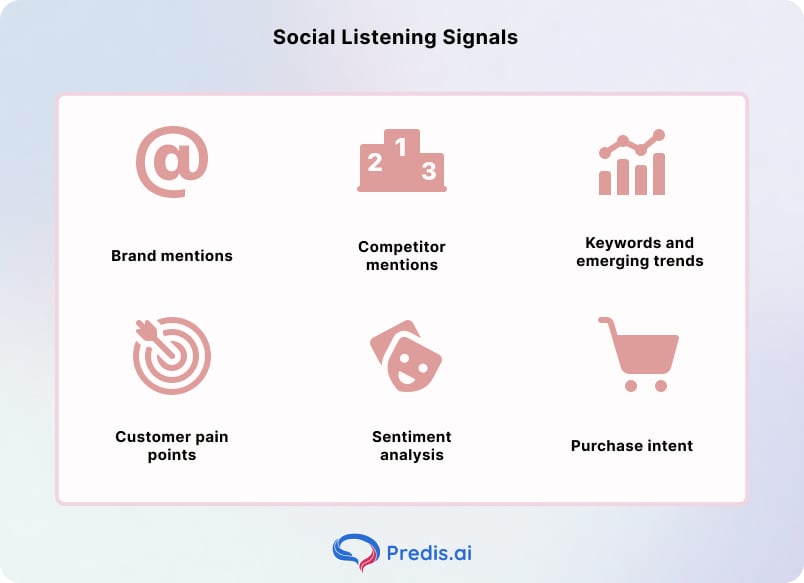
1. Brand Mentions — Direct and Indirect
Your brand name, product names, and campaign hashtags are the obvious starting point. But also track misspellings (users rarely type brand names correctly), abbreviated versions, and the slang your community has coined. If your users call your product something you didn’t name it, you need to know that.
2. Competitor Mentions
This is where some of the most actionable intel lives. Track competitor brand names, product names, and the complaints customers air publicly about them. Spotting competitors’ weaknesses — like slow customer support — and positioning your brand as the fix is one of the highest-leverage moves in social listening.
A project management tool that catches users complaining about a competitor’s pricing can introduce flexible plans before those users even start actively shopping around.
You can also supplement these findings by using competitor analysis tools like Predis AI to find areas where your competition is thriving, and you are not.
3. Industry Conversations and Emerging Trends
Track the keywords and emerging trends your customers use when describing their problems — before they even know your product exists. “How do I stop losing track of invoices?” is more valuable than a direct brand mention if you sell electronic invoice approval software.
4. Customer Pain Points
Recurring complaints are a product roadmap in disguise. Topic clustering helps brands spot new memes and hashtags before everyone else jumps on them, giving them a first-mover advantage. The same principle applies to pain points — pattern recognition across hundreds of complaints reveals what to fix next.
5. Sentiment and Emotion
Basic sentiment (positive/negative/neutral) is table stakes. Emotion-level analysis — distinguishing between frustration and disappointment, or excitement and relief — gives you the context to respond appropriately. A frustrated customer needs a different response than a disappointed one.
6. Purchase Intent Signals
“Best alternative to [competitor]”, “is [product] worth it in 2026”, “recommend me a tool for [problem]” — these phrases signal active buying intent. Tracking them gives sales and marketing teams real leads hidden in plain sight.
How to Build a Social Listening Strategy That Actually Gets Used
The gap between brands that “do social listening” and brands that act on it comes down to structure. Here’s the framework that works.
Step 1: Define the Business Objective First
Social listening without a clear objective produces a lot of interesting data that sits in a report nobody reads. Before setting up a single keyword alert, answer: what decision will this data inform?
The main use cases worth building around:
- Brand reputation management — catch sentiment shifts before they become crises
- Product development — surface feature requests and recurring bugs
- Competitive intelligence — understand where competitors are losing customers
- Demand generation — find prospects actively researching solutions
- Customer support — resolve issues before they escalate publicly
Step 2: Build a Keyword Map
| Category | Examples |
|---|---|
| Brand | Brand name, product names, misspellings, abbreviations |
| Competitors | “best alternative to”, “recommend”, “is [X] worth it.” |
| Category | Problem-describing keywords, job-to-be-done language |
| Intent | “best alternative to”, “recommend”, “is [X] worth it” |
| Campaign | Specific hashtags tied to current campaigns |
| Pain points | Frustration language related to your category |
Step 3: Choose Platforms Based on Where Your Audience Actually Is
There’s no point in monitoring TikTok if your buyers are B2B finance teams spending their time on LinkedIn. The platform priority list for most brands:
- X (Twitter): still fastest for breaking trends and real-time brand crises
- Reddit: unfiltered, high-intent, especially strong for B2B and tech categories
- TikTok and Instagram comments: short-form video comments as a qualitative signal
- LinkedIn: increasingly important for B2B brand conversations
- G2, Trustpilot, Capterra: review sites often missed by teams focused only on social platforms
- YouTube comments: longer-form feedback on product use cases and tutorials
Step 4: Set Up a Reporting Rhythm
- Daily alerts: negative sentiment spikes, potential crises, urgent mentions needing response
- Weekly digests: trending topics, competitor mentions, share of voice snapshot
- Monthly reports: strategic insights, sentiment trend lines, input to product and marketing planning
Make sure the relevant input reaches the right team on time so that they can act on it accordingly to improve customer satisfaction.
Turning Insights Into Business Value: What Each Team Gets
Social listening can guide product development, protect brand reputation, improve customer experience, and help prove ROI on marketing spend — especially as global ad spend is expected to exceed $1 trillion for the first time in 2026.
Here’s how different teams extract that value:
- Marketing uses listening to find the language customers actually use — not the language the brand invented — and writes copy that resonates.
- Product teams use it to prioritize the roadmap and build features that are getting requested a lot.
- Sales uses it to find warm prospects.
- Customer support uses it to catch problems early.
- PR and reputation teams use it for crisis prevention. Sentiment and emotion detection are critical for catching crises before they escalate.
For a fuller framework on integrating listening with online reputation management – spanning monitoring, engagement, content strategy, and reputation repair and use this guide to translate insights into actions that protect loyalty and reduce churn.
The Metrics That Tell You If It’s Working
Tracking social listening activity isn’t the same as measuring its impact. The metrics that actually matter:
- Mention volume trend — are conversations about your brand growing, shrinking, or staying flat?
- Sentiment trend over time — is overall sentiment improving quarter over quarter?
- Share of voice vs. competitors — how much of your category’s conversation do you own?
- Response time to negative mentions — are you getting faster?
- Recurring complaint categories — are the same issues coming up month after month, or is the list changing?
- Insights-to-action rate — of the insights your team surfaces, how many actually inform a decision?
That last one is underused. Social listening that generates data without corresponding action doesn’t improve outcomes — the real value comes from measuring the right metrics and using the right tools to act on them.
Real Examples Where Social Listening Made a Measurable Difference
These aren’t hypotheticals. These are documented cases where brands turned social signals into real business outcomes.
1. McDonald’s and the $5 Meal Deal
When customers started posting photos of $18 Big Macs on social media in early 2024, McDonald’s social listening team didn’t just respond to individual complaints — they analyzed the broader pattern. What they found was a deep, growing concern about affordability that threatened long-term brand perception, not just a short-term PR flare-up.
The insight led directly to a strategic business response: the nationwide $5 meal deal launch and a public commitment to slow future price increases. One insight. One strategy shift. Measurable impact on Q2 earnings.
2. Duolingo’s Viral “Death” Campaign
Duolingo noticed through social listening that users had developed a deep, sometimes threatening parasocial relationship with the Duolingo owl mascot — memes about the owl “dying” if you missed a lesson were everywhere.
Instead of fighting this perception, they leaned into it with their “Duo’s death” campaign, announcing the owl had died, which sparked massive engagement across platforms, with even pop star Dua Lipa responding.
Duolingo turned a potential brand liability into a viral marketing win. Social listening gave them the confidence that the joke would land because they’d already seen how invested users were in the bit.
3. Samsung Turns Apple’s Misstep Into a Win
When Apple released a promotional video showing a hydraulic press crushing musical instruments and creative tools to promote the iPad Pro, the backlash from the creative community was immediate and visceral.
Samsung’s social listening team spotted the backlash and acted quickly — creating a response video celebrating creative tools rather than destroying them, positioning Samsung as a brand that respects creative traditions while embracing technology.
The window to respond was narrow. Brands without real-time listening would have missed it entirely.
4. GoPro Builds a Content Engine From UGC
GoPro’s approach to social listening is less about crisis prevention and more about community amplification. In April 2025 alone, GoPro was mentioned in over 70,000 user-generated posts and comments — nearly 95% of all brand mentions that month.
By tracking branded hashtags and terms like “action camera footage,” their team identifies the best community content and reshares it — turning customers into their primary content creators and cutting production costs significantly in the process.
Tips and Tricks: What Separates Good Social Listening From Great
Most of what’s written about social listening covers the basics. These are the specifics most guides skip.
1. Track misspellings from day one
Run a search for your brand name in Twitter’s advanced search and look at what actually comes up. You’ll find variations you never anticipated — abbreviations. Add these to your keyword map immediately.
2. Use Reddit as a product research lab
Reddit’s search is weak, but listening tools that index it are powerful. Subreddits are where buyers do pre-purchase research honestly. Search your category keywords in relevant subreddits and read the threads where people ask for recommendations.
The language, objections, and comparisons in those threads are a direct input into your messaging and product roadmap.
3. Separate your listening by intent, not just topic
Build separate keyword lists for:
- complaints (frustration language)
- feature requests (“I wish it could…”, “it would be great if…”)
- competitor comparisons (“alternative to”, “vs”)
- purchase intent (“looking for a tool that”)
Routing these to different dashboards means your product team sees feature requests, your sales team sees intent signals, and your support team sees complaints — without everyone wading through everything.
3. Time-box your analysis sessions
Social listening can become a rabbit hole. The teams that extract the most value schedule fixed 30-minute “listening sessions” two to three times a week, with a clear output: one insight, one recommended action, one owner. This beats running the tool continuously and never synthesizing anything.
4. Don’t just listen to your mentions — listen to the replies
When someone mentions your brand and another user replies, that reply is often more honest than the original post. A customer complaining gets a sympathetic response from another customer who had the same experience. That secondary conversation is rich data that most teams miss entirely.
5. Cross-reference social signals with support ticket data
When social listening surfaces a spike in a specific complaint, pull that period’s support tickets and search for the same keyword. If you see the same issue appearing in both channels simultaneously, you have a validated problem that needs immediate attention. If it’s only in one channel, you can calibrate how urgent it really is.
6. Set a competitor alert for their product update announcements
When a competitor announces a new feature or pricing change, track the social response for 48–72 hours. The comments on that announcement — positive, negative, skeptical — tell you exactly what the market thinks of the move, which is intelligence your sales team needs immediately.
The Mistakes That Kill Social Listening Programs
Most social listening programs fail not because the tools don’t work, but because of how teams are structured around them.
- Tracking only branded mentions. You’ll miss 60–70% of relevant conversations — competitor complaints, category discussions, intent signals — if your keyword list starts and ends with your brand name.
- Collecting insights but not sharing them. Listening insights that stay inside the marketing team don’t improve products. Build a process for routing insights to the teams that can act on them.
- No clear reporting structure. If there’s no agreed format for how insights get summarized and who receives them, the program quietly dies within a quarter.
Start Small, Act Fast
The brands winning with social listening aren’t necessarily using the most sophisticated tools. The brands that are actually ahead aren’t just gathering social data — they’re jumping on it, fast.
Start with three keyword categories: your brand, your top competitor, and the top pain-point language in your category. Run that for 30 days. Find one insight that can inform one real decision — a campaign message, a product fix, a support response. Act on it. Measure the outcome. Then expand.
The brands that treat social listening as a strategic function — not a reporting exercise — will consistently see signals their competitors miss. The conversations are already happening. The question is whether you’re in the room.
FAQs
Social listening is the practice of tracking and analyzing online conversations about your brand, competitors, and industry to extract strategic insights. It matters because customer expectations move faster than surveys can capture, and the brands that respond to real-time signals outcompete those relying on lagging data.
Social monitoring tracks what is being said (mentions, tags, volume). Social listening analyzes why it matters — identifying patterns, sentiment trends, and recurring themes that inform decisions.
It depends on your audience, but the highest-signal platforms for most brands are Reddit (unfiltered, high-intent), X/Twitter (real-time trends), LinkedIn (B2B conversations), TikTok and Instagram comments (qualitative signals), and review sites like G2 and Trustpilot.
By tracking recurring complaints, feature requests, and competitor gaps across platforms, product teams can identify what to build next — often before support tickets or formal research surfaces the same insight.