

In the business landscape of 2026, the problems we face are rarely “linear.” We are dealing with “wicked problems”—challenges that are ill-defined, interconnected, and constantly shifting due to technological and social changes. Traditional problem-solving, which often relies on historical data and rigid logic, frequently falls short because it fails to account for the most unpredictable variable: the human.
Design Thinking is the antidote to this rigidity. It isn’t about making a product “look pretty”; it is a cognitive process and a collaborative culture. It is a way of seeing the world that prioritizes human needs over technical requirements or business constraints. Whether you are a CEO, a teacher, or a software engineer, Design Thinking provides the framework to innovate reliably in a high-pressure world.
What is Design Thinking?
At its core, Design Thinking is a non-linear, iterative process used to understand users, challenge existing assumptions, and redefine problems.
- The Core Definition: It is a methodology for creative problem-solving that focuses on the end-user.
- Mindset over Method: While there are steps to follow, the true power lies in the mindset. It encourages a “beginner’s mind”—the ability to look at a familiar problem as if for the first time, setting aside biases to see what is actually happening.
The goal of Design Thinking is to put the human first and design systems that work for them.
Design Thinking vs. The Traditional Way
To understand the value of Design Thinking, you must contrast it with the traditional “Waterfall” or “Analytical” approach.
| Design Thinking | Traditional Analytical approach |
| Flexible approach to problem solving | Scientific, methodical approach |
| Focussed on human requirements | Focussed on goals and objectives |
| Output validated with users early on | Output can be validated only after building |
| User input is given importance | Expert input is given importance |
| Finds the right questions to solve | May focus on the wrong problem |
| Has iterations and testing | Does not have iteration and testing |
The Core Principles of Design Thinking
Before diving into the process, you must embrace the five pillars that support Design thinking:
- Empathy: You cannot solve a problem for someone you do not understand. Empathy is the work of stepping into the user’s shoes.
- Collaboration: Innovation happens at the intersection of disciplines. Design Thinking breaks down silos by bringing engineers, marketers, and customers into the same room.
- Ideation: This is about “divergent thinking.” In the early stages, quantity is better than quality. You need a hundred bad ideas to find the one brilliant one.
- Prototyping: “Thinking by doing.” Don’t just talk about a solution—build a rough version of it.
- Iterative Culture: In Design Thinking, failure isn’t a dead end; it’s a data point. Each failed test teaches you exactly what to change in the next version.
By embracing these important pillars, you can get the mindset that helps with solving problems creatively.
The 5-Stage Process of Design Thinking
The most widely recognized model for Design Thinking follows five distinct stages. While they look like a sequence, creators often jump back and forth between them.
- Empathize: Conduct interviews, shadow users, and observe behaviors to understand their physical and emotional needs. Draw up an empathy map to understand what the requirements of the user are.
- Define: Synthesize your research to create a “Point of View” (POV). Instead of saying “We need to grow sales,” you define it as: “Busy parents need a way to organize healthy meals in under 10 minutes.” This way, you have a specific problem statement to solve rather than a vague idea.
- Ideate: Use brainstorming techniques like “Mind Mapping” or “Worst Possible Idea” to generate a wide range of potential solutions. This is the step of the process where everybody, from engineers to stakeholders, needs to take part and speak their mind. With more perspectives, you can generate fresh ideas that change the way you look at problems.
- Prototype: Build a “Minimum Viable Product” (MVP). This could be a paper sketch, a cardboard model, or a simple digital wireframe. Instead of hanging on to ideas, create a prototype that is in line with your final output so you can refine requirements.
- Test: Put the prototype in front of real users. Watch where they struggle. Listen to their feedback. Then, go back to the Define or Ideate phase to improve. This feedback-driven approach can help you refine the product in ways you never thought of.
Key Design Thinking Frameworks
While the 5-stage process is the foundation, different organizations use specific frameworks to guide their work. Some of the popular Design Thinking Frameworks that you can use include:
IDEO’s Three-Phase Model
Developed by the global design firm IDEO, this three-phase model simplifies the process into three manageable buckets:
- Inspiration: Identifying a challenge and observing the world.
- Ideation: Developing and testing ideas.
- Implementation: Bringing the solution to life and scaling it. This model is perfect for teams that need to move quickly from curiosity to action.
Double Diamond Framework
Created by the UK Design Council, this framework visualizes the “rhythm” of design. It consists of two diamonds, each representing a phase of “opening up” (divergent thinking) and “closing down” (convergent thinking).
- Discover: Open up to all possible perspectives.
- Define: Narrow down to the single most important problem.
- Develop: Open up to all possible solutions.
- Deliver: Narrow down to the best, most viable solution.
AIGA’s Head-Heart-Hand Model
This holistic model ensures that the solution is balanced:
- Head (Analytical): The logic, the data, and the business viability.
- Heart (Empathy): The emotional connection and the human need.
- Hand (Craft): The actual execution, prototyping, and technical skill.
You can adopt any of these frameworks to base your design thinking capabilities on. All these ideas offer their unique perspective on how to understand user requirements, explore that further, and then find a solution that solves the root cause of it.
The Benefits of a Design-Led Approach
Organizations that adopt Design Thinking see measurable results. But what are the benefits that they observe? Let us check out:
- Enhanced Innovation: It allows companies to find “Blue Ocean” opportunities—unmet needs that competitors haven’t noticed.
- Increased ROI: By testing early, companies avoid building features that nobody wants, saving millions in development costs.
- Improved User Retention: Products designed with empathy feel intuitive, leading to higher customer loyalty.
- Better understanding: By adopting the design thinking approach, we can understand well what the requirements of the users are. This way, you can create solutions that better cater to them.
- Reduced risk: With the traditional approach of problem-solving, you will not know if the solution worked until the build is done. But with design thinking, you iteratively test regularly so that by the time you make the final product, you will have tested it for user reaction multiple times.
- Makes Alignment easier: Since cross-functional teams are involved with the process, everyone is aligned with the requirements of the users.
How to Find Inspiration for Your Designs
Where do great ideas come from? They rarely come from staring at a blank screen. By looking around at similar problems, you can often come up with ideas that otherwise would not have stuck.
- The “Look-Aside” Method: Look at how other industries solve similar problems. For example, high-speed rail engineers in Japan looked at the beak of a Kingfisher bird to solve a noise problem.
- Extreme Users: Talk to the people who use your product the most and the people who refuse to use it. They will show you the edges of your design that average users won’t mention.
- Analogous Inspiration: If you’re designing a waiting room, look at how a high-end hotel manages guest arrivals.
- Take breaks: Staring at the problem consistently might not give you answers. Instead, take a break and let your mind relax; this might often help you find the needle in the haystack.
Real-World Examples of Design Thinking
There are many examples around us where brands have used design thinking strategically to solve the issues their customers are facing. Let us look at a few of them so you can understand how to solve yours:
- Airbnb: In their early days, the founders realized users weren’t booking because the photos were terrible. They traveled to New York, took professional photos themselves (Empathize/Prototype), and bookings doubled instantly. Now, Airbnb’s Instagram is a traveller’s dream!

- IBM: IBM trained thousands of employees in Design Thinking, shifting their culture from “engineering-first” to “human-first,” which saved them millions in design-and-development time.
- Uber Eats: Their team conducts “Walkabouts”—immersing themselves in the cities where they operate to understand the unique challenges of local delivery drivers.
Common Myths About Design Thinking
When people think of Design Thinking, they think of something that is specific to creators and designers. But this cannot be further from the truth. Down below, we will be dissecting common myths around design thinking and what the reality is:
Myth 1: It’s only for creative people.
Truth: It is a structured process that anyone can learn to solve problems their users face.
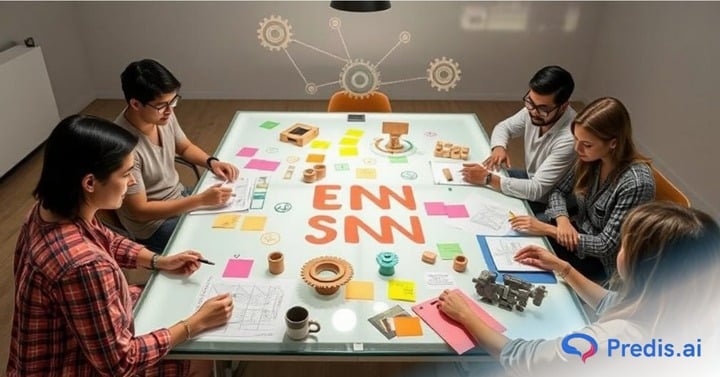
Myth 2: It’s just about Post-it notes.
Truth: The notes are just a way to visualize thoughts; the real work is the deep research and rigorous testing. It is in understanding what the users truly want so you can give it to them.
Myth 3: It takes too long.
Truth: While deep design takes time, “Design Sprints” can yield breakthrough results in just five days. Even though it is an iterative process that brings results late, it always delivers the right one. Like a traditional analytical approach, you do not have to wait till the build ends to find if it aligns with your goals.
How to Implement Design Thinking in Your Organization
Don’t try to change the whole company overnight. Systems take time to change, and handling it delicately is the way to make the transition smooth and sustainable.
- Start Small: Choose one project with a clear problem and apply the 5-stage process.
- Create “Safe to Fail” Spaces: Allow teams to build “ugly” prototypes without judgment.
- Cross-Functional Sprints: Bring people from different departments together for a 3-day workshop to solve a specific bottleneck.
- Help teams adopt the mindset: As we have said time and again, Design Thinking is a mindset. Conduct workshops within your organization to help the teams attain this mindset. Make design thinking a habit in their workflow.
Conclusion: The Future of Problem-Solving
As we move further into 2026, the ability to solve problems creatively is the single most valuable skill a professional can possess. Design Thinking isn’t a trend; it’s a fundamental shift in how we work. By prioritizing empathy, embracing failure, and focusing on the human at the center of the problem, you can create solutions that aren’t just functional—they’re transformative.
Frequently Asked Questions (FAQ)
No. UX Design is a specific field focused on digital interfaces. Design Thinking is a broader problem-solving methodology that can be applied to anything from business strategy to social issues.
You don’t need expensive software. A whiteboard, sticky notes, a notebook, and a willingness to talk to your users are the only “must-haves.”
Absolutely. In B2B, your “user” might be a procurement officer or a factory manager. Their human needs (saving time, reducing stress, looking good to their boss) are just as important as B2C needs.