


Running an ad campaign is intimidating! But what if we say you could see every single ad your competitors are running, down to the last detail. Won’t it be a brilliant way to gain insights into making a successful ad? Who knows, you might even be able to nail the perfect ad on your first try! Sounds too good to be true? It can become true, with Google Ads Transparency Center!
So let us dive in and find out how you can use the Google Ads Transparency Center to your benefit!
What Is the Google Ads Transparency Center?
The Google Ads Transparency Center is a public, searchable database that shows ads run by verified advertisers across Google platforms.
Anyone can use it to:
- View active and recent ads from advertisers
- See where those ads appear (Search, YouTube, Display, Maps)
- Analyze creative formats and messaging
- Understand advertiser identity and regions targeted
Google launched this tool to improve transparency but for marketers, it’s also a powerful competitor research resource.
How to Use Google Ads Transparency Center for Competitor Research?
1. Search for an Advertiser or Website
You can search the Transparency Center using:
- The advertiser’s business name
- A website domain (for verified advertisers)
Note: Only advertisers who have completed Google’s verification process will appear in results.
2. Use Filters to Narrow Down Results
Once you see search results, filters help you analyze ads more precisely.
You can filter by:
- Date range: Last 7 days, last 30 days, or custom dates
- Location: Country-specific ad visibility
- Platform: Search, YouTube, Display Network, Google Maps
This helps you understand where and how aggressively competitors are advertising.
3. View Detailed Ad Breakdowns
When you click on an ad, you can see useful information, such as:
- Format of the ad (text, image, video, Shopping, Performance Max assets)
- Full creative preview, with playable videos
- Ad copy and messages
- Where the ad was shown
- When the ad was last shown
This lets you see your competitor’s creative style, tone of voice, and content strategy right away, which can be very useful for any Google Ads company analyzing competitor advertising approaches.
What the Google Ads Transparency Center Does NOT Show?
While the tool is powerful, it has limitations. You cannot see:
- Ads from unverified advertisers
- Exact audience targeting settings
- Keywords, bidding strategies, or budgets
- The specific webpage where an ad appeared
However, you can still gather indirect insights using smart observation.
Additional ways to analyze your Competitor’s ads
There are some things that the Google Transparency Center does not provide. Some of these are:
- Ads of advertisers who are not registered
- You cannot see the ad on the page where it is being displayed
- The audience targeting options provided by your competitors
Although there are no straightforward ways to find these details, there is a sneaky way you can find them. Let’s see how:
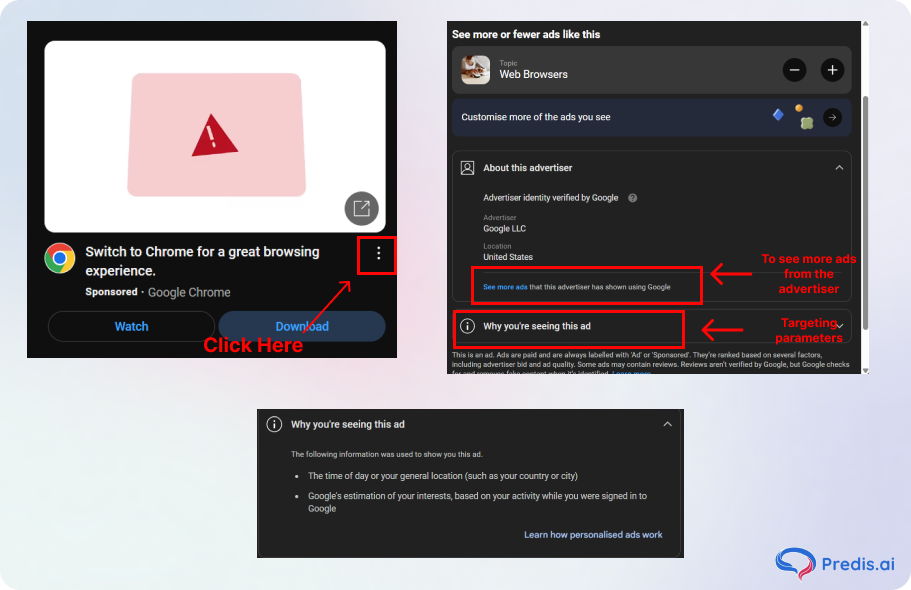
Suppose you see an ad when scrolling through, and click on the three dots button under it. A pop-up will arise, where you can see the advertiser’s name and the location the advertiser chose to display it.
Below that, you have an option to see more from the advertiser if you are interested.
You’ll also find an option called “About this ad,” which shows simplified reasons why the ad appeared for you. While Google now provides less granular targeting data because of new privacy rules, you can still see useful clues like the advertiser’s identity, the general location they targeted, and broad audience categories.
This gives you a quick sense of who the advertiser is trying to reach without revealing sensitive targeting details.
Why is my competitor not showing up on search?
Sometimes, you can type your competitor’s website name in the search bar, and Google Transparency centre will not return any results. Why is this happening?
This is because your competitor has not undergone the Advertiser verification process by Google. In such cases, you will not be able to see their ads on the platform.
But don’t worry, Google is consistently pushing verification for its users, so you will not have this issue for long.
What Is Google Advertiser Verification?
To get verified by Google as an advertiser, you need to provide the following information:
- Personal information
- Business information like location, contact details, and the nature of the business
- The content in your ad will be under review to see if it is in alignment with Google’s ad policies
- Payment information
Along with basic personal and business information, advertisers may also need to complete Business Operations Verification (BOV) and meet updated ad disclosure requirements, especially in regulated industries.
Accounts that fail verification or violate Google’s advertising policies risk being flagged or even having their Google Ads account suspended, which can be difficult to reverse without expert guidance.
6 ways how Google Ads Transparency Center can help you
Google Ads Transparency center provides ample information about your competitors’ ad strategy.
- You can figure out the format of the ads they are running frequently
- Based on the messaging in the ad, you can deduce the stage of the funnel they are focusing on.
- Which platform is your competitors primarily focusing on? Is it YouTube or Google?
- The ad style they are working with. Are they rolling out vintage video ads or UGC type videos?
- See how many variations of an ad they are running
- Find the best performing ads based on the duration they have been running. (Pro tip: The longest-running ads are the most successful ones, because the ads that lose money would be pulled back quickly.)
Conclusion
Running smarter ads does not have to feel like a hassle, thanks to the Google Transparency Center. You can gain insights into your competitor’s ad strategy, see what is working and what is not.
Then there is nothing left to do other than tweaking it based on your business and adopting it in your ad strategy.
If you think making these ads can still prove difficult, stop right there! Because Predis AI can take this off your plate. You can generate ads with AI in minutes or create your own ads manually, schedule, post, and automate your ads and social media with Predis AI.
So, set up your account with Predis AI and get your ads running and winning today!
FAQ:
The Google Ads Transparency Center is a public, searchable database that anyone can use to find ads published by any advertiser across Google platforms. It was created in an attempt to improve transparency with the users.
You can get the following information from the site:
1. All ads from a certain advertiser
2. The platforms on which the ad was run
3. The identity of the advertiser
4. Ads that are currently running
5. Regional availability of ads
Yes, you can use the transparency center to find what kinds of ads your competitors are running, how long they have been running them for where the long-running ones are the successful ones. You can even see the platforms they are focusing on. Even though you won’t get detailed targeting parameters, you can see a lot about your competitor’s ad strategy.