


Explore this content with AI:
Etsy’s advertising revenue grew by $62.2 million in 2025, and the company’s annual report credits most of that to a higher average price per click on Etsy Ads. Over the same year, gross merchandise sales across Etsy’s marketplaces fell 5.3%.
Read that again from the seller’s side. Clicks cost more while buyers spent less.
That’s why “are Etsy ads worth it” keeps getting the same shrug of an answer: it depends. True, but not much help.
What it depends on is two numbers you can work out for each listing in about a minute, before you spend anything. Below you’ll find both, along with what Etsy’s own filings say about ad costs right now and a 30-day plan for deciding what to cut and what to scale.
Are Etsy ads worth it? The short answer
Etsy ads are worth it for listings that already sell without ads and earn enough per order to cover the clicks it takes to land one sale. They’re rarely worth it for low-priced items, brand-new listings with no reviews, or listings with weak photos.
Ads don’t make a listing more convincing; they put it in front of more shoppers. If 1 in 40 visitors already buys, ads bring you more of those buyers. If almost nobody buys, ads bring you a bigger bill.
So the useful question is whether this listing, at this price, can pay for its own clicks. Your Etsy ads cost only makes sense measured against that.
How do Etsy Ads work in 2026?
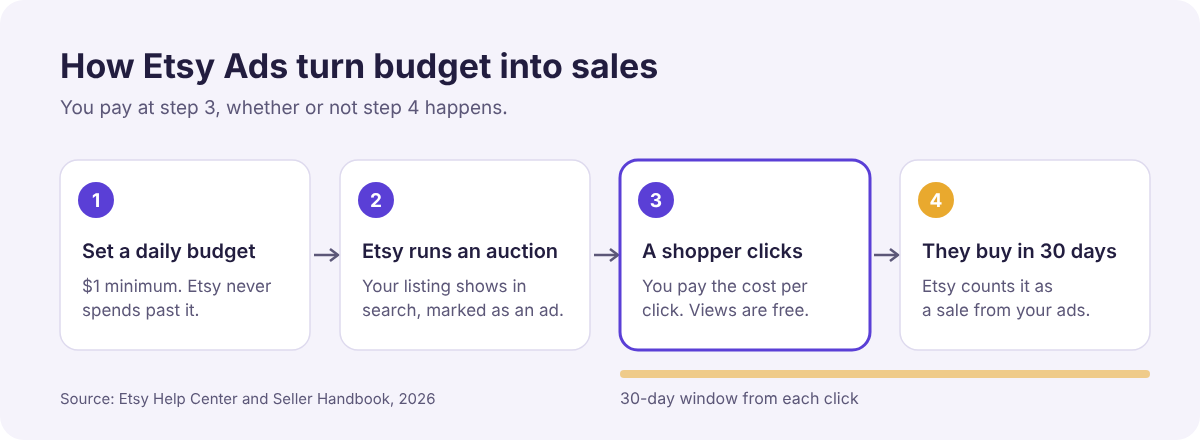
Etsy Ads (plenty of sellers still call them Etsy promoted listings) place your listings in Etsy search results and other busy pages, marked as ads.
You set a daily budget, starting at a $1 minimum, and you’re charged only when a shopper clicks. Etsy adds up each day’s clicks and bills your Payment account the next day, per the Etsy Help Center.
A few rules shape what you actually pay:
- You don’t set your own bid. An auction sets your cost per click, and Etsy’s House Rules say sellers generally can’t set a CPC bid. Your daily budget is the main lever, and Etsy won’t spend past it.
- Weak listings can pay more per click. Etsy says lower-quality listings (photos, titles, tags) may see a higher cost per click, and so can listings in crowded searches.
- Sales count for 30 days. If a shopper clicks your ad and buys within 30 days, Etsy counts it as an ad sale.
- More control starts at $25 a day. With a daily budget of $25 or more, you can choose a listing strategy for each item: Greater visibility, Efficient spending or Lower click cost, according to Etsy’s June 2026 guide to getting started. Etsy also added Ad Groups in 2026, so you can sort advertised listings into up to 20 groups and compare them.
Your main photo is what shoppers judge first in a search grid, and per Etsy it also affects what you pay per click. To try new angles for a product before paying for clicks, Predis.ai makes product ads that look like your brand from a product link. Test them on social first, then bring your winner back to the listing.
What Etsy’s own numbers say about ad costs
Every quarter, Etsy files results with the SEC, and those filings tell a clearer story than any seller forum thread.
In 2025, ad revenue rose mostly because each click cost more. By the third quarter of 2026 the driver had shifted. Etsy’s Q3 2026 quarterly report shows a $30.9 million year-over-year jump in advertising revenue, mainly from higher click volume.
In the shareholder letter for the same quarter, Etsy says better matching and ranking lifted ad click-through and conversion rates.
Two more lines from that letter are worth knowing. Most Etsy Ads revenue comes from sellers doing under $100,000 a year in sales, and Etsy says it only spends part of sellers’ ad budgets today.
So the ads are getting more relevant, which helps you, but Etsy’s ad business runs on small shops and its growth comes out of your margin. Treat that as a reason to measure every listing, not to avoid ads.
The break-even test: run this before you spend a dollar
Every listing has two numbers that decide whether ads can work for it: break-even ROAS and clicks per sale.
Break-even ROAS is the return on ad spend at which ads pay for themselves and nothing more. Below it, every ad sale loses money. To find it with Etsy’s fees included, take a $40 personalized necklace with free shipping:
- Start with the order total: $40.
- Subtract your costs: $9 in materials and packaging, $5 for the shipping label.
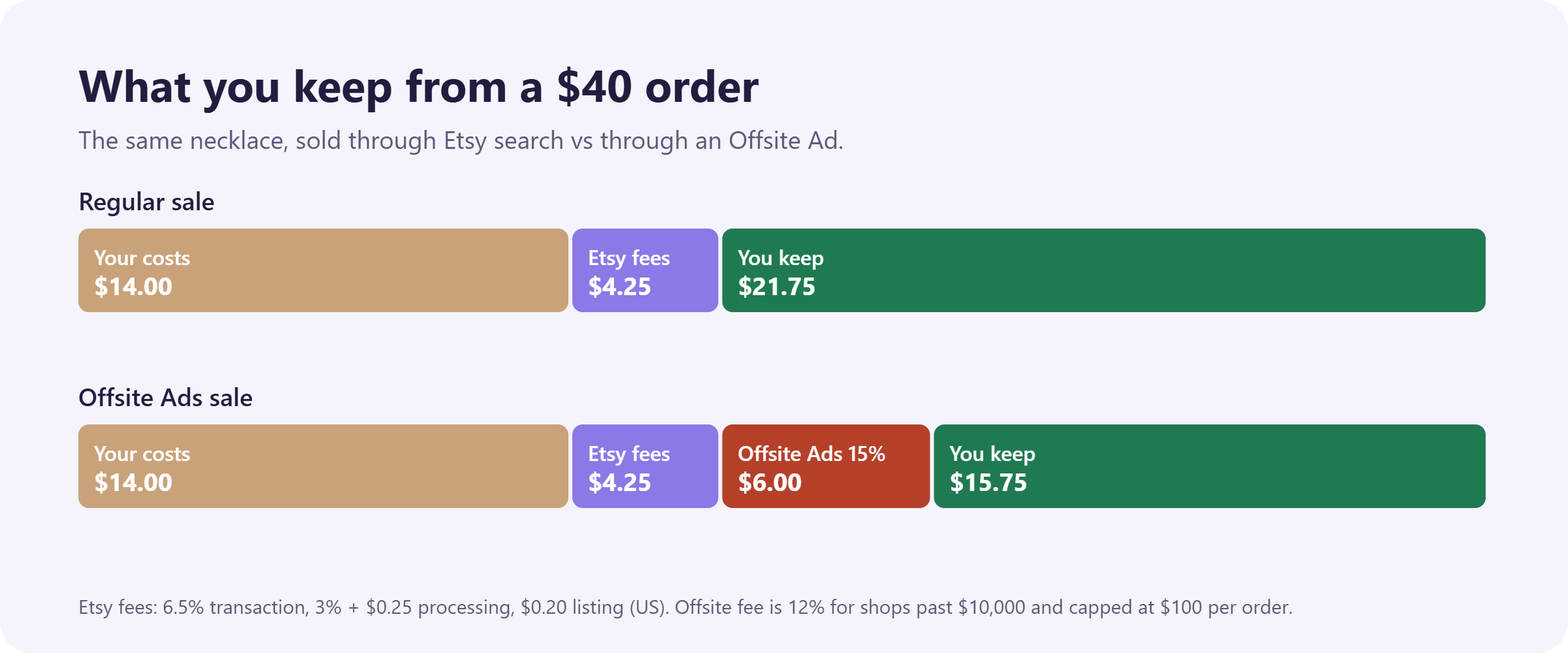
- Subtract Etsy’s fees: the 6.5% transaction fee ($2.60), 3% + $0.25 payment processing ($1.45) and the $0.20 listing fee, all from Etsy’s published US rates. That’s $4.25.
- What’s left is your contribution: $40 − $14 − $4.25 = $21.75, a 54.4% profit margin.
- Divide 1 by that margin: 1 ÷ 0.544 = 1.84 break-even ROAS.
So every $1 of Etsy ads has to bring back at least $1.84 in sales. The $21.75 is also the most you can pay in clicks to win one order.
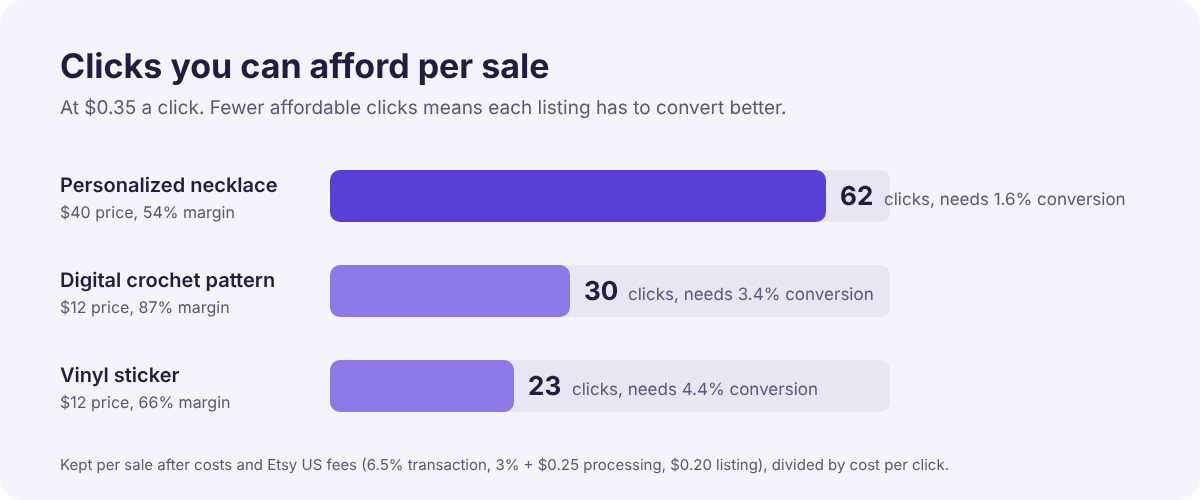
Now the second number. Find your average cost per click in the Etsy Ads dashboard by dividing budget spent by clicks. Say it’s $0.35 (yours will differ). Divide $21.75 by $0.35 and you get about 62. That’s how many clicks you can afford per sale, which means the listing has to convert at least 1.6% of ad clicks.
Cheap listings get caught out right here:
| Listing | Price | You keep per sale | Margin | Break-even ROAS | Clicks you can afford per sale (at $0.35) |
|---|---|---|---|---|---|
| Personalized necklace | $40 | $21.75 | 54% | 1.84 | 62 |
| Digital crochet pattern | $12 | $10.41 | 87% | 1.15 | 30 |
| Vinyl sticker | $12 | $7.91 | 66% | 1.52 | 23 |
The pattern has the best margin of the three and the hardest job. It has to sell to 1 in 30 ad clicks, about twice the conversion rate the necklace needs, because each order carries fewer dollars to pay for all the clicks that didn’t buy.
Low-priced listings show the problem fast. PlanetJune, a crochet pattern designer, tested Etsy Ads at $1 a day. After $15 she had over 5,000 ad views, 69 clicks and not one sale. Most of her budget went to broad searches like “crochet patterns” and even “flower pot kit,” where shoppers were unlikely to want a succulent pattern.
Run your own listings through the calculator below. For ROAS math that applies to any ad channel, Predis.ai’s ROAS calculator guide also covers target ROAS.
Can this listing pay for its own clicks?
Enter one listing’s numbers. Etsy’s US fees are filled in, so you see what you keep per sale, your break-even ROAS and how many ad clicks you can afford for each sale.
| Order total | $40.00 |
| Your costs | −$14.00 |
| Etsy fees | −$4.25 |
| Offsite Ads fee | −$0.00 |
| You keep per sale | $21.75 |
You can afford about 62 clicks per sale, so the listing needs to sell to at least 1.6% of ad clicks.
Fees default to Etsy’s published US rates. Offsite Ads sales aren’t paid per click, so the clicks figure ignores that fee. Nothing you type is saved.
When Etsy ads are worth it (and when they’re not)
Ads tend to pay off when:
- The listing already sells organically and has reviews.
- Your clicks-per-sale number is comfortably high (think 40 or more, not 20).
- Shoppers search for the item by name, like “personalized dog collar,” rather than “gift.”
- You sell related items, so a click on one can turn into a sale of another. In one seller’s 30-day test, 5 of 14 ad orders were for a different item than the one clicked, per an EtsyHunt roundup of seller tests.
- It’s peak season for what you sell.
Skip ads, or wait, when:
- The listing is new and hasn’t made an organic sale yet.
- The item sells for under about $15 and isn’t bundled.
- You haven’t tested the photos, title or price.
- Your only goal is more views. Views don’t pay the click bill.
How much to spend on Etsy ads: a 30-day plan
Pick a daily budget you could lose for 30 days straight without it hurting. That’s your test budget. For a test, Etsy recommends at least $3 to $5 a day and asks sellers not to change anything for 30 days while its system learns.
The same guide suggests promoting all your active listings at first. That works with a healthy budget. At $3 a day spread across 100 listings, though, each one gets so little traffic that 30 days tells you almost nothing. Concentrate instead: pick 5 to 10 listings that already sell and put them in one Ad Group.
The month, week by week:
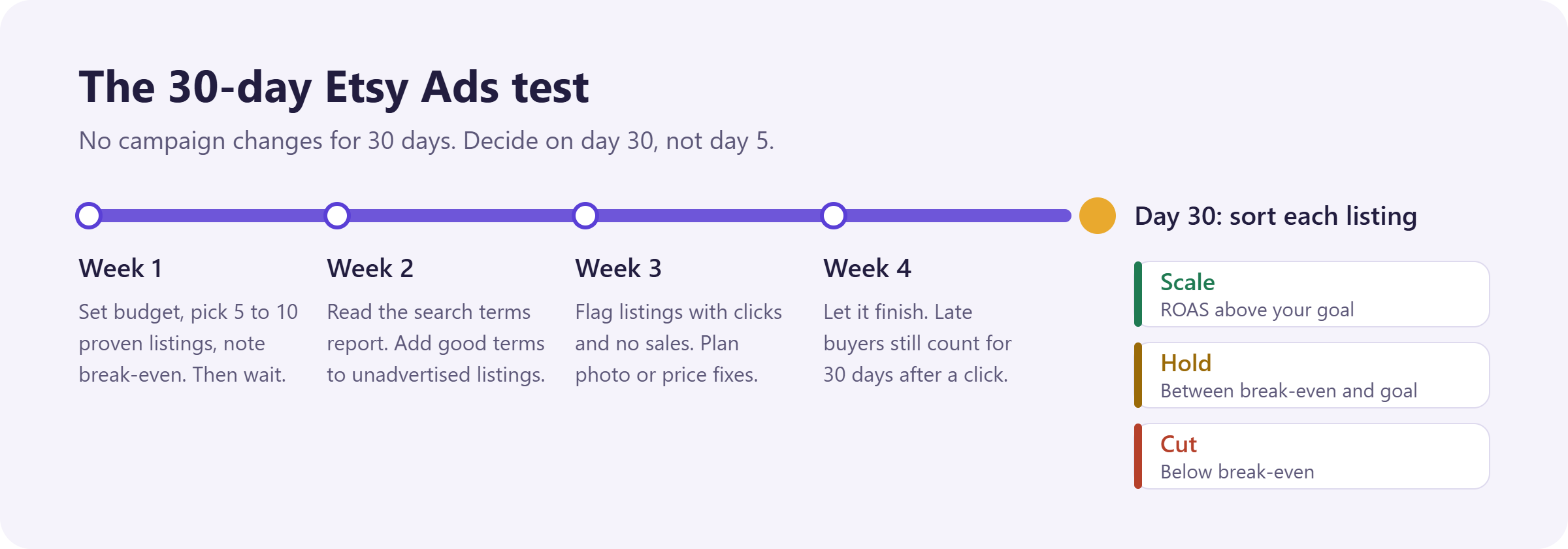
- Week 1: Set the budget, choose your listings and write down each one’s break-even ROAS. Then leave it alone.
- Week 2: Open the search terms report and note which searches bring clicks. Add the useful ones to the tags of similar listings you’re not advertising.
- Week 3: Flag listings with clicks and no sales, and plan photo, price or title fixes for day 30.
- Week 4: Let the data finish. Etsy credits a sale to your ads for 30 days after each click, so late buyers still count.
On day 30, sort every advertised listing:
| Result at day 30 | What to do |
|---|---|
| ROAS above break-even plus your profit goal | Scale: raise the budget in small steps and check that ROAS holds |
| ROAS between break-even and your goal | Hold: fix the photo, price or title before adding budget |
| ROAS below break-even, or clicks with no sales | Cut: stop advertising that listing |
Real tests vary widely. In the EtsyHunt roundup, a clothing seller spent about $155 over 30 days across 108 listings and made about $507 from 14 ad orders, a ROAS of roughly 3.3, even though 15 of the 30 days brought no sales at all. Another seller spent $80 in one week on a single template listing and made about $95, a ROAS near 1.2, which leaves almost nothing after fees even on a digital product.
Those quiet days are the lesson: judging after a week would have killed the campaign that ended up paying off.
Should you keep Etsy Offsite Ads?
Offsite Ads are a separate program. Here, Etsy promotes your listings on other sites and apps, including search engines and social media, and you pay only when an ad leads to a sale.
Per Etsy’s Offsite Ads rules, the fee is 15% of the order if your shop has always made under $10,000 in any 365-day period, and 12% once it passes $10,000. It’s capped at $100 per order. Shops under the threshold can opt out; past it, you’re enrolled for the life of the shop.
Back to the necklace. A $40 sale through Offsite Ads costs another $6 at 15%, so you keep $15.75 instead of $21.75. You still make money on that order, just less of it.
For many shops that trade is fine, because you never pay for a click that didn’t buy. PlanetJune, whose onsite test failed, found the opposite with Offsite Ads: just over $100 CAD in fees brought in roughly $880 CAD of extra sales.
If your margins are thin, opting out under $10,000 can make sense, as long as you replace that traffic yourself. The simplest version is posting your products on Instagram, Facebook and TikTok often enough to be found.
Predis.ai can autopost on a schedule, and its competitor intelligence shows what similar shops post and when, so you’re not guessing at what earns attention in your category.
If you later pay for social ads yourself, this guide to a good ROAS for Facebook ads applies the same break-even logic.
Mistakes that drain an Etsy ad budget
- Judging after a few days. Etsy needs about 30 days to learn, and buyers have 30 days to come back.
- Advertising listings that don’t sell organically. Ads scale whatever conversion rate you already have, including a bad one.
- Counting revenue instead of profit. A 2.0 ROAS sounds healthy. On a listing that breaks even at 2.5, it’s a loss.
- Ignoring the search terms report. It shows the searches you paid for. If they don’t match what you sell, tighten your titles and tags.
- Raising the budget on a listing that isn’t selling. More budget buys more of the same clicks. Fix the listing first.
Run the numbers, then decide
So, are Etsy ads worth it? For some of your listings, probably yes. For others, the math says no before you spend anything. The point is to stop treating Etsy Ads as one decision for the whole shop.
Work out break-even for your top listings, run a focused 30-day test, and let day 30 sort them for you. Whatever you decide on Etsy, the traffic you bring yourself comes with no per-click price attached.
FAQs
Pick a daily amount you could lose for 30 days without stress. Etsy recommends $3 to $5 a day for a test. Below that, advertise only a handful of listings that already sell, so each gets enough clicks to judge.
$1 a day is Etsy’s minimum, and it will run, but it buys very little data. PlanetJune’s $1-a-day test produced 69 clicks in 15 days, too few to judge a listing with confidence. If $1 is all you can spare, advertise one or two proven listings only.
Give it 30 days. Etsy says its system needs about that long to learn which placements work, and it counts any purchase within 30 days of an ad click as an ad sale. Quiet weeks early on are normal.
There’s no universal number. A good ROAS beats your listing’s break-even plus the profit you want to keep. A 54% margin breaks even at 1.84; a 40% margin needs 2.5. Check yours with the calculator above.
Only if your shop has always made under $10,000 in any 365-day period. If you qualify, go to Shop Manager, then Settings, then Offsite Ads, and choose to opt out. Once you pass $10,000, you’re enrolled for the life of the shop at the lower 12% fee.
You may also like: