

Explore this content with AI:
In June 2025, a 30-second ad for Kalshi ran in YouTube TV’s stream of Game 3 of the NBA Finals, and nobody filmed a frame of it. Kalshi told NPR that the AI prompting, which stood in for studios, directors and actors, cost under $2,000.
Here’s the part that gets skipped in the retelling: the creator still ran hundreds of generations to get 15 clips worth keeping.
So yes, an AI commercial generator can get you a spot that holds up next to a produced one. You don’t need to hire a production crew. What you can’t skip is knowing what “holds up” means, and checking your draft against it before a dollar goes to media.
What changed, and what counts as “TV” now
An AI commercial generator takes a brief or a product link and makes the parts a crew used to make: the script, the shots, the voice, the music and the captions. Some tools just stitch stock clips together; an ai commercial video generator makes original footage from your prompts, which is what you want if the ad has to look like yours.
Big advertisers got there first. In the IAB’s 2026 video report, six in 10 buyers said they use generative AI to build or enhance video ads, up from 51% a year earlier, and a third of digital video ads now carry some AI work.
“TV” also stopped meaning a network buy. The same report found that the share of small spenders buying connected TV rose from 60% in 2024 to 85%, with self-serve platforms lowering the entry barrier. That’s YouTube on a living room screen, streaming apps, and ad-supported tiers you can buy without an agency.
Georgia State marketing professor Alok Saboo told NPR that AI lowers the barrier for smaller brands that can’t afford a traditional campaign. Fair enough. The barrier that’s left is quality, and that one’s on you.
What “TV-quality” actually means: a six-point test
Almost every AI commercial maker promises “broadcast quality,” and almost none of them tell you how to check for it.
Viewers can. In Canva’s 2026 study with The Harris Poll, 70% of consumers said AI-generated ads feel like they’re missing their soul. The same survey found 68% don’t mind AI in ads when it makes them helpful or relevant. People aren’t judging the tool; they’re judging the result.
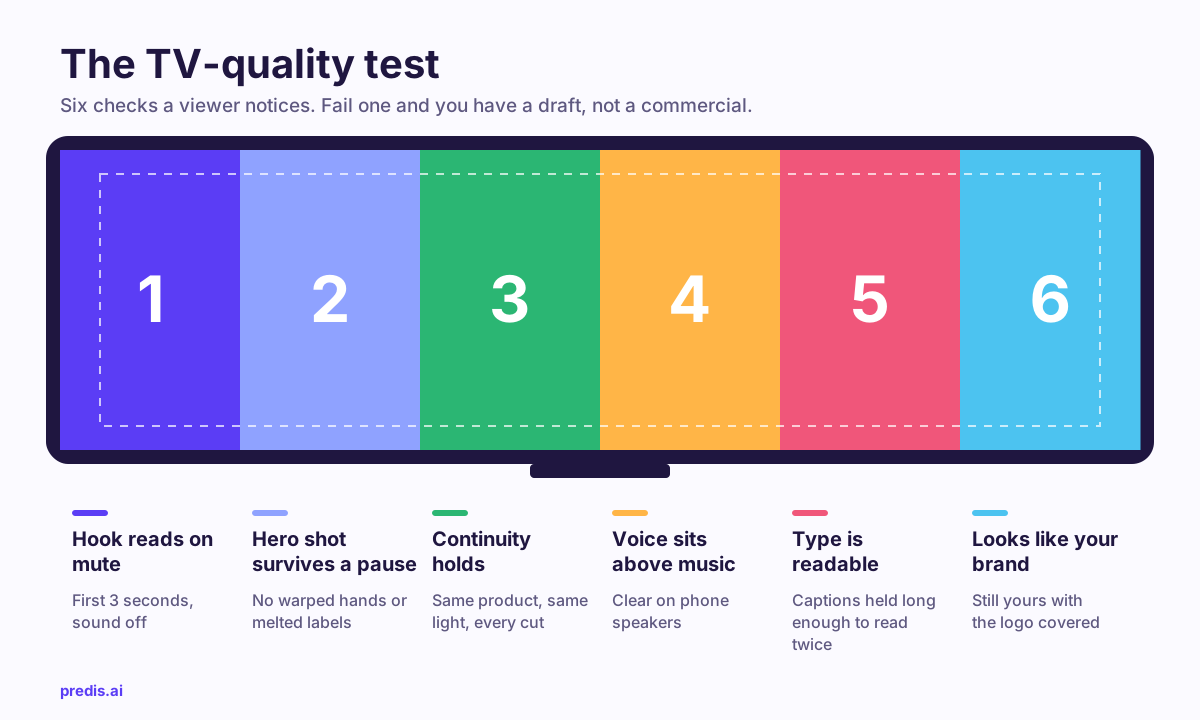
So judge yours the way they will. A TV-quality ai tv commercial passes these six checks:
- The hook reads on mute. Watch the first 3 seconds with the sound off. If you can’t tell what’s being sold or why to keep watching, the hook isn’t done.
- The hero shot survives a pause. Freeze on the frame where your product is biggest. Look for warped hands, melted text on the label, or a logo that drifts.
- Continuity holds. Your product keeps the same shape, color and label from shot to shot, and the light doesn’t jump from morning to dusk between cuts.
- The voice sits above the music. Every word is clear on phone speakers. If the music fights the voiceover, the music loses.
- The type is readable on a phone. Captions and the end card stay on screen long enough to read twice, at a size you can read at arm’s length.
- It looks like your brand with the logo covered. Cover the logo with your thumb. If it could be anyone’s ad, your colors, fonts and tone haven’t made it in yet.
Run the TV-quality test on your draft
Watch your export once, then mark each check. Every pass lights up a bar.
Fail one check and you have a draft, not a commercial. Every step below is there to get you through all six.
How to make a commercial with AI in 5 steps
Step 1: Write a one-line brief and gather what the tool can’t guess
Start with one sentence: who it’s for, what you sell, and the one thing a viewer should feel or do. “Busy parents, a 10-minute meal kit, order this week’s box” is a brief. “Make an ad for my food brand” is a wish.
Then collect what no tool can invent for you. That’s your product page link, your logo, your brand colors and fonts (most tools store these in a brand kit), one proof point you can actually back up, and the offer.
A product commercial lives or dies on that proof point. One real review count or a real guarantee does more work than any camera move ever will.
If your product has a page, start there, since most AI commercial makers can read a product link. Predis.ai’s video ad maker takes a product link and writes the script around what’s on the page, so the details come from your store and not from a guess.
Step 2: Script it to a 30-second beat sheet
A 30-second commercial is long enough for a problem, a product, proof and an ask, and short enough that you can’t pad it. Wyzowl’s 2026 survey found 71% of marketers think 30 seconds to 2 minutes is the most effective length for video.
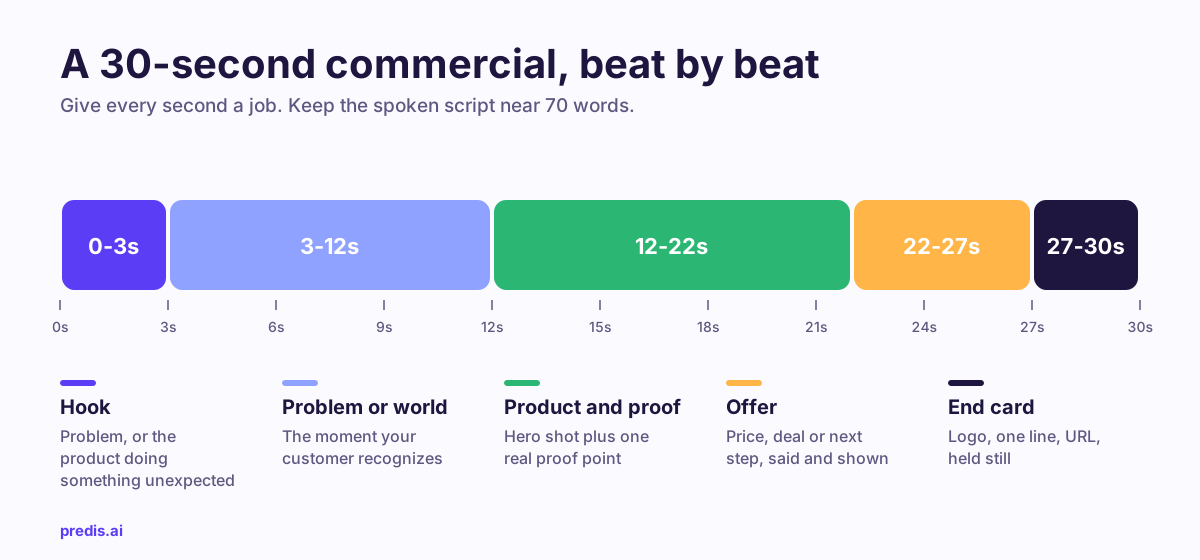
Give every second a job:
| Time | Beat | What’s on screen |
|---|---|---|
| 0-3s | Hook | The problem, or the product doing something unexpected |
| 3-12s | Problem or world | The moment your customer recognizes |
| 12-22s | Product and proof | The hero shot, plus your one real proof point |
| 22-27s | Offer | Price, deal or next step, in words and on screen |
| 27-30s | End card | Logo, one line, URL, held still |
Keep the spoken commercial script to roughly 70 words, then read it aloud with a timer. If you have to rush, cut words, not beats. For more on scripting a spot around one product, read this guide to product video ads.
Build your 30-second beat sheet
Fill in what you know. You get a draft script you can edit, a timing check for every beat, and one shot prompt per beat for your AI commercial generator.
Step 3: Generate shot by shot, not all at once
Ask for a whole commercial in one prompt and you’re handing the model a few dozen decisions to get right at once. Write one prompt per beat instead, each with a subject, a setting, a camera move, the light and the mood.
Here’s what that looks like for the hero beat of a coffee brand:
12-22s, hero shot. A matte black 12 oz bag of Northbound dark roast coffee with a cream label, standing on a walnut counter. Slow push-in from waist height. Soft morning window light from the left, steam rising from a white mug behind the bag. Calm, warm, unhurried. No text on screen.
Notice what’s missing: adjectives like “stunning” or “cinematic.” Models respond to what you describe, not to how excited you sound. If you want more starting points, we keep 50 copy-paste video prompts for product ads, sorted by what you sell.
Copy that product description word for word into every prompt. It’s a boring habit, and it prevents most continuity problems before they start, whether you’re using text to video or an image of your product as the starting frame.
Then budget for discards. Kalshi’s creator told NPR the spot took about 300 to 400 generations to get 15 usable clips.
A simple product spot won’t take that many. Still, plan on three takes of your hero shot and keep the clean one, and make sure your ai video ad generator lets you regenerate a single shot without starting over.
Step 4: Finish the sound and the type
Pick one AI voiceover that sounds like your brand would sound in person, and keep it for the whole spot. Lay the music underneath it and pull the music down wherever someone is speaking.
Add captions for everyone watching with the sound off, because on a phone in a waiting room, that’s a lot of your audience. Then export each aspect ratio you’ll run: 9:16 for Reels, TikTok and Shorts, 16:9 for YouTube and streaming, and 1:1 or 4:5 for the feed. Check that nothing important sits at the edges, since each crop cuts something different.
Step 5: Run the test, fix one frame, then make variants
Now run the six-point test on your export. When a check fails, fix that shot and only that shot. Regenerating the whole commercial to fix one bad frame throws away the five shots that already work.
Predis.ai is built around this: fix-one-frame editing lets you change a single shot and keep everything else in place.
Once it passes, make three video ad variations that each change one thing, such as the hook, the offer or the voice. Sonata Insights analyst Debra Aho Williamson told NPR the real economics of AI ads come down to putting several concepts out quickly and cheaply. Run them side by side with the same budget. Whichever one earns attention at the lowest cost is your winner, and that’s a finding, not a guess.
What it costs: a crew versus an AI commercial maker
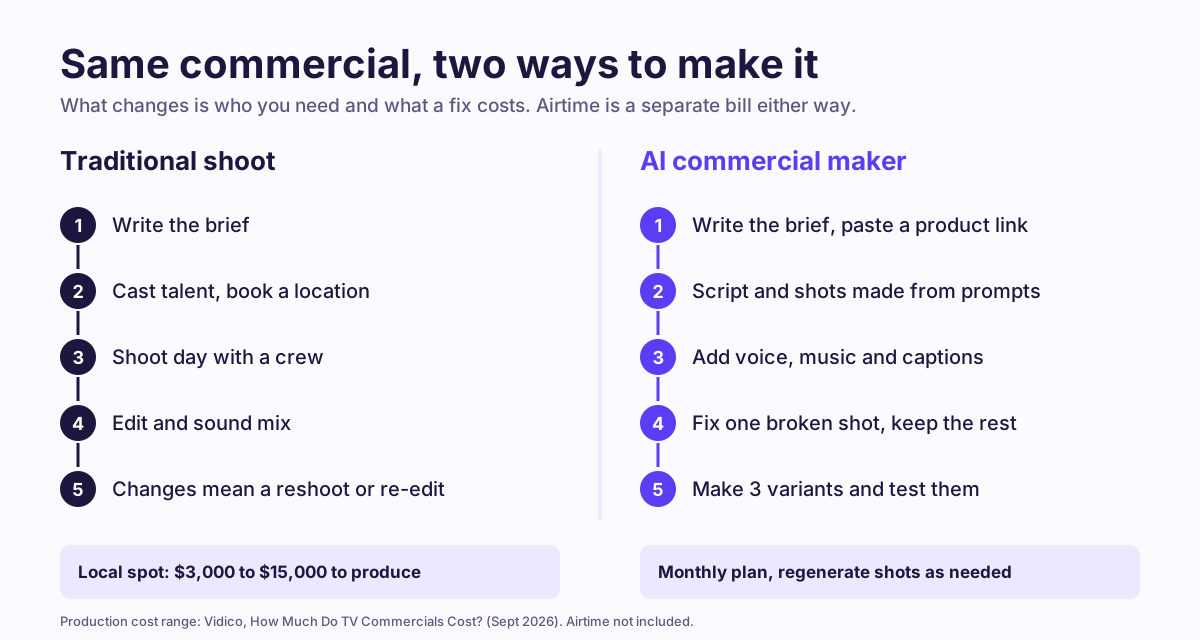
A traditional TV commercial production cost starts higher than most small businesses expect. Production company Vidico prices a local or small-business commercial at $3,000 to $15,000 to produce, before you pay for a single airing.
That buys a simple concept, one or two non-professional actors, a single location and basic editing.
On the AI side, the best-known number is still Kalshi’s: under $2,000 in prompting for a spot that ran during the NBA Finals. That figure leaves out the creator’s fee. Read it as the generation bill for one high-profile ad, not a price tag.
An AI commercial maker usually runs on a monthly plan instead of a per-project quote. Predis.ai’s plans start at $19, which is the kind of math that turns a low-budget commercial from a one-off into something you can refresh every month.
Here’s how the two routes line up:
| Traditional shoot | AI commercial maker | |
|---|---|---|
| Who you need | Director, crew, talent, editor | You, plus a reviewer you trust |
| What you pay for | Each project | A monthly plan [VERIFY] |
| Fixing one shot | A reshoot or a new edit | Regenerate that shot |
| Making 3 variants | Usually priced as extra edits | Part of the same session |
| Airtime | Separate bill | Separate bill |
That last row matters. An AI commercial maker cuts the cost of making the ad, not the cost of showing it.
Will people care that it’s AI?
Some will, and you should plan for that rather than hope it away.
In January 2026, the IAB and Sonata Insights found that 82% of ad executives believe Gen Z and Millennials feel positive about AI-generated ads, while only 45% of those consumers actually do. Gen Z was nearly twice as likely as Millennials to feel negative, at 39% versus 20%.
The same research points to a way through. 73% of those consumers said clear disclosure would either raise or not change their likelihood to buy. The IAB’s new disclosure framework focuses on material cases, like synthetic people, rather than labeling every AI-assisted cut.
In practice, three habits keep you on the right side of this:
- Show your real product, not a generated stand-in that looks better than what ships.
- Don’t put praise in the mouth of a person who doesn’t exist.
- Label the ad wherever a viewer could reasonably be misled.
Polished commercial or UGC-style ad?
A polished commercial says “a real company stands behind this” before anyone speaks. It earns its keep on launches, YouTube pre-roll, streaming placements and your homepage.
UGC-style ads work differently. A creator talking to camera reads as a recommendation, which suits the feed and makes it cheap to test angles. If you need ideas for the format, start with these UGC video ad examples.
You don’t have to pick one. Plenty of brands run both from the same brief: one polished spot to carry the brand and a handful of creator-style cuts to find what sells. A good ai ad generator should make both from one input, so testing the two side by side doesn’t double your work. If you want to try the second format, Predis.ai’s UGC ad maker turns the same product link into creator-style video ads with an AI avatar.
What the generator still can’t do for you
Even the big-budget AI films had people finishing them, and your AI commercial will too. When Toys R Us premiered a brand film made almost entirely with OpenAI’s Sora, the team still added corrective visual effects and an original score.
Kalshi’s creator said it more bluntly: just because this was cheap doesn’t mean anyone can do it. The AI commercial generator handles production, and you still own the offer, the proof and the call on what ships.
Production is no longer the gate
For most of advertising history, the question was whether you could afford to make a commercial at all. That question is mostly gone. What’s left is judgment: a clear brief, a script that earns every second, and the patience to fix the one shot that’s wrong.
Start small: one brief, one beat sheet, three variants. Your first AI commercial won’t be perfect, and it doesn’t need to be, because the test-and-fix loop is what gets it there. When you’re ready to turn a product link into a commercial that looks like your brand, Predis.ai is the place to start.
FAQs
Yes. Kalshi’s AI-generated 30-second spot ran in YouTube TV’s stream of the 2025 NBA Finals, and Coca-Cola has run AI-made holiday commercials two years in a row. What AI can’t do is decide what your ad should say, check your claims, or approve the final cut. Those still need a person who knows the business.
A free AI commercial generator exists in the sense that several tools offer free tiers or trials, but free versions usually limit length, resolution or exports, and many add a watermark. Before you build a campaign on one, check three things: whether you can export without a watermark, whether you own commercial rights to the output, and whether you can regenerate a single shot.
Start with 30 seconds, whichever AI commercial generator you use. It’s long enough for a hook, the product, one proof point and an offer. Then cut 15- and 6-second versions from the same shots for social placements and pre-roll, where viewers can skip.
Rules vary by platform and country, so check each one you advertise on. As a working habit, disclose when an ad shows synthetic people or could mislead a viewer. IAB research found most young consumers say clear disclosure either helps or doesn’t change whether they buy.
Usually, yes. Self-serve connected TV platforms accept video files that meet their specs, and the IAB found the share of small-budget ad buyers on CTV reached 85% in 2026. Export at 16:9 in the resolution the platform asks for, keep text inside safe margins, and review each platform’s creative policy before you upload.
You may also like: