


Explore this content with AI:
Mental health leads are the priciest in healthcare search advertising. LocaliQ’s 2026 healthcare benchmarks put the average cost per lead for mental health at $141.17, the highest of 16 healthcare categories and more than double the $66.02 healthcare average.
That number lands hardest on solo therapists running Google Ads themselves. You open an account on a Sunday night and accept Google’s suggested settings. By Friday, a big share of the budget has gone to people searching for therapist jobs or free worksheets, plus a few trying to understand their own symptoms.
None of that is a reason to skip paid search. It’s a reason to set it up on purpose. Private practice marketing on Google rewards precision and quietly punishes defaults.
So where does the money actually go?
What a Therapy Lead Costs on Google Right Now
Here’s the odd part. Clicks in mental health aren’t expensive by healthcare standards. LocaliQ’s median cost per click for the category is $4.22, below the $5.64 healthcare average.
The cost per lead is high because so few clicks turn into inquiries. Mental health converts at 1.85%, second-lowest of the 16 categories (only addiction recovery sits lower). Conversion rate fell 61% year over year while CPC climbed 42%, and cost per lead jumped 146%.
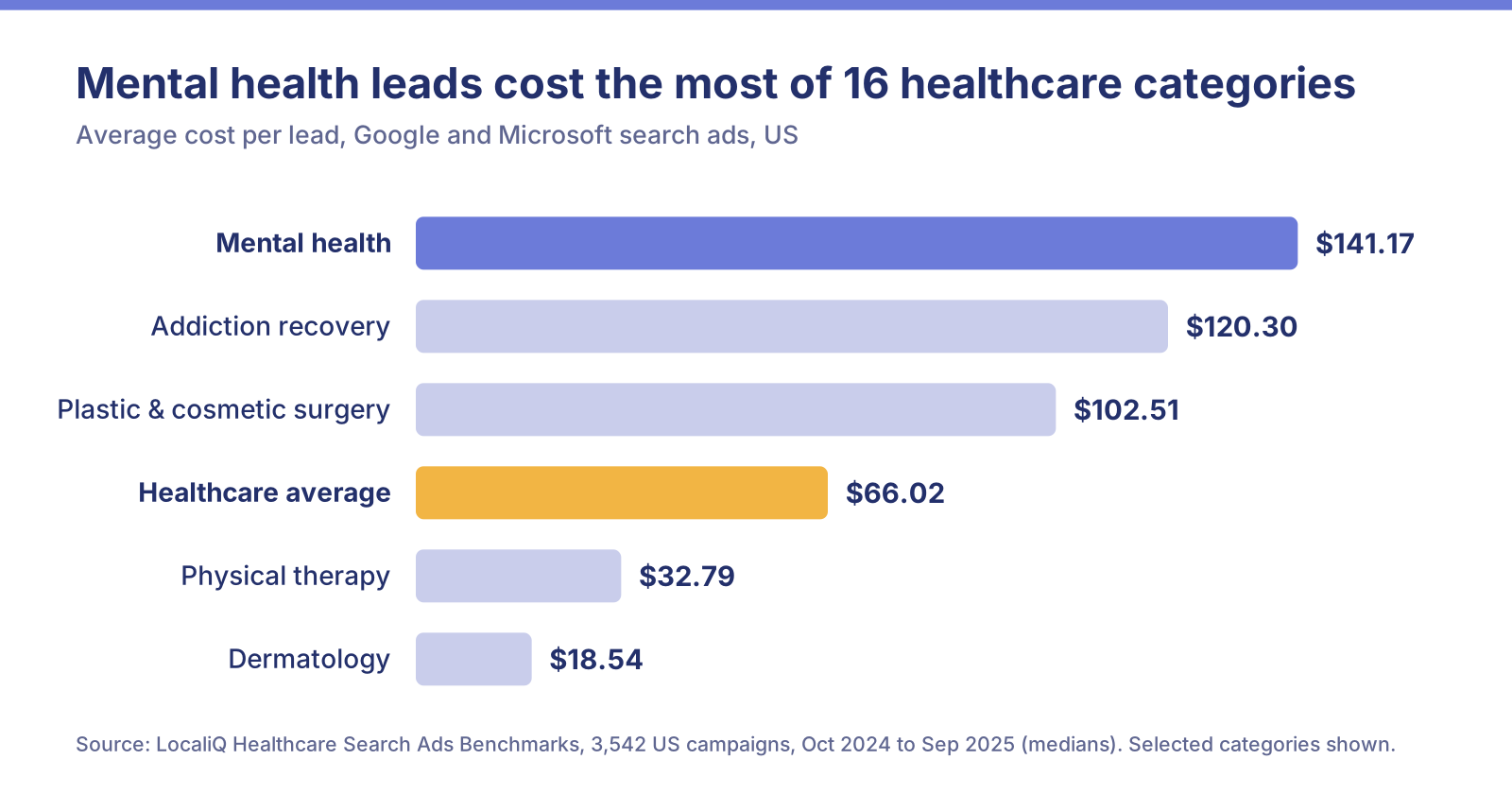
Read that as a diagnosis, not a verdict. When clicks are cheap and leads are expensive, the problem usually sits after the click. Think homepage instead of a service page, or a long intake form. Sometimes it’s just a phone nobody answers.
The other half of the math is what a client is worth to you. Take an illustrative case. With a $150 session fee and a client who stays for 12 sessions, that’s $1,800 in revenue. Paying $141 for an inquiry still works if roughly one in four inquiries books and stays. Run your own fee and retention through the calculator further down.
One honest check before you spend anything. The APA’s 2025 Practitioner Pulse Survey found 46% of psychologists had no openings for new patients. If your caseload is full, ads buy you inquiries you’ll have to turn away.
Google’s Health Rules Shape Your Whole Setup
This is where Google Ads for therapists parts ways with ads for a dentist or a plumber. Most local businesses can upload a client list, follow website visitors around the internet, and build lookalike audiences. You can’t, and it changes how every later step works.
Google’s personalized advertising policy treats Health as a sensitive interest category, and it names counseling services for depression, anxiety and addiction as examples. For those ads, advertiser-curated audiences are off the table. That means no Customer Match and no “your data segments” (Google’s term for remarketing lists). Predefined Google audiences are still allowed.
Couples and family therapists get a second flag. Relationship hardships is its own sensitive category, and family or relationship counseling is listed in it.
What’s left? Two levers, and both are strong:
- Search intent. You can’t target “people with anxiety.” You can show up when someone types “anxiety therapist near me,” which tells you more than any audience list.
- Location. A radius around your office, or the states where you’re licensed for telehealth.
One more rule that isn’t in Google’s policy but belongs in yours. A paid ad is the wrong place to meet someone in crisis. Add crisis terms to your negative list, and put a visible note on every page of your site pointing people to the 988 Suicide and Crisis Lifeline.
Step 1: Build a Search-Only Campaign
Every solid therapist Google Ads account starts the same way. Create a new campaign and choose Search. Google will offer to add the Display Network and search partners. Turn both off. Display puts your ad on third-party websites and apps, which is a poor match for someone deciding whether to call a therapist, and partner sites are harder to judge.
Then work through the settings that matter most for a therapy practice:
- Location options. Pick “Presence: people in or regularly in your targeted locations.” Google’s default setting also counts people merely “interested in” your area, so a student in another state reading about your city can trigger your ad.
- Radius or state. For in-person work, start with a radius you’d realistically expect clients to drive. For telehealth, target only the states where you hold a license.
- Ad schedule. Run ads when someone can answer the phone or reply to a form the same day. A lead who waits until Monday often books someone else.
- Bidding. With no conversion data yet, many practices start on Maximize clicks with a max CPC limit, then switch to Maximize conversions once tracking has recorded real inquiries. Either way, give it two weeks before judging.
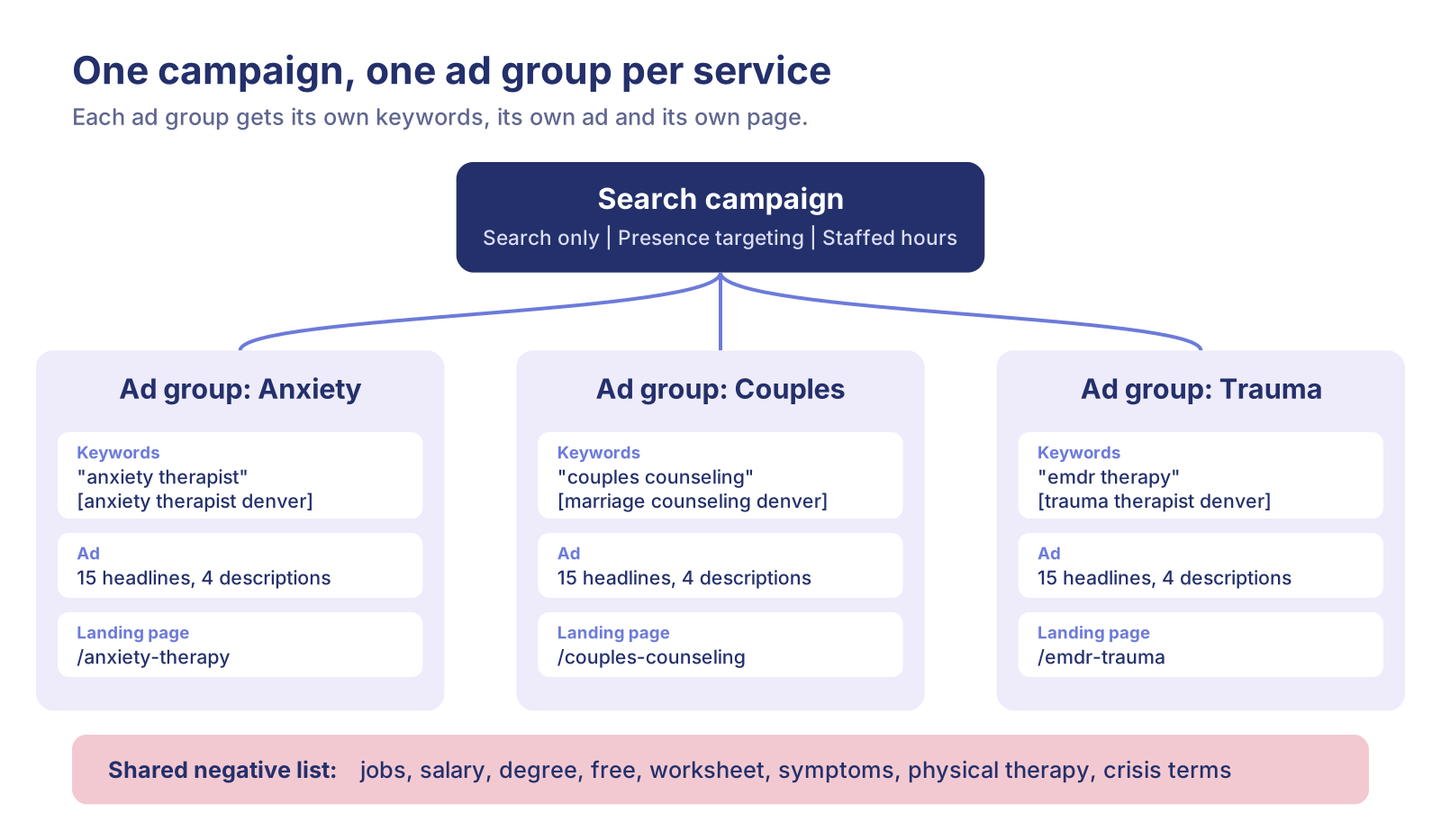
Structure is the step most DIY accounts skip. Build one campaign with one ad group per service you want to fill, for example anxiety, couples and trauma. Each ad group gets its own keywords, its own ad and its own landing page.
That separation is what keeps the person searching for couples counseling from landing on your anxiety page.
Step 2: Choose Keywords People Type When They’re Ready
Keywords are where PPC for therapists is won or lost. Most guides hand you a list like “therapist, counseling, mental health services” with no numbers. Here’s what US searchers actually type, pulled from Ahrefs Keywords Explorer in November 2026.
The keyword table
| Keyword | Monthly US searches | Est. CPC |
|---|---|---|
| therapist near me | 219,000 | $8.00 |
| online therapy | 132,000 | $12.00 |
| marriage counseling near me | 44,000 | $4.50 |
| psychologist near me | 29,000 | $4.50 |
| emdr therapy near me | 19,000 | $3.00 |
| grief counseling near me | 16,000 | $1.90 |
| teen therapist near me | 12,000 | $4.00 |
| couples counseling near me | 10,000 | $4.50 |
| anxiety therapist near me | 9,100 | $2.50 |
| trauma therapist near me | 4,300 | $4.50 |
| family therapist near me | 2,900 | $3.50 |
| depression therapist near me | 1,500 | $1.50 |
See the pattern? Broad terms like “online therapy” carry the highest estimated CPC on the list, and national telehealth brands compete for them. Specific terms like “depression therapist near me” cost a fraction as much and say far more about intent.
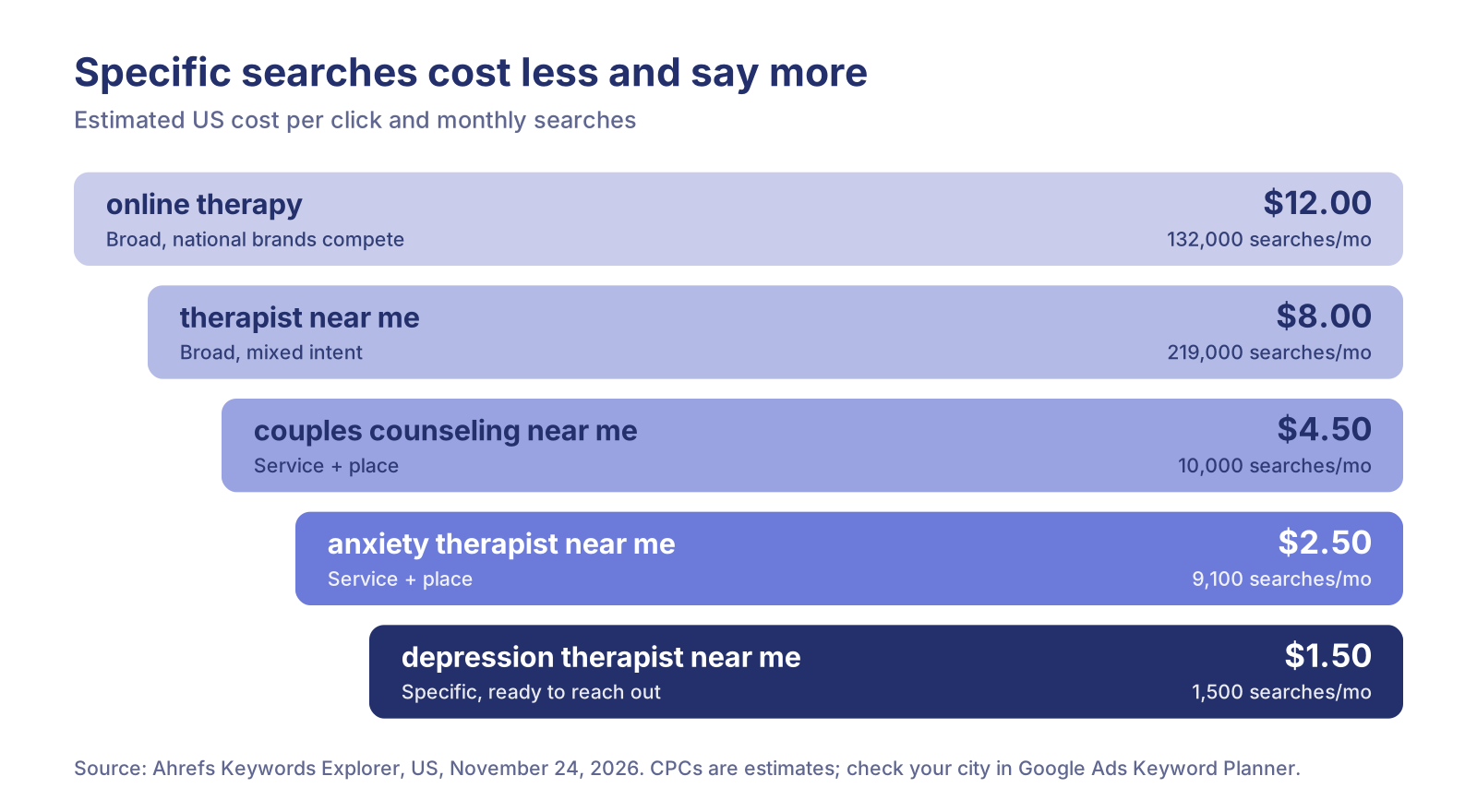
Two caveats. These are national figures, and your city will see a small slice of them. Ahrefs CPCs are estimates, so check local numbers in the free Google Ads Keyword Planner before setting a budget.
Match types
Google assigns broad match by default, and it’s the setting behind a lot of wasted therapy budgets. Broad match lets “anxiety therapist” trigger on “anxiety therapist salary” or “is anxiety therapy worth it.”
Start with phrase match (“anxiety therapist”) and exact match ([anxiety therapist denver]). Aim for 10 to 20 keywords per campaign at first. Broaden later, once you can see which searches actually book.
Negative keywords for day one
Negative keywords stop your ad from showing on searches that will never turn into clients. Add these before launch:
- Jobs: jobs, salary, hiring, career, internship, CEU
- Education: degree, school, license exam, how to become
- Free and research: free, worksheet, PDF, quiz, symptoms, definition
- Wrong services: physical therapy, massage, psychiatrist, medication, rehab (unless you offer them)
- Crisis: emergency and crisis terms, so people in urgent need reach 988 instead of an ad
“Therapist jobs” alone draws about 1,600 US searches a month. That’s real money on day one if you leave it open.
Step 3: Write Ads That Respect the Person Reading
Google search ads use the responsive format. You can supply up to 15 headlines of 30 characters and 4 descriptions of 90 characters, and Google mixes them into combinations.
Mental health ads also have one of the lowest click-through rates in healthcare, 4.46% in LocaliQ’s data. People scan carefully before they click on a therapist.
Calm, specific copy earns more of that attention than clever copy, and that’s true of advertising for therapists in every format.
A few rules that keep you inside policy and on the reader’s side:
- Name the service and the place. “Anxiety Therapy in Denver” works. “Are You Depressed?” reads as if you know something about them.
- State facts that help a decision. Insurance you accept, telehealth states, evening hours, fees.
- Never promise an outcome. “Feel Better in 4 Sessions” is a claim you can’t make about someone you haven’t met.
- Match the landing page. If the ad says sliding scale, the page should say it too.
New to how headlines and descriptions fit together? This beginner’s guide to ad copy in Google Ads covers the basics.
Ad Examples You Can Adapt
Most guides on Google Ads for therapists stop at one or two sample headlines. Each set below is a full responsive search ad.
Swap anything in [brackets] for your practice’s details, and only keep a line if it’s true for you. All headlines stay under 30 characters with a city name up to 10 letters.
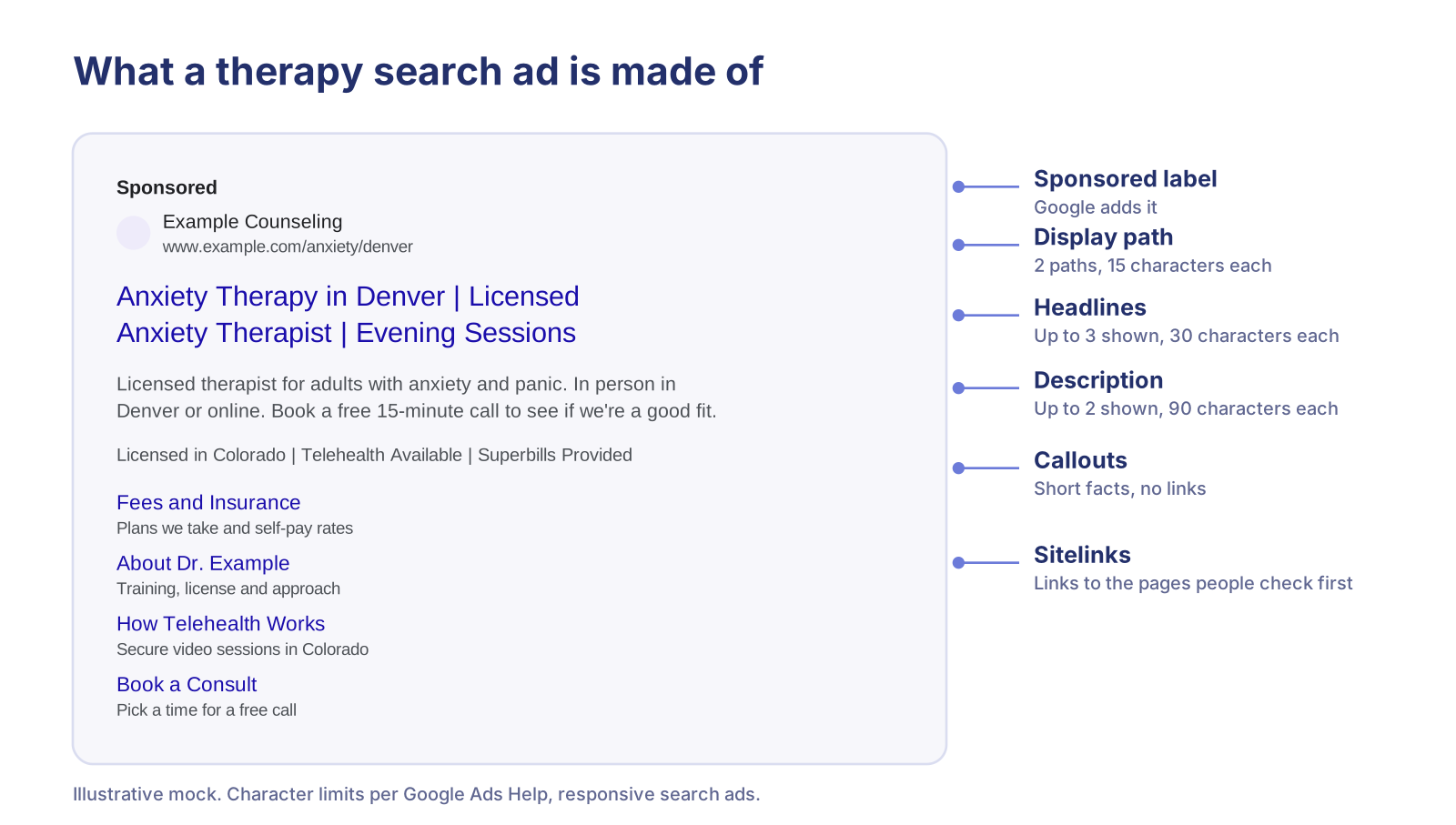
Anxiety therapy
Headlines
- Anxiety Therapy in [City]
- Licensed Anxiety Therapist
- Telehealth Across [State]
- Evening Sessions Available
- In-Network With [Plan]
- Free 15-Minute Phone Consult
- CBT and ACT Approaches
- Book Online Anytime
- [Credential] With [X] Years
- Openings This Month
- Sliding Scale Spots Open
- Talk to a Real Person
- Private, Confidential Care
- Office Near [Neighborhood]
- Anxiety and Panic Support
Descriptions
- Licensed therapist for adults with anxiety and panic. In person in [City] or online.
- Book a free 15-minute call to see if we’re a good fit. No waitlist right now.
- In-network with [Plan] and [Plan]. Superbills for out-of-network clients.
- Evening and weekend sessions. Straightforward fees listed on our site.
Paths: /anxiety /[city]
Couples counseling
Headlines
- Couples Counseling [City]
- Marriage Counseling Near You
- Gottman-Trained Therapist
- Evening Couples Sessions
- Online Couples Therapy
- Licensed MFT in [City]
- Free Consult Call
- Premarital Counseling
- Book Your First Session
- Weekend Openings Available
- Fees Listed Upfront
- In-Person or Telehealth
- [X] Years Helping Couples
- Office Near [Neighborhood]
- Schedule Online Today
Descriptions
- Licensed MFT seeing couples in [City] and online across [State].
- Evening and weekend sessions for couples with busy schedules. Book a free consult call.
- Gottman Method and EFT approaches. Fees and session lengths listed on our site.
- Premarital, communication, and rebuilding trust. Find a time that works for both of you.
Paths: /couples /counseling
Trauma and EMDR
Headlines
- EMDR Therapy in [City]
- Trauma Therapist Near You
- EMDRIA-Certified Therapist
- Telehealth EMDR in [State]
- Licensed Trauma Therapist
- Free Consultation Call
- Openings for New Clients
- Evening Sessions Available
- In-Network With [Plan]
- Book a Consult Online
- [Credential] in [City]
- Office Near [Neighborhood]
- Trauma-Informed Care
- Learn How EMDR Works
- Private Practice in [City]
Descriptions
- EMDR and trauma-focused therapy in [City] and online across [State].
- Book a free 15-minute call to ask questions about EMDR before you commit to anything.
- In-network with [Plan]. Clear fees and superbills for out-of-network reimbursement.
- Evening appointments available. Read about our approach and training before you call.
Paths: /emdr /trauma
Sitelinks and callouts for every ad group
Sitelinks: Fees and Insurance, About [Your Name], How Telehealth Works, Book a Consult. Callouts: Licensed in [State], Telehealth Available, Evening Hours, Superbills Provided.
Only certify what’s true. “EMDRIA-Certified” and “Gottman-Trained” are real credentials with real requirements, so drop the line if it doesn’t apply.
Before you upload your own version, paste it into the checker below. It counts characters against Google’s limits and flags wording that reads as intrusive or promises an outcome.
Check your therapy ad copy before Google does
Paste one headline or description per line. Each line gets a character count against Google’s limits and a flag for wording that can read as intrusive, promise an outcome, or need proof.
Headlines
Descriptions
A writing aid, not a policy review. It catches common patterns only, and Google makes the final call on approval. Limits per Google Ads Help (responsive search ads). Health-related targeting rules per Google’s personalized advertising policy.
Check AI Max Before You Launch
Here’s the 2026 change most guides on Google Ads for therapists haven’t caught up with. Google announced that campaigns using automatically created assets or the campaign-level broad match setting would be auto-upgraded to AI Max starting September 2026.
Why does that matter for a therapist? AI Max can widen the searches you match. Its text customization also writes extra headlines from your website, so a line pulled from a blog post could end up in an ad, sounding like a promise you’d never make.
Final URL expansion can also send clicks to a different page than the one you chose, and Google’s help center notes that pinned assets aren’t respected when it’s on.
Open campaign settings and confirm what’s on. If you keep AI Max, review the asset report weekly and add term exclusions and text guidelines. Set URL exclusions for your blog and resource pages too. If you’d rather control every word, turn text customization off. It’s your call, but make it on purpose.
Landing Pages and Tracking Without Health Data
Landing pages are where most campaigns of Google Ads for therapists quietly lose money. Send each ad group to its own page. Your homepage is built for everyone. An ad click is one person with one specific question.
A therapy landing page that turns clicks into inquiries usually has:
- A headline that repeats the ad (“Anxiety Therapy in Denver and Online in Colorado”)
- Who you help, in two or three sentences, without diagnosing the reader
- Your license, a photo and a short bio
- Fees, insurance and superbill details
- Location, telehealth states and hours
- One next step: a short form, a click-to-call button or a booking link
- A crisis note pointing to 988
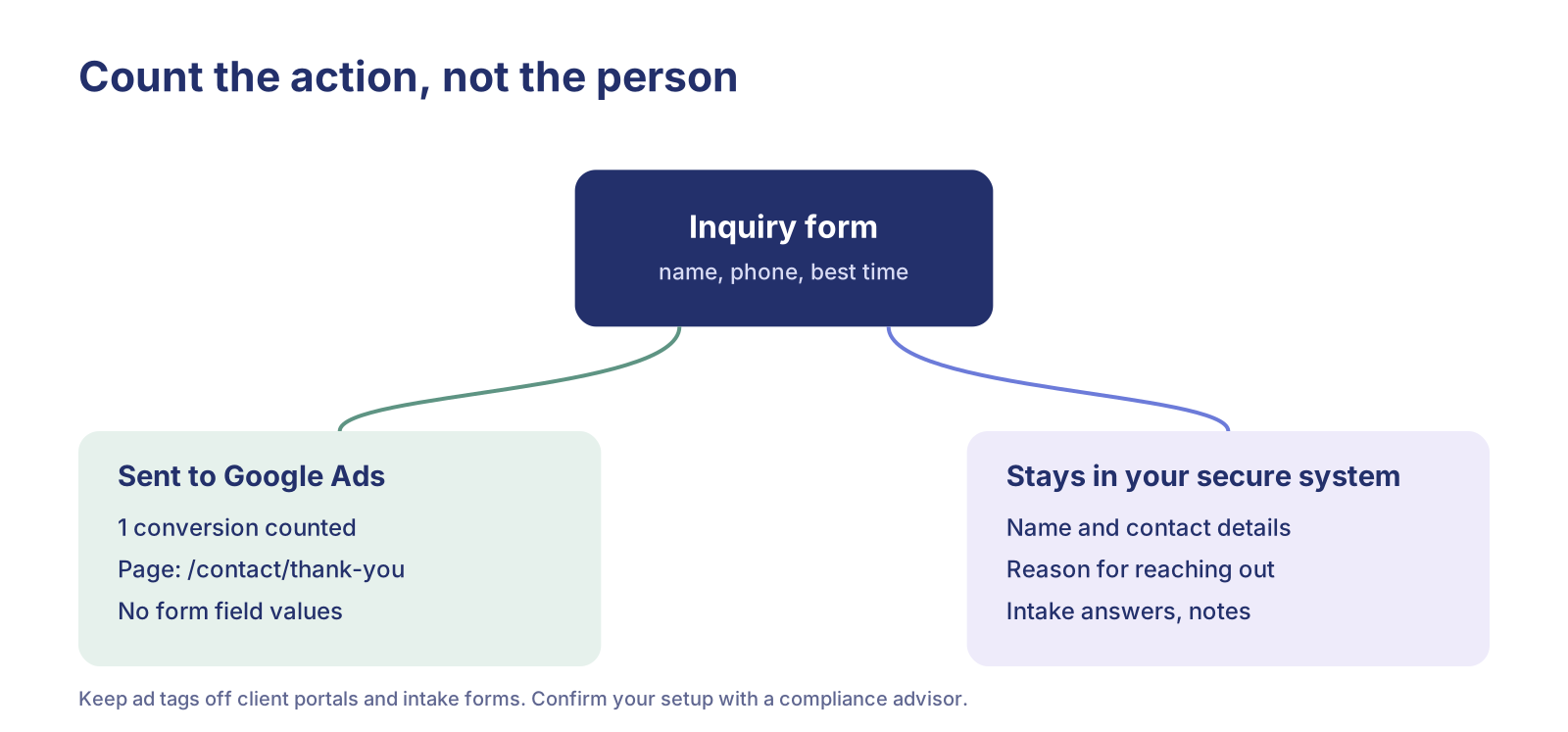
Keep the form short. Name, phone or email, and a preferred contact time are plenty. Asking about symptoms on an ad page collects health information you then have to protect.
Tracking needs the same restraint. Count the action, not the person: a form submit or a call click is a conversion, and form field values never go to Google. Use generic thank-you URLs like /contact/thank-you rather than /depression-intake/thank-you, and keep ad tags off client portals.
The cautionary tale is BetterHelp. The FTC found it shared email addresses, IP addresses and health questionnaire answers with platforms including Facebook and Snapchat for advertising, and the company agreed to pay $7.8 million.
A solo practice won’t face that scale. The lesson about health data and ad platforms still holds. For HIPAA questions specific to your setup, check with your compliance advisor, since this guide isn’t legal advice.
What to Watch in Your First 90 Days
With Google Ads for therapists, week one is cleanup. Open the search terms report every few days and add negatives for anything that isn’t a person looking for a therapist like you.
After that, watch three numbers:
- Cost per inquiry. Total spend divided by forms and calls.
- Inquiry-to-consult rate. How many inquiries become a scheduled first call.
- Cost per new client. The one that decides whether the campaign pays.
Here’s why the landing page matters so much. At LocaliQ’s median $4.22 CPC, $1,000 buys roughly 237 clicks. At the category’s 1.85% conversion rate, that’s about 4 inquiries. Lift the page to 5% and the same budget brings in about 12.
Will Google Ads pay for themselves in your practice?
Enter your own numbers. The defaults use the 2026 median for mental health search ads, so you can see where a typical account starts and what changes it.
- Clicks per month
- Inquiries per month
- New clients per month
- Cost per inquiry
- Cost per new client
- Lifetime revenue from those clients
- Revenue per $1 of ad spend
Estimates only, before session costs and taxes. Defaults: mental health median CPC $4.22 and conversion rate 1.85%, healthcare average conversion rate 8.09% (LocaliQ Healthcare Search Ads Benchmarks, US campaigns Oct 2024 to Sep 2025, medians). Fee, sessions and inquiry-to-client rate are illustrative. Actual costs depend on your city and competition.
Plug your own budget, fee and intake numbers into the calculator below to see where your break-even sits.
Treat month one as learning. Decide at 90 days, using booked clients against what each client is worth.
When to Add a Second Channel
Your therapist paid advertising plan doesn't have to stop at Search. Once Search brings in consults at a cost you're happy with, look sideways.
A complete Google Business Profile helps you show up in the map results for free, and reviews there do a job ads can't.
It also helps to know what other practices are saying. Google's Ads Transparency Center shows the search ads competitors run, and this guide walks through using it.
If you test image ads on Google later, run them in their own campaign with the same policy limits: no client lists and no re-marketing. Predis.ai's Google display ad maker can make those ads in your brand kit from one line of text, so the creative work doesn't land on your weekend.
Start Small, Then Scale What Books
Google Ads for therapists works when the setup matches how people search for help: specific services, a real location, a page that answers their questions, and someone who responds the same day.
Start with one campaign, three ad groups and a tight negative list. Give it 90 days, judge it by booked clients, and put more budget behind the ad group that fills your calendar.
FAQs
There's no single right budget for Google Ads for therapists, because local competition sets the price. Work backward from your goals instead. If an inquiry costs around $141 at the mental health median and you need 4 inquiries to sign one client, plan for roughly $560 per new client, then compare that with what a client is worth. Budget enough for at least 2 to 3 months of data.
Not with Google's own audience tools. Mental health counseling falls under Google's Health sensitive category, so Customer Match and your data segments (remarketing lists) can't be used for those ads. Plan around search intent and location instead. Honestly, it's also kinder to the people who visited.
A small, Search-only campaign is manageable on your own if you can spend an hour a week on search terms and negatives. An agency makes sense when you're running several locations or specialties. Either way, keep ownership of the account, and ask any agency how they handle tracking without sending health data to Google.
No. Paid ads and organic results are separate systems, and paying for ads doesn't move your website up in the free listings. What ads do give you is fast data on which searches book clients, which you can use to plan service pages and content for SEO.
You may also like: