


Explore this content with AI:
You’re posting consistently. You’re using hashtags. You’ve got a bio. And nothing is growing.
That’s not a content problem — it’s an optimization problem. Most accounts treat social media like a bulletin board: post something, hope people see it, repeat. Social media optimization (SMO) is the opposite of that. It’s the deliberate process of tuning every element of your presence — profile, content, timing, distribution — so the platform actively works for you instead of burying you.
Here are 13 steps that actually change the numbers.
What Social Media Optimization Actually Means (And What It Doesn’t)
SMO isn’t SEO with a different name, and it’s not the same as social media marketing. Marketing is what you say. Optimization is how you set up the system that delivers what you say to the right people, at the right time, in the right format.
The overlap with SEO is real: keywords in bios, captions as indexable text, a link building marketplace, and platform search algorithms that reward relevance and engagement signals. But SMO also covers things SEO doesn’t touch — visual consistency, story sequencing, save-and-share ratios, and the 60-minute engagement window after posting.
Three pillars hold everything together:
- Profile (how you’re found and what impression you make)
- Content (what you put out and how it’s built)
- Distribution (when, where, and how content reaches people)
Every step below maps to one of them.
Sell More via Social 💰
TRY FOR FREE
1 — Treat Your Profile Like a Landing Page
Your profile is the first thing someone sees when they tap your name anywhere on the platform. Most profiles waste this moment.
A keyword-rich bio formula that actually works:
[What you do] + [Who you do it for] + [Proof or result] + [CTA]
A fitness coach targeting working moms might write: “Helping busy moms lose 10kg without giving up carbs 🍕 | 3,000+ clients | Free meal plan 👇.” Every word is doing a job.
Your profile photo, cover image, and link-in-bio URL are the “first 5 seconds test” — a visitor decides whether to follow in the time it takes to glance at those three elements.
Use a high-contrast profile image with a clear face or logo, cover art that visually communicates your niche, and a link-in-bio tool that links to a specific destination, not just your homepage.
2 — Define Your Content Pillars
Random content creates random results. Content pillars are the three to five topic territories your account owns — the consistent themes that make your audience know exactly what they’re getting.
A D2C sleep brand like Wakefit might build pillars around sleep science, bedroom setup, productivity, and customer stories. Each pillar serves a different audience need (education, inspiration, social proof), and together they create a feed that feels coherent rather than chaotic.
Map each pillar to a specific audience pain point. “Sleep science” answers “why can’t I sleep?” “Bedroom setup” answers “what environment helps me sleep?” The pillar isn’t about what you want to talk about — it’s about which questions your audience is already asking.
3 — Platform-Specific Optimization Is Non-Negotiable
What works on Instagram actively hurts you on LinkedIn. What performs on X doesn’t translate to Reels. Platform-specific optimization means designing content for each platform’s native format, algorithm logic, and audience behavior — not resizing the same post and calling it done.
| Platform | Top-performing format | Algorithm priority signal |
|---|---|---|
| Reels (discovery), Carousels (saves) | Saves, shares, watch time | |
| Text posts with line breaks, native docs | Dwell time, comments | |
| X (Twitter) | Threads, topic clusters | Replies, reposts |
| TikTok | Native vertical video, trending audio | Completion rate, shares |
| Tall static images, keyword-rich titles | Saves, outbound clicks |
4 — Add Alt Descriptions to Every Image You Post
Alt text isn’t just an accessibility feature — it’s an indexable signal. On platforms that support it (Instagram, LinkedIn, Pinterest), alt descriptions tell both screen readers and platform search algorithms what your image contains. Most accounts leave this field blank, which means they’re handing a free SEO input to their competitors.
Writing good alt text takes 10 seconds per post:
- Describe the image literally and specifically
- Work in a relevant keyword where it fits naturally
- Keep it under 125 characters
“Flat lay of skincare routine products — cleanser, niacinamide serum, and SPF on marble surface” is strong. “Image1.jpg” is not.
On Pinterest especially, keyword-rich alt text directly improves content discoverability in search — the platform treats it similarly to how Google treats image alt attributes on web pages.
5 — Hashtag Strategy That Builds Reach, Not Just Noise
The goal of hashtags is topic association, not just discoverability. Platform algorithms use hashtag context to understand what a post is about and who should see it — not just to surface it in hashtag searches.
A tiered hashtag method: use a mix of niche tags, mid-range tags, and broad tags. Niche tags get you seen in a less crowded space; broad tags put you in front of a larger scale.
How many hashtags actually work?
- On Instagram, 3–5 targeted tags consistently outperform 30 generic ones.
- On LinkedIn, 3–5 is the sweet spot.
- On TikTok, 3–4 specific tags outperform keyword-stuffed tag clouds.
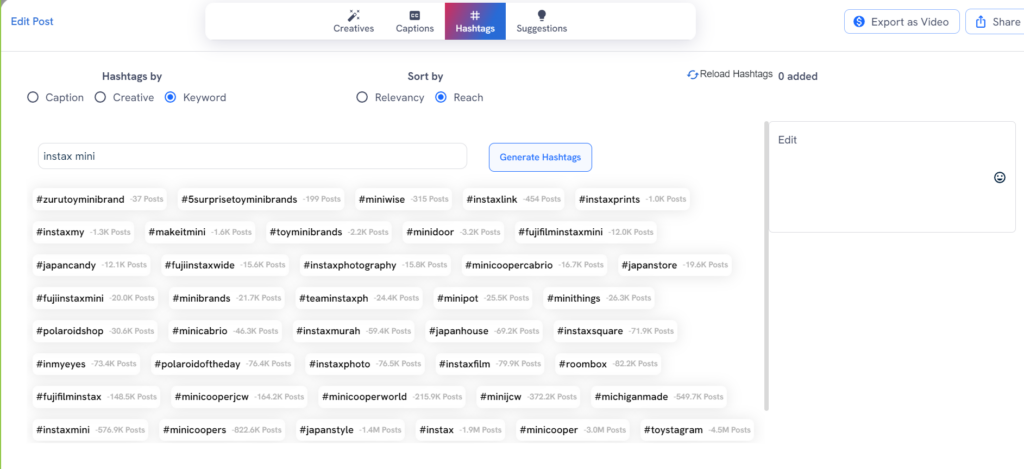
Predis AI’s hashtag generator clusters tags by topic relevance rather than just volume — which means the tags it suggests are related to your content, not just popular in your vague category.
6 — Post Timing Is a Strategy
“Best times to post” charts are averages. They describe when everyone’s audience is online, which means everyone is competing for attention at the same moment.
Find your audience’s specific active window in your platform analytics. Look at “Most Active Times” under your audience data. Your followers’ peak activity is the window where your first 60 minutes of engagement will be highest — and that 60-minute window is what platforms use to decide whether to push your content further.
Consistency at your audience’s peak time compounds. A post that reliably hits during high-activity windows builds momentum that sporadic posting never achieves.
7 — Social Media Optimization For Visual Content
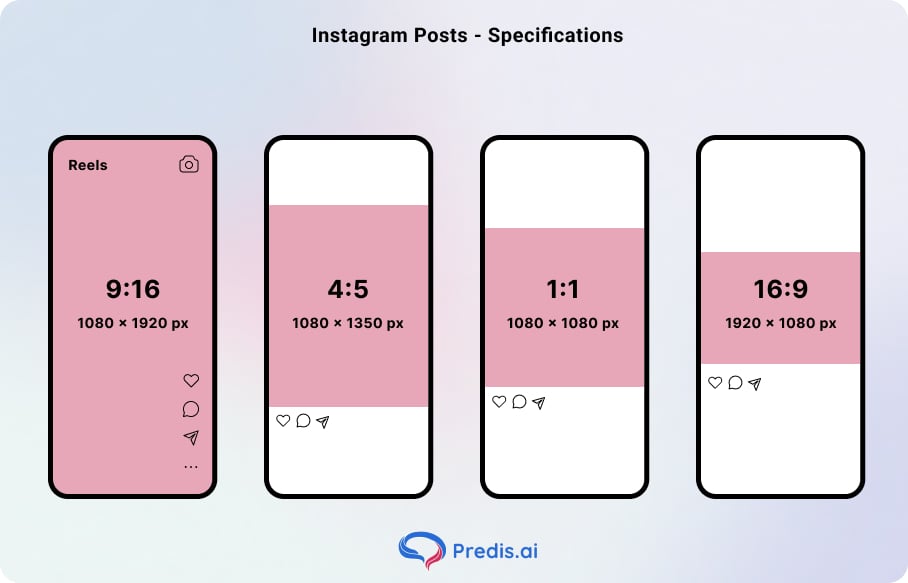
Format specs aren’t suggestions. A 1:1 square on Instagram’s main feed, a 4:5 portrait for maximum feed real estate, a 9:16 for Stories and Reels — each format is a different contract with the platform’s display system.
Post the wrong ratio and the platform crops, compresses, or disadvantages your content automatically.
Beyond specs, visual consistency compounds over time. An account with a recognizable color palette, consistent font usage, and a coherent visual style builds pattern recognition — followers start to recognize posts before they read a word. That recognition drives saves, follows, and shares.
8 — Engagement Is Not a Vanity Metric
Comments, saves, shares, and DMs aren’t just feel-good numbers. They’re the signals platforms use to decide how widely to distribute your content. More engagement in the first 60 minutes after posting = more algorithmic push to non-followers.
Seed engagement intentionally elevates your post engagement:
- Reply to comments within the first hour
- Ask a question in your caption that has a one-word or emoji answer (lower friction = more replies)
- Respond to DMs promptly — DM activity is a strong positive signal on Instagram in particular.
Across platforms, saves outperform likes as an algorithmic signal on Instagram; dwell time and comments outperform reactions on LinkedIn; reposts outperform likes on X.
9 — Use UTM Parameters to Attribute Traffic Properly
If you can’t connect a sale, a signup, or a session to the specific post that drove it, you can’t make intelligent decisions about what to create next. UTM parameters solve that problem.
A UTM tag is a short string appended to any URL you share on social media. It passes source information to your analytics platform — Google Analytics, GA4, or any third-party dashboard — so you can see exactly which platform, campaign, or post drove each visit.
Without UTM tagging, Instagram traffic shows up in analytics as “direct” — a black hole with no actionable information. With it, you know which Reel drove 40 purchases and which bio link update doubled your newsletter signups. That’s the data that shapes your next month’s strategy.
10 — Collaborate With Influencers
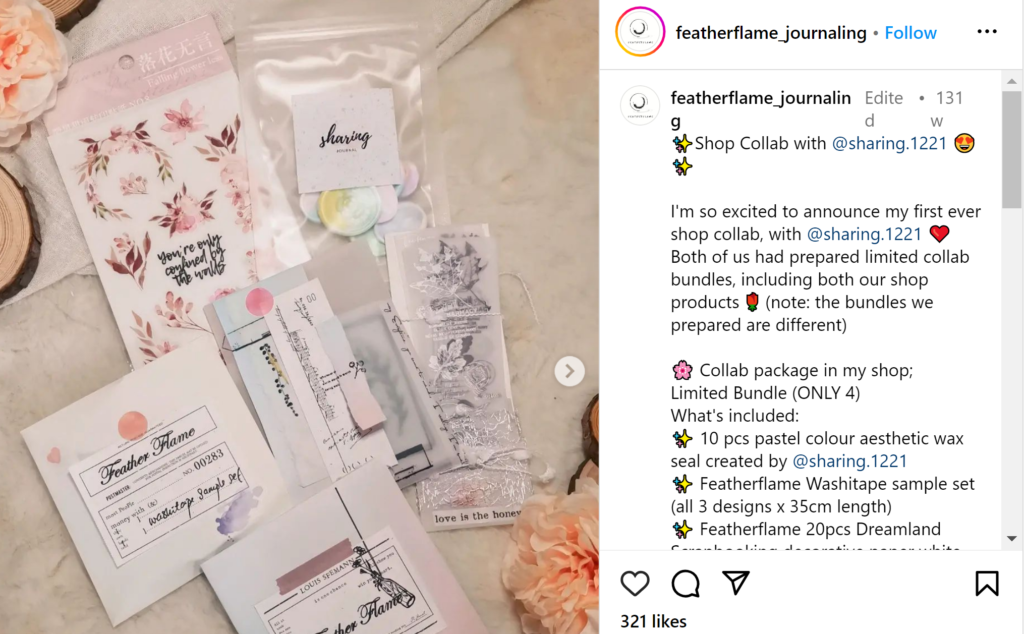
Influencer collaborations compress trust-building dramatically. A creator with a loyal niche audience vouching for your brand delivers social proof that months of your own organic posting can’t replicate — because their audience trusts them, and that trust transfers.
Start with micro-influencers (10K–100K followers) in your specific niche rather than chasing celebrity reach. A skincare brand partnering with a 40K-follower dermatologist-led account will consistently outperform the same budget spent on a generic 500K lifestyle influencer, because the audience match is tighter and the endorsement carries more credibility.
11 — Double Down on Video
When a collaboration performs well — strong reach, comments, saves, or direct sales — the immediate next move is to create more video content in the same territory. Video compounds influencer momentum in a way static posts don’t.
A collab post with a creator drives awareness; a Reel you produce in the same week that references the same topic, product, or theme catches the wave of increased profile traffic and converts it. Audiences who discover you through a collaboration are primed to engage with your next piece of content — and video gives them the highest-engagement format to land on.
The pattern that works:
- Identify a collab that drove real results
- Understand why (what topic, what format, what audience)
- Build a video content mini-series around the same theme
- Let the collab’s audience fuel the video’s early engagement signals.
12 — Track the Right Metrics and Kill What Doesn’t Work
Five metrics actually predict growth (not just impressions):
- Reach Rate (reach ÷ followers)
- Save Rate (saves ÷ reach)
- Share Rate (shares ÷ reach)
- Link CTR (link clicks ÷ reach)
- Follower Conversion Rate (new followers from a specific post ÷ reach).
Monthly audit framework: look at your top five posts by save rate and your bottom five by reach rate. The top five tell you what format, topic, and hook to repeat. The bottom five tell you what to stop producing. Keep what’s working, kill what isn’t, test one new format per month. Don’t optimize what you haven’t killed yet.
13 — Use AI to Optimize Faster Without Losing Brand Voice
AI handles the volume problem — ideation, first drafts, hashtag research, scheduling, caption variants. What it can’t handle: strategic decisions, relationship-building in comments, and the tonal judgment that makes a brand feel human rather than automated.
The dividing line: AI is your production assistant, not your editor-in-chief. Use it to draft, approve, and refine before publishing. A tool like Predis AI reduces the time from content idea to scheduled post significantly — caption generation, visual creation, and hashtag clustering in one workflow — but the strategic layer (which pillar, which audience, which business goal) stays human.
The SMO Audit: Score Your Current Presence in 30 Minutes
Most optimization guides tell you what to do without helping you figure out where you actually are. This self-audit does both.
Score yourself 0–10 across five dimensions:
| Dimension | What to assess | Red flags |
|---|---|---|
| Profile | Keyword-rich bio, clear CTA, on-brand visuals | Vague bio, missing link, low-res photo |
| Content | Tracking the right metrics, a monthly review habit | Random topics, only promotional posts |
| Cadence | Posting frequency, time consistency | Gaps of 2+ weeks, random timing |
| Engagement | Reply rate, comment quality, save/share ratio | No replies, low saves, zero DMs |
| Analytics | Tracking the right metrics, monthly review habit | Checking only likes and follower count |
Quick-fix gaps (can be resolved in a day):
- bio rewrite
- Link-in-bio setup
- Adding a CTA to recent captions
- Adjusting posting times.
Strategic-fix gaps (require 4–8 weeks):
- Building content pillars
- Developing a visual system
- Creating a repurposing workflow
- Establishing a monthly analytics review.
Score yourself, identify your two lowest dimensions, and fix those before touching anything else. A 10/10 on content doesn’t offset a 2/10 on frequency— the algorithm needs both to work.
The Bottom Line
Social media optimization isn’t a one-time project — it’s an operating system. Profile, content, and distribution each have levers, and they compound when they work together.
Run the audit.
Find your lowest-scoring dimension.
Fix it this month.
Then run it again.
The accounts that grow aren’t posting more than you. They’re posting smarter — and reviewing the data to know the difference.
FAQs
Marketing is the message — the campaigns, ads, and content you create.
Optimization is the system — how your profile, posting schedule, content formats, and engagement behavior are tuned to maximize how many people see that message and act on it. You can market without optimizing; you just get worse results for the same effort.
Indirectly. Social signals aren’t a direct Google ranking factor, but high-performing social content drives backlinks (people link to viral posts or resources), increases branded search volume, and builds domain authority signals over time. The relationship is real but not immediate.
Use your primary keyword in your display name (where the platform allows), in the first line of your bio, and in your bio keywords field (Instagram and TikTok both have one). Include location terms for local businesses. Update your bio whenever you launch a new offer so the language stays current and indexed.