

Explore this content with AI:
In the third quarter of 2026, nearly 10 million advertisers used at least one of Meta’s generative AI creative tools. Generative ad tools stopped being a niche experiment a while ago.
So why does your ad account still run on the same eight ads you made three weeks ago?
For most small teams, the answer isn’t talent. It’s throughput. One person can hand-build maybe 10 decent ads in a week if nothing else breaks, and something always breaks. Meanwhile the platforms keep asking for more ads, more often, and more different from each other.
Ad creative automation closes that gap, but only if you know what you’re building toward. “Make more ads” isn’t a plan. A hundred ads a week, structured the right way, is.
What ad creative automation actually does
Ad creative automation is software taking over the repeatable parts of making ads. You give it a brief, a product link, or a template, and it hands back variants: fresh headlines and visuals, plus every size and copy angle you asked for, ready for review.
The software doesn’t decide what to say. It doesn’t know your customers flinch at the word “cheap,” or that your best seller only sells in blue. And it can’t tell you which ad earned its budget last week (the numbers can, if someone reads them).
People often lump creative automation in with dynamic creative optimization, so it helps to separate them. DCO works at serve time: you upload pieces, and the platform shuffles them into combinations for each viewer. Automation works upstream. It makes the pieces. Plenty of teams use both, with automation feeding better raw material into Meta’s or Google’s built-in mixing.
A useful way to think about it: ad automation on the platform side (bidding, targeting, placement) is now mostly handled for you. The production side isn’t, and that’s where your hours go.
Why 100 ads a week, and why 100 copies won’t count
Creative isn’t a side variable. NCSolutions and Nielsen’s analysis of nearly 450 sales studies credits creative with about half of the incremental sales advertising drives. When Advertiser Perceptions asked marketers and agencies to guess, they put creative at about a fifth and ranked targeting first, even though targeting measured at only 11%.
Then there’s creative fatigue. TikTok’s own help center suggests updating creative at least every 7 days. Meta doesn’t publish a fixed number, but anyone who has watched an ad’s cost per result creep up over two weeks knows the pattern.
So you need a steady stream of new ads. Fine. This is the point where most volume plans fall apart.
Meta’s Andromeda retrieval system changed what “new” means. Meta’s guidance is creative diversification: ads that differ in message, theme, and visual, as opposed to near-duplicates with a swapped button color. Triple Whale put it bluntly, noting that 30 small variations on one idea look like a single ad to the system.
Read that again. You could make 100 ads this week and still hand Meta five ideas to work with. Or one.
So 100 ads is a structure question before it’s a production question.
The variant math behind 100 ads
Every ad creative automation plan at this volume runs on one formula:
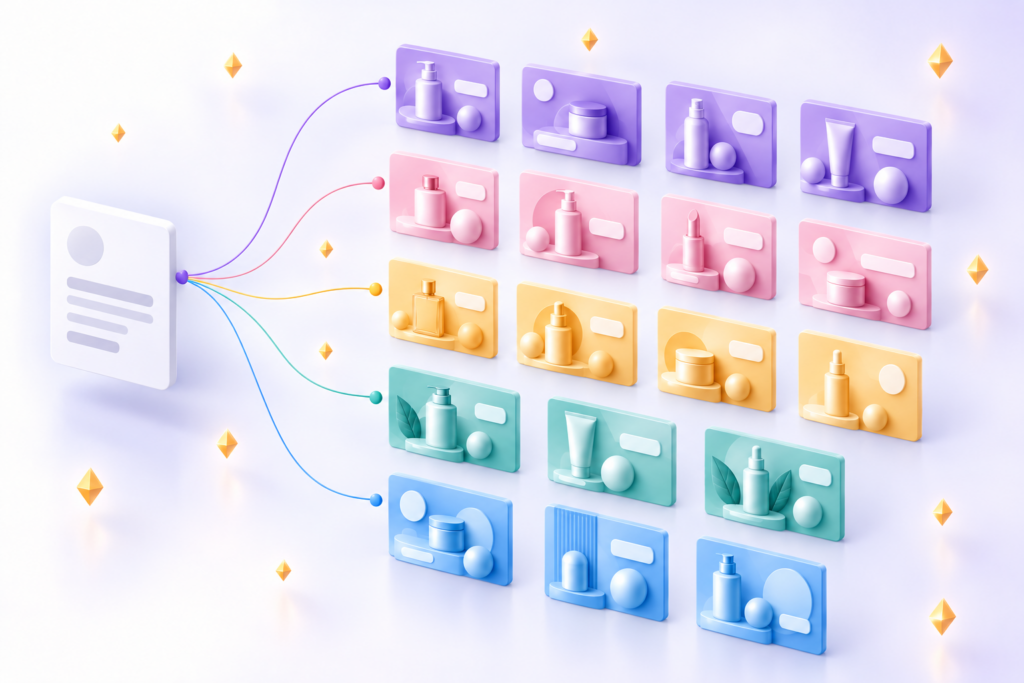
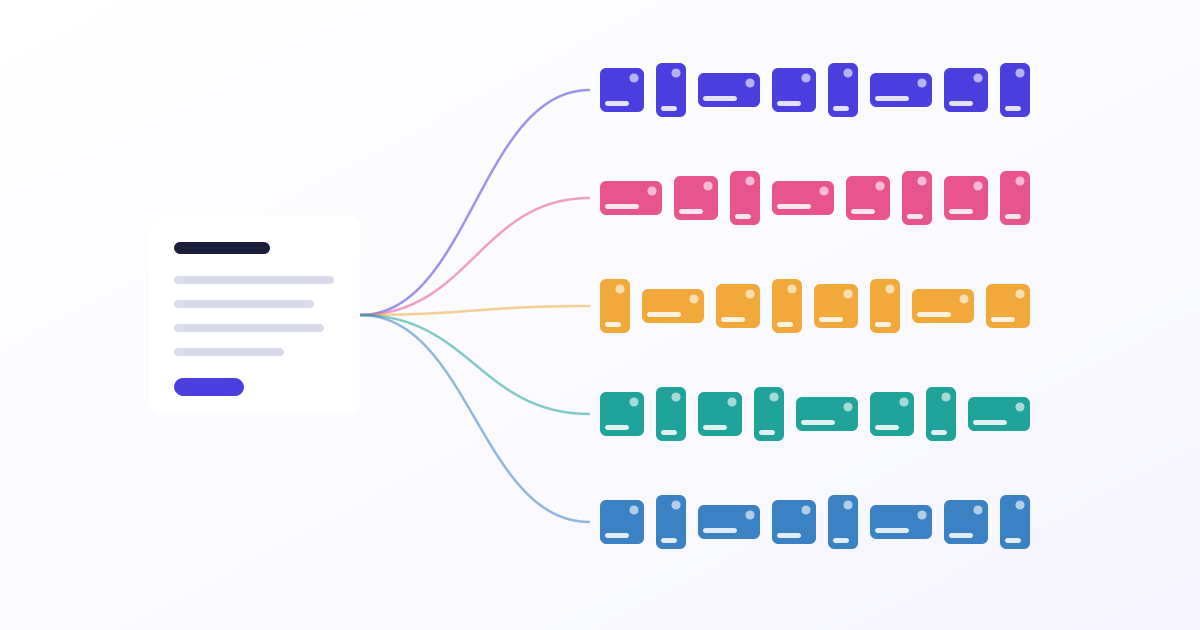
Concepts × hooks × formats = ads per week
Each layer has a different job.
- Concepts are the big idea: problem-and-fix, social proof, product demo, offer, founder story, comparison. Two concepts should feel like different ads to a stranger scrolling past.
- Hooks are the first line of copy or the first 2 seconds of video. Same concept, different way in (copy and visuals pull different levers, so test both).
- Formats are the container, like a 1:1 static, a 4:5 feed post, a 9:16 Reel or story, a carousel, or a short video.
Five concepts, four hooks each, five formats per hook: 5 × 4 × 5 = 100 ads.
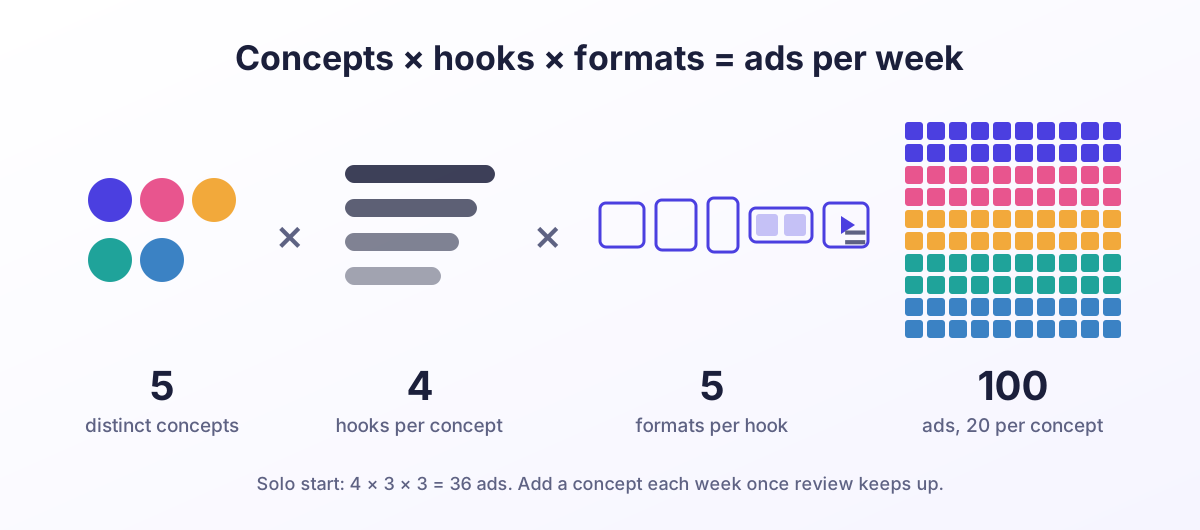
Notice where the diversity lives. The concept layer gives Andromeda distinct ideas to sort. The hook layer is where you learn what gets people to stop. Formats mostly make sure each idea fits every placement, which happens to be the repetitive part that ad creative automation handles well. For the testing side in more depth, this guide to ad variations for A/B testing walks through it.
Running a team of one? Don’t start at 100. Start at 4 concepts × 3 hooks × 3 formats, which gets you 36 ads, and add a concept each week once your review step holds up. Plug in your own numbers below.
How many ads does your plan make each week?
Set your concepts, hooks, and formats. The grid shows every ad, one color per concept, so you can see where your volume actually goes.
5×4×5=100
ads per week, across 5 distinct ideas
The 16-creative figure comes from TikTok’s Ads Help Center and applies when automated creative optimization is off. Review time is an estimate you set. Guidance on concept spread reflects Meta’s creative diversification advice; how you split your volume is your call. Made by Predis.ai.
A 5-day ad creative production workflow
The number is the easy part. What keeps it going in week six, after the novelty wears off, is a rhythm, so below is an ad creative production workflow a small team can actually run.
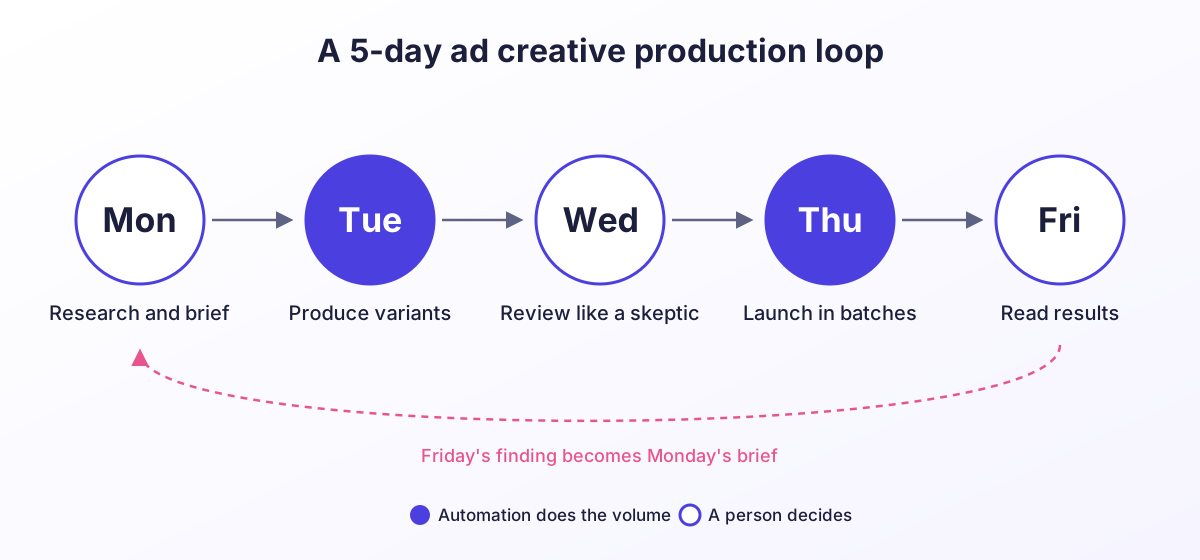
Monday: research and brief
Start with two inputs: what competitors are running, and what your own ads did last week. The Meta Ad Library and TikTok Creative Center cover the first one for free. If you want it organized, Predis.ai’s competitor analysis shows the best and worst performing posts for brands you track, which makes a good shortlist of angles.
Pick your five concepts. For each one, write a single sentence: “We think [audience] will respond to [angle] because [reason].” That sentence is your brief, and it’s what you’ll check against on Friday.
Twenty minutes of thinking here saves two hours of regenerating on Tuesday.
Tuesday: produce the variants
This is the day ad creative automation earns its place. Set up your brand kit first (logo, colors, fonts, voice) so nothing comes back looking like a stranger’s ad. Then feed each concept in.
With the Predis.ai AI ad generator, the input can be a product link, a prompt, or a reference ad you like. Predis.ai rebuilds that structure around your product, applies your brand kit, and sizes it for each platform.
Other tools work too. What matters is that you make fresh ads for each concept instead of patching old ones. In a field study by NYU and Emory researchers, fully AI-generated ads beat the human-made control on click-through by 19%, while AI edits of existing ads didn’t help.
Leave room for video. Meta reported that advertisers using its video generation tool saw conversion rates more than 3% higher in tests. Launching something new? The same steps apply when you auto-generate ads for a product drop.
Wednesday: review like a skeptic
Automation makes volume cheap. It also makes mistakes cheap to multiply.
So one person reviews every batch. Is every claim true, and does it look and sound like us? Then the harder question: would a stranger clock it as AI? That one matters more than it used to. In DISQO’s late-2025 survey of 3,000 US consumers, 45% said they notice AI when voices or visuals sound computer-generated.
When something’s off, fix the part that’s off. Predis.ai lets you change one frame or element without regenerating the whole ad, so the parts that already work stay put. If a lot of a batch fails, the problem is usually upstream in Monday’s brief, not in review.
CTA 2: place at the end of “Wednesday: review like a skeptic”
Thursday: launch in batches
Group ads by concept so you can read results by idea, not just by file. On TikTok, the same help page caps an ad group at 16 creatives when you’re not using automated creative optimization, so a concept with 20 variants splits across two ad groups, and a full 100-ad week fits into about 10.
TikTok’s Smart Creative will also pause videos that show fatigue within the first 3 to 5 days and rotate in queued replacements. One more reason to keep a queue ready.
Organic can ride along: Predis.ai’s autoposting publishes variants to your social accounts on a schedule.
Then leave the ads alone. Judging an ad after 48 hours is mostly reading noise.
Friday: read results and pick next week’s concepts
Friday is the step most teams skip, and it’s the only one that makes next week smarter than this one.
Look at results by concept first, then by hook. Common creative refresh signals include frequency climbing past 2.5 on cold audiences, or CTR falling 20 to 30% from the ad’s own baseline over a few days. Meta also shows a “Creative fatigue” status when an ad’s cost per result reaches double what your past ads cost.
Whatever comes out ahead is your winner, for now. It’s a finding, not a prediction. Write down why you think it worked, keep it running, and build two new concepts around that reason on Monday. Retire the concept that lost.
Then Monday starts again, a little smarter.
Creative automation tools mapped to each stage
You don’t need one tool that does everything. You need each stage covered. The creative automation tools on the market sort neatly by job:
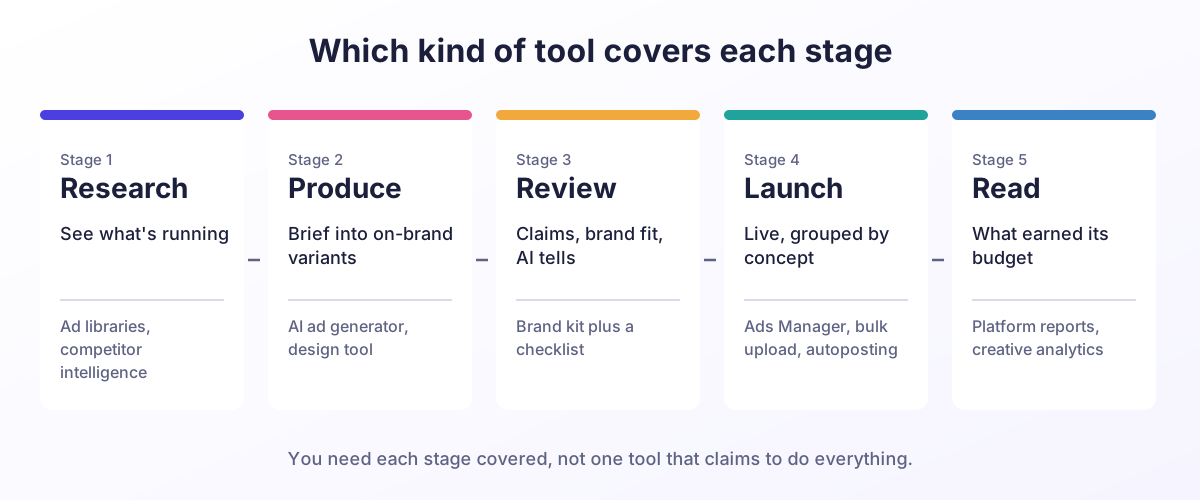
| Stage | The job | Tool type | Examples |
|---|---|---|---|
| Research | See what’s running and what worked | Ad libraries, competitor intelligence | Meta Ad Library, TikTok Creative Center, Predis.ai competitor analysis |
| Produce | Turn a brief into on-brand variants | AI ad generator, design tool | Predis.ai, Canva Magic Studio, Meta and TikTok built-in generators |
| Review | Check claims, brand fit, AI tells | Brand kit plus a checklist | A shared doc works fine |
| Launch | Get ads live, grouped by concept | Ads Manager, bulk upload, autoposting | Meta Ads Manager, TikTok Ads Manager, Predis.ai autoposting |
| Read | Find what earned its budget | Platform reports, creative analytics | Ads Manager breakdowns, Motion, Madgicx |
A few notes. Platform-native tools cost nothing extra and keep improving, but they only work inside their own platform. If you run ads on more than one, a separate creative automation platform keeps your brand kit in one place. Enterprise teams with big catalogs or many markets usually look at Smartly or Celtra, which are built for feed-based templating at that scale. For a longer list with feature notes, see this roundup of AI tools for ad creatives.
One workflow tip for teams that already live in Claude or ChatGPT. The Predis.ai MCP server lets you paste a product page or a reference ad into the chat, and static ads, carousels, and video come back in your brand kit. It’s AI creative automation without the tab-switching.
Mistakes that stall an ad creative automation pipeline
Spamming micro-variants. Twenty ads that differ by one word count as one idea to Meta. Spend your volume on concepts and hooks.
Skipping review because the tool is “good now.” It is better. It still invents claims and gets small product details wrong.
Ignoring how AI labels land. The same NYU and Emory study found that tagging ads as AI-generated cut click-through by about 31.5%. Platform and legal disclosure rules still apply, so the takeaway is to make ads worth watching, not to skip the label.
Volume without learning. If nobody does Friday, you’re paying to make ads, not to find anything out.
Changing everything at once. Swap audiences in the same week new creative goes live, and you can’t tell which change did what. That’s the first rule of ad creative testing.
Start at 36, earn your way to 100
A hundred ads a week sounds like a production target. It’s really a byproduct of a rhythm: decide on Monday, make on Tuesday, check on Wednesday, ship on Thursday, learn on Friday. Get that loop working at 36 ads, and the jump to 100 is mostly adding concepts.
Ad creative automation handles the making. You handle the deciding, and that split is the whole point.
If you want to run the Tuesday step on your own products this week, Predis.ai is rated 4.7 out of 5 on G2 and has a 3-day trial (card required).
FAQs
There’s no official number. Platform guidance points toward frequent refreshes, and TikTok specifically suggests new creative at least weekly. A practical ad creative automation starting point for a one-person team is 3 to 5 distinct concepts with a few hooks and formats each, roughly 30 to 40 ads. Add concepts as your review and reporting keep up.
For weekly testing volume, often not, because ad creative automation plus a solid brand kit covers most of it. A designer still earns their fee on brand-defining work. Think of the visual identity your brand kit is built from, or a launch where one hero asset carries the whole message.
Both Meta and TikTok build generative creative tools into their own ad managers, which tells you where they stand on AI-made ads in general. The real risks sit elsewhere: misleading claims, policy violations, and ads that look obviously synthetic and get scrolled past. Check each platform’s current disclosure rules for realistic AI people and scenes.
It ranges from no extra cost (the generative tools inside Meta and TikTok) to enterprise contracts for catalog-scale platforms. Most small-team tools charge a monthly plan with credits per image or video. Predis.ai offers Core and Rise plans [VERIFY: current pricing and credit costs]. Compare tools on cost per finished ad, not sticker price.
You may also like: