

Explore this content with AI:
About 6 in 10 video ad buyers now use generative AI to build or improve their ads, and AI-assisted ads make up 33% of all digital video ads, up from 24% a year earlier. So you’re not early. You’re shopping.
Arcads is usually the first stop for AI UGC ads, and its AI actors are genuinely good. The friction shows up later, and it’s usually about money. You can’t see the price until you sign up, and once you’re in, credits reset monthly and a re-take costs as much as the first try.
Full disclosure: this is the Predis.ai blog, and Predis.ai is on this list. We’ll show you how to judge us with the same yardstick as everyone else.
That yardstick isn’t the sticker price. It’s what one usable ad costs you.
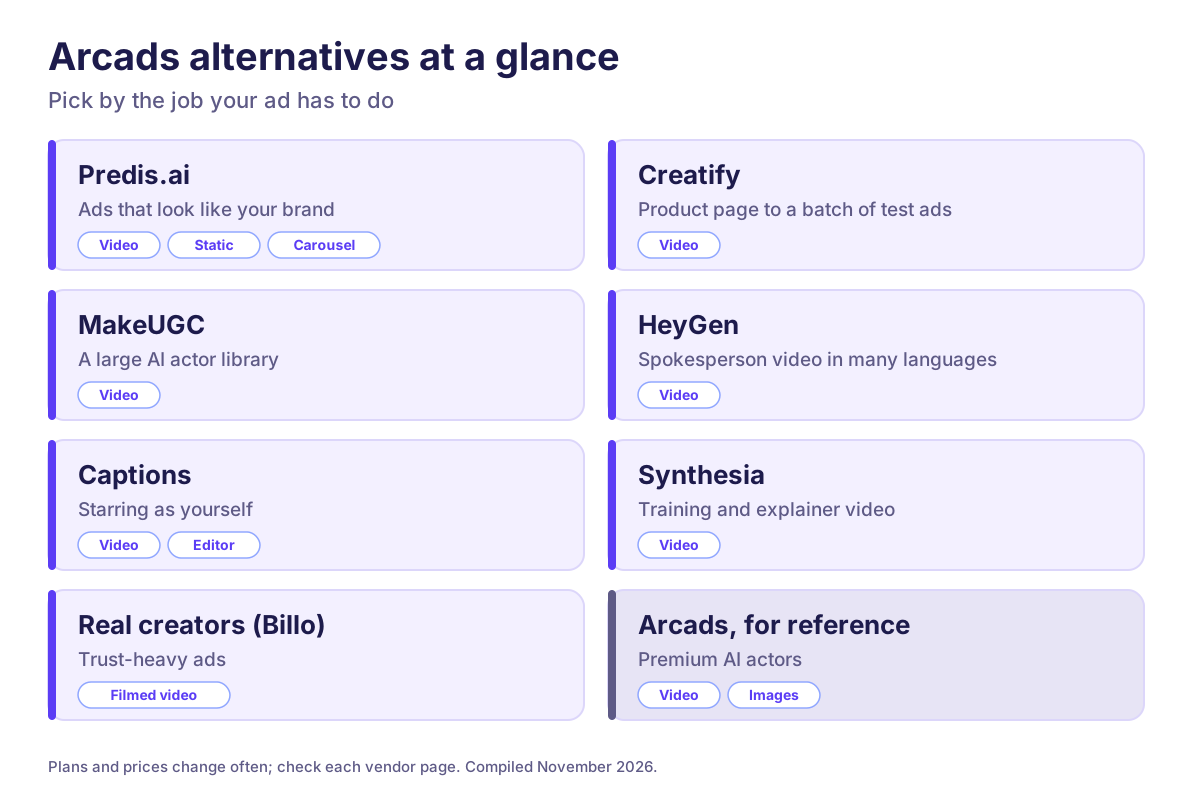
Arcads alternatives at a glance
Pick by the job your ad has to do, not by the logo. The short version is below, with prices as each vendor listed them in November 2026.
| Tool | Best for | Formats | Free way in | Starts at |
|---|---|---|---|---|
| Predis.ai | Ads that look like your brand, across formats | Video, static, carousel | 3-day trial, card required | $32/mo monthly ($19 billed yearly) |
| Creatify | Product page to a batch of test ads | Video | Free plan (watermarked) | ~$15/mo monthly |
| MakeUGC | A large AI actor library | Video | $1 trial, renews at plan price | $59/mo monthly ($29 billed yearly) |
| HeyGen | Spokesperson video in many languages | Video | Free plan, 3 videos/mo | $29/mo ($24 annual) |
| Captions | Starring as yourself | Video + editor | Free tier | $24.99/mo (iOS price) |
| Synthesia | Training and explainer video | Video | Free Basic plan | $29/mo ($19 for US visitors) |
| Real creators (Billo) | Trust-heavy ads | Filmed video | None | ~$150 to $300 per video |
| Arcads (for reference) | Premium AI actors | Video, images | 72-hour trial, card required | ~$110/mo, reported in-app |
One thing before you read down the price column: those numbers sit on different billing bases (monthly, annual, iOS). Compare like with like.
What Arcads does well, and why people still look elsewhere
Let’s be fair first. Arcads earned its spot as the benchmark, because its actors look natural and the lip-sync holds up. You can also batch one script across many actors to test hooks fast, which is the whole point of AI UGC ads. For a team that already knows the format works for its product, that’s worth budget.
So why are you reading a list of Arcads alternatives?
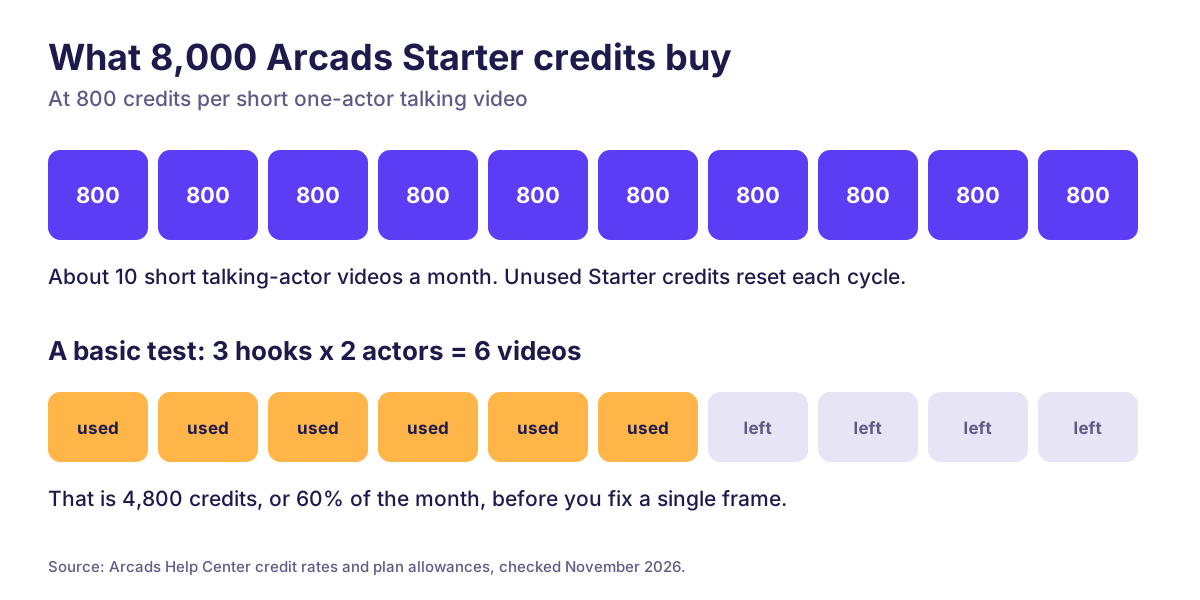
Most of the time, it’s the pricing. Arcads has no public pricing page, and dollar figures only appear inside the app. Its help center does publish the credit math, though: Starter carries 8,000 credits a month and Creator 16,000. A short talking-actor video with one actor uses 800 credits (the same 800 whether the clip runs 15 seconds or 45). That means Starter covers roughly 10 videos a month.
What does that cost? Reviewers who checked inside the app report Starter at about $110 a month, sometimes discounted. Arcads also notes it tests pricing, so your screen may differ.
Arcads pricing in plain numbers
Here’s what each plan’s credits buy, using the 800-credit rate for a short one-actor video:
| Arcads plan | Credits a month | Short talking-actor videos | Unused credits |
|---|---|---|---|
| Starter | 8,000 | About 10 | Reset each cycle |
| Creator | 16,000 | About 20 | Reset each cycle |
| Pro | 48,000 | About 60 | Roll over |
That reset matters more than it looks. Starter and Creator credits don’t carry over, so a slow month is money you don’t get back. Pro and the larger plans roll unused credits forward.
Then there’s the Arcads free trial, which is really a 72-hour paid-plan preview. It needs a card and rolls into Starter unless you cancel. (In fairness, Predis.ai’s trial works the same way: 3 days, card required.)
None of this makes Arcads a bad tool. It makes Arcads a tool you should price per usable ad before you commit, which is exactly what most people searching for Arcads alternatives are trying to do.
How we judged them: the cost of a usable ad
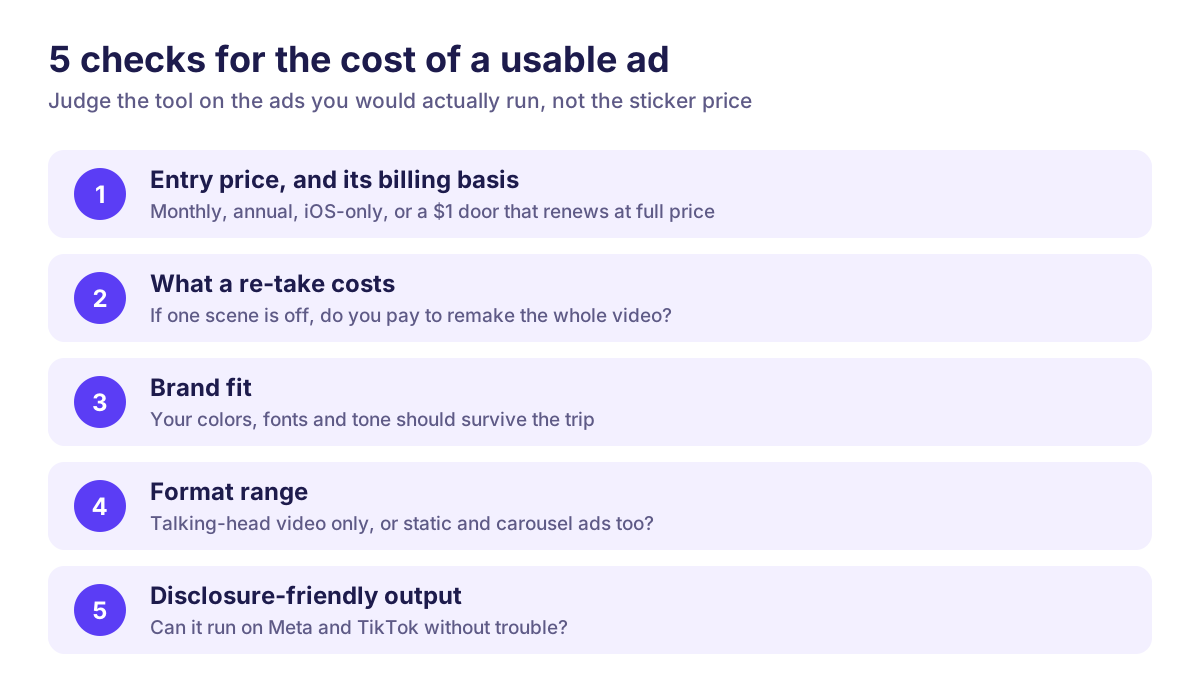
A low monthly price means little if half your videos need a redo. So instead of ranking Arcads alternatives by sticker price, we checked five things for each tool:
- Entry price, and the basis behind it. Monthly, annual, iOS-only, or a $1 door that renews at full price? A $29 annual rate and a $29 monthly rate are not the same offer.
- What a re-take costs. If one line or one scene is off, do you regenerate the whole video? This is where most credit budgets quietly go.
- Brand fit. Does the output look like your brand, or like every other AI ad in the feed? Your colors and fonts should survive the trip, and so should your tone of voice.
- Format range. Talking-head video only, or static and carousel ads too? Static image ads still run on Facebook and Instagram, and they cost far less to make.
- Disclosure-friendly output. Can you run it on Meta and TikTok without trouble? Any tool can make an ad that breaks platform rules if you script it that way.
Brand fit gets more weight than you’d think. In a 2026 survey, 54% of consumers said they trust a brand less when they can tell its ads were made by AI. An AI UGC video ad that looks generic costs you twice: once in credits, and again in trust.
7 Arcads alternatives worth testing
These Arcads alternatives are grouped by the job they do, not ranked. Predis.ai comes first because it’s ours, and you should read its entry with the same skepticism as the rest.
1. Predis.ai: brand-consistent ads in more than one format
Predis.ai is an AI ad generator that helps businesses make ads that look like their brand, shaped by what works in their category. Paste a product link and pick an AI creator. From there, the AI UGC ad maker writes the script and adds voiceover and captions. You can edit anything before you export.
The difference from a pure actor tool is range. The same brief can become a UGC-style video, a static ad, or a carousel, so you can test an angle cheaply before you spend video credits on it. If one frame is off, fix-one-frame editing lets you change that scene instead of starting over. Competitor intelligence and reference-ad input help shape the ad around what works in your category.
Predis.ai is rated 4.7/5 on G2. Plans are Core, Rise, and Enterprise+, with a 3-day trial that needs a card.
Watch-out: if all you want is the biggest library of stock actors for talking-head video, a specialist like MakeUGC may suit you better.
2. Creatify: product pages to batches of test ads
Creatify’s strength is speed from a product page. You paste a URL and it builds avatar-led video ads, with batch mode for running many variations at once.
It has a free plan with 10 credits a month and watermarked exports, and paid plans start around $15 a month on monthly billing (less on annual).
Arcads vs Creatify comes down to priorities: Arcads leans on actor realism, while Creatify leans on volume from a catalog.
Watch-out: the watermarked free tier is for judging output, not for running ads.
3. MakeUGC: for the closest like-for-like actor library
If you liked the Arcads workflow and just want another option, MakeUGC is the nearest match. It advertises 1,000+ AI actors, and its pricing page lists product-in-hand scenes on its self-serve plans.
The entry door is a $1 trial. Read the next line, though: it renews at the plan price, which is $59 a month on monthly billing or $29 a month billed yearly.
Arcads vs MakeUGC is a close call on format. The real decision is which actors feel right for your audience, so test both with the same script.
4. HeyGen: for polished spokesperson video in many languages
HeyGen is built around avatars and translation. Its lip-synced translation reaches 175+ languages on the higher tiers, which matters if you sell in several markets.
There’s a free plan with 3 videos a month, and Creator costs $29 a month ($24 on annual billing).
Arcads vs HeyGen is mostly a style choice. HeyGen’s output reads like a presenter, while Arcads reads more like someone filming on their phone. Pick the look your audience trusts.
5. Captions: star as yourself, not a stock actor
Captions builds a digital twin of your own face and voice, then pairs it with a built-in AI editor for captions, cuts and B-roll. It fits founders and creators who want a recognizable face on every ad.
There’s a free tier, and Max costs $24.99 a month. Note the fine print: Captions labels that price as iOS-only, so check the web price before you budget.
6. Synthesia: for training and explainer video, not feed ads
Synthesia shows up in almost every comparison, so it gets an honest entry here. It makes clean, studio-style avatar videos in 140+ languages, and it’s built for onboarding, training and internal video.
It has a free Basic plan, and Starter runs $29 a month on its standard rate card ($19 for US visitors). For native-looking UGC on TikTok or Reels, it’s the wrong category.
7. Real creators via Billo: when trust is the ad
Sometimes the ad needs a real person with real hands on your product. A human UGC creator typically charges $150 to $300 for one short video.
That isn’t a reason to skip AI; it’s a reason to use both. Let AI find the hook that earns attention, then pay a human to film the version you scale.
What a re-take really costs, and how to spend less
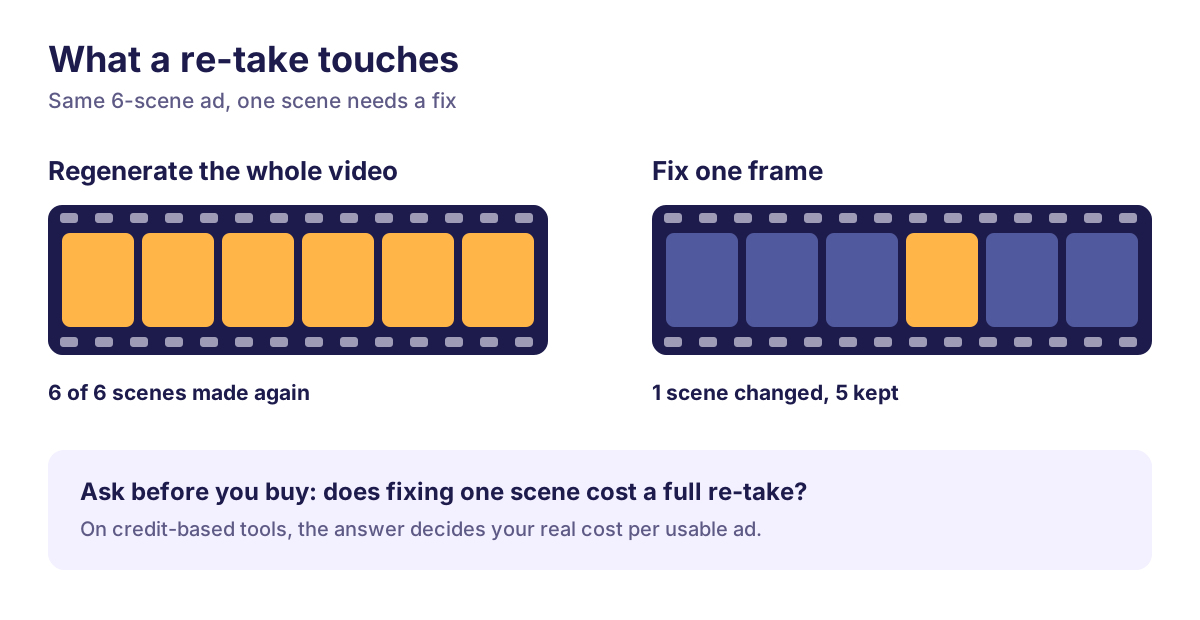
Here’s the part most comparisons skip. AI video rarely lands perfectly on the first try. Maybe a hand looks odd, or the product label blurs at the one moment it needs to be readable. What happens next decides your real cost.
On Arcads, credits come back only when a generation fails for technical reasons. A successful re-generation is charged in full.
Now run a basic test. Three hooks, two actors each, is 6 videos. At 800 credits each, that’s 4,800 credits, or 60% of a Starter month. And you haven’t fixed a single frame yet.
Now look at the price per ad. Say you pay the reported $110 for 10 videos, so about $11 each. If one in three needs a second take, those 10 generations give you roughly 7 or 8 ads you’d actually run.
Your real cost lands around $14.65 per usable ad, about a third higher than the sticker math. That’s an illustration, not a quote, but the pattern holds on any credit-based tool.
Three habits keep this in check:
- Test the hook as a static ad first. If a headline can’t earn a click as an image, it won’t save a video.
- Only batch the angles that earned attention. Make video variants of your top 1 or 2, not all 6.
- Pick a tool that edits instead of regenerating. Changing one scene should cost less than remaking the whole ad.
That last point is why we built fix-one-frame editing into Predis.ai’s AI ad generator, and why the same brief can become static and video ads. Your call whether that matters for your workflow. Run your own numbers in the calculator below.
What does one usable ad really cost?
Enter your plan, then plan a test. The receipt counts re-takes, so you see the price of ads you’d actually run.
Your test, itemized
Cost per usable ad
$14.63
33% above the sticker price
This test needs more credits than the plan includes in a month.
Defaults use Arcads Starter figures cited above (8,000 credits a month, 800 per short video, about $110 reported in-app). Swap in any tool’s numbers. Estimates only; each usable ad assumes at most one re-take.
The disclosure checklist for AI actor ads
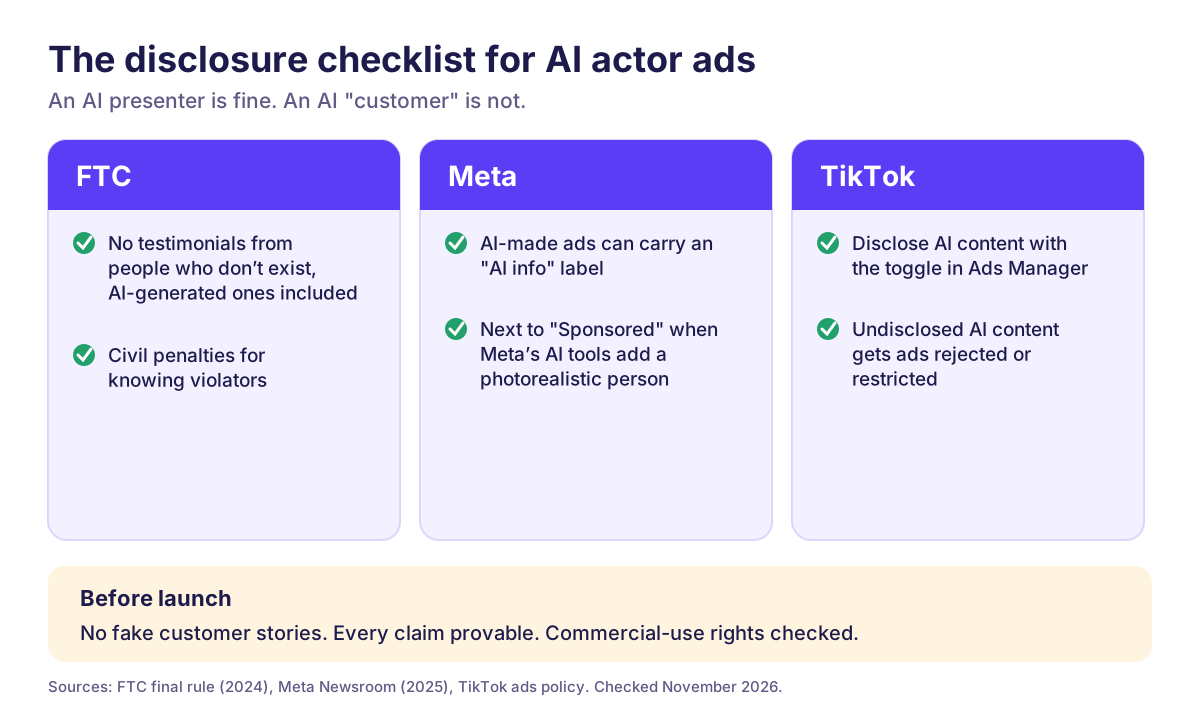
An AI actor presenting your product is fine. An AI actor pretending to be a real, happy customer is a problem.
The FTC's final rule bans reviews and testimonials attributed to people who don't exist, including AI-generated ones. It lets the agency seek civil penalties, which ran up to $51,744 per violation when the rule took effect in October 2024.
The platforms have their own rules too:
- Meta: Ads made or heavily edited with Meta's own AI tools get an "AI info" label, and when they include an AI-generated photorealistic person, the label sits next to "Sponsored". For ads made with outside tools like the ones on this list, Meta says it detects them through industry-standard signals and adds the label inside "About this ad".
- TikTok: If TikTok finds AI-generated content you didn't disclose, your ad is rejected or restricted.
Before any AI actor ad goes live, check these:
- No fake customer stories, ratings or "I've used this for 3 months" scripts.
- Switch on TikTok Ads Manager's AI-generated content toggle, and check Meta's current disclosure options for your ad type.
- Every claim in the script is true and provable.
- The tool's terms allow commercial use of the actor.
Is disclosure bad for performance? Consumers are warier than marketers think: IAB found that 82% of ad executives believe young consumers feel positive about AI ads, while only 45% actually do. That sounds like a reason to hide the AI. But IAB's research lead, Jack Koch, said the same work shows disclosure can play a decisive role in building trust, and on TikTok an undisclosed AI ad gets rejected anyway. Hiding it isn't the move.
Which Arcads alternative should you pick?
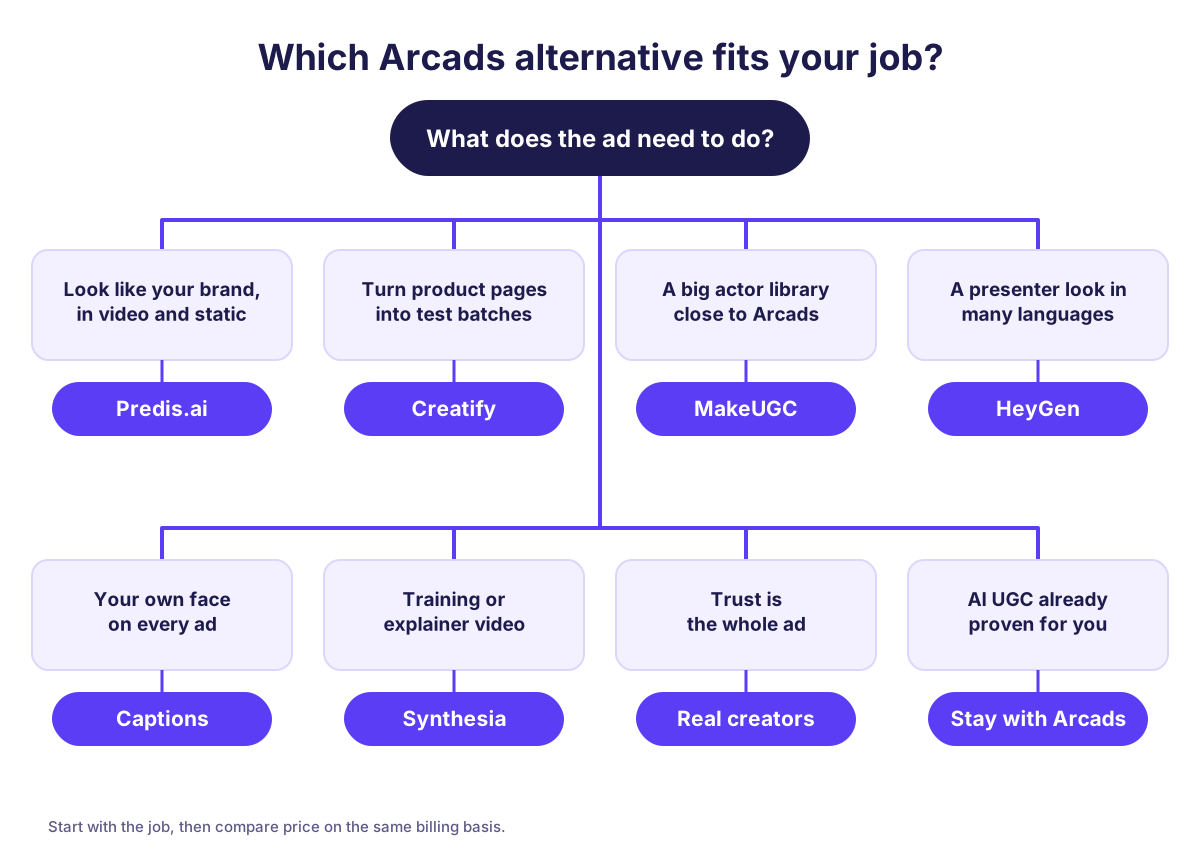
The best AI UGC video generator is the one that makes the ad you actually need. Match the job first:
- You want ads that look like your brand, in video and static: Predis.ai
- You have a catalog and want a batch of test ads from product pages: Creatify
- You want a big actor library close to Arcads: MakeUGC
- You sell in several languages and want a presenter look: HeyGen
- You want your own face on every ad: Captions
- You're making training or explainer video: Synthesia
- Trust is the whole ad: real creators through a marketplace
- You've already validated AI UGC and want premium actors: staying with Arcads is a fair call
Not sure? The picker below asks three questions and points you to a starting tool. And if Facebook is your main channel, our roundup of tools for UGC Facebook ads goes deeper on that one platform.
Which Arcads alternative fits your ad?
Three questions. You get one starting tool, plus a second to compare.
Answer all three to see your starting tool.
After the first test, scale the ones that sell
Picking a tool is step one. The money is in what you do after the first batch runs.
Give each test a fixed window and a fixed budget. Keep the offer and the call to action the same, so you're testing the creative and nothing else. A simple 2-week plan works for most small stores:
- Week 1: Run 3 hooks as static ads with a small, equal budget each.
- Week 2: Turn the top 1 or 2 hooks into UGC-style ads with AI avatars, using 2 actors per hook.
- After day 14: Keep the variant with the lowest cost per sale, pause the rest, and write the next round of hooks.
When the window closes, your winner is the ad that earned attention and sales, not the one you liked best in the editor. New to scripting the format? This walkthrough on making UGC ads with AI covers hooks and scripts step by step.
Then make more of that one. Insights in an AI UGC platform like Predis.ai help you see which variant earned its budget, and competitor intelligence shows what's working for others in your category before you write the next hook.
Picking your Arcads alternative
Arcads set the bar for AI actors, and it's still a fair choice once you know AI UGC works for your product. The right Arcads alternative is the one whose cost per usable ad fits your budget, with re-takes counted in.
The next shift is already visible. Many of these tools now rent the same handful of video models, such as Veo, Kling and Seedance, so actor count will matter less each year. Brand fit and the cost of a fix will matter more, along with how many formats one brief can cover.
If that's the direction you're betting on, Predis.ai is built for it. Start with one product link and see what comes back.
Arcads alternatives: FAQs
Yes, a few Arcads alternatives have free plans. HeyGen has one with 3 videos a month, and Creatify has one with watermarked exports. Synthesia and Captions offer free tiers too. Treat any free AI UGC video generator as a way to judge output quality. Watermarks and caps usually mean you'll need a paid plan to run real ads.
Arcads pricing isn't on a public page; you see it inside the app after sign-up. Its help center lists Starter at 8,000 credits a month and Creator at 16,000, with a short talking-actor video using 800 credits. Reviewers who checked in-app report Starter at about $110 a month, so roughly $11 per video before any re-takes.
The Arcads free trial lasts 72 hours, and there's no free plan. It needs a card at sign-up and moves you onto the Starter plan automatically unless you cancel before the 72 hours end. Set a reminder if you're only testing.
They solve different problems. Arcads is stronger on natural-looking AI actors and lip-sync. Creatify is stronger on turning product pages into many ad variations quickly, and it has a free plan. If you have a big catalog and need volume, start with Creatify. If one convincing presenter carries the ad, Arcads fits better.
On the major platforms, effectively yes when the ad shows a realistic AI person. TikTok rejects or restricts ads with undisclosed AI content, and Meta labels AI-made ads with "AI info", including ads from outside tools it detects. Separately, the FTC bans fake testimonials, so never present an AI actor as a real customer.
You may also like: