

Explore this content with AI:
Well, setting up an online store on Shopify is easy, but it’s the first step. Now that your business is up and running, you will need customers to boost sales and have the money pouring in. You’ve probably realized that attracting traffic isn’t as simple as setting up an internet store.
To turn things around, you’ll need some forethought and a robust Shopify marketing approach. By integrating influential and inspirational Shopify marketing strategies, you can create a comprehensive and effective plan to boost your ROI. In this blog, we will talk about some effective marketing strategies and tips that will help you increase traffic and sales to your Shopify store.
Importance of Effective Shopify Marketing in 2026
When it comes to creating an online store, Shopify is, without a doubt, the greatest e-commerce platform. Great interface, ease of use, product customizability, SEO friendliness, outstanding inventory management, and compatibility with key payment gateways are just a few of the characteristics that have propelled it to the market’s top spot.
Let us look at some significant facts and stats related to Shopify marketing campaigns:
- Shopify’s revenue was $7.413 billion as of March 2024.
- Shopify accounts for more than $444 billion in global economic activity.
- 79% of all Shopify traffic now comes from mobile devices.
- Emails generate a conversion rate of almost 4.29%, higher than PPC advertising.
- Live chat boosts average order value by 10-15% and the brand’s overall revenue by 13%.
- Customers are twice as likely to purchase an item that offers a 3D image.
Why Use Shopify Marketing Strategies?
You can rely on its incredible capabilities to establish your online stores quickly, improve online sales, and develop your business.
If you want to flourish in the market, you will need a well-defined Shopify marketing guide. Implementing effective marketing strategies on Shopify is essential for boosting your Return on Investment (ROI) and overall business success. However, even the strongest marketing plan needs a technically sound store foundation, which is why many businesses invest in professional Shopify development services to support growth, performance, and scalability with the help of a Shopify development partner.
A great marketing plan can help you succeed with Shopify in a variety of ways.
- Successfully market or promote your services to attract new clients
- Shows a clear roadmap to reach your goals and put your ideas into action.
- Marketing can boost your company’s reach and increase its sales potential.
- Can convert leads into customers by implementing effective CTAs and optimizing product pages.
- Effective marketing strategies can lead to consistent branding and make your Shopify store more recognizable among your target audience.
- Social media ads can reach specific demographics, drive traffic, and increase sales.
- Implementing SEO-enriched Shopify marketing strategies ensures that your Shopify store ranks well in search engine results.
- Such marketing campaigns can allow you to run promotions and discounts strategically.
- Segment Shopify marketing campaigns that are based on demographics, behavior, or purchase history of consumers.
- Shopify marketing strategies include enhancements to the user experience.
- Finally, Shopify marketing strategies ensure that you have concrete goals for your Shopify store to assess and track.
Boost Sales on Social Media with AI ⚡️
TRY NOW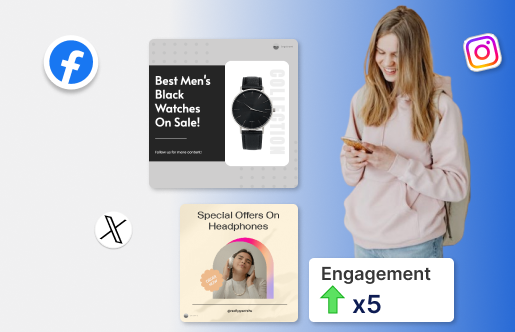
Effective Strategies to Kick-start Your Shopify ROI in 2026
To succeed with Shopify, businesses must rely only on the best Shopify marketing strategies. When you own an online business, you are certainly looking for ways to increase your e-commerce sales.
Let’s go over all the Shopify marketing strategies in-depth.
1. Sustainable eCommerce Practices
One of the best ways to highlight your brand on Shopify is to show your commitment to sustainability. Your brand should emphasize eco-friendly packaging, transparent sourcing systems, and carbon-neutral shipping solutions.
Such eCommerce brands attract the attention of environmentally conscious consumers. Here are some initiatives that you can take:
- Use recyclable or biodegradable packaging material and partner with carriers that promise eco-friendly shipping solutions.
- Brands must prioritize products made from sustainable materials using environmentally friendly and energy-efficient practices.
- You can also implement a ‘take-back’ program for some old or obsolete products that are no longer in use or production.
- Maintain transparency around your sustainability initiatives and highlight them on your product pages.
2. Cross-Sell and Upsell Strategies
Brands can implement cross-selling and upselling techniques on their Shopify store and recommend other related products during the checkout process. Here are some ways to cross-sell:
- Create bundles of related products (for example, mobile phone + accessories + extended warranty) and offer them at a discounted price.
- Create bundles based on ‘complete the look’ recommendations; for example, recommending footwear or accessories with a particular attire for a special occasion.
- Recommend ‘frequently bought together’ products.
Some of the common upsell activities include:
- Offer a comparison chart of different brands or versions at tiered pricing to highlight features, price ranges, or reviews of different brands selling the same product.
- Another technique is to encourage consumers to upgrade to a premium or subscription service or add some extras during the checkout process.
3. Voice Commerce and Conversational AI
If you are using Shopify marketing campaigns that are not powered by AI or updated technology, you are surely missing out on the attention of your potential consumers. Here are some practices that you can follow:
- Integrate voice commerce capabilities and help consumers make the right choice using voice commands
- You must use conventional AI to offer personalized promotions or recommendations after viewing the purchase history or preferences of your customers.
- Offer voice-activated discounts, voice-driven consumer support, and AI-enabled loyalty programs.
- Integrate Augmented Reality (AR) and Virtual Reality (VR), where customers can experience a virtual store environment and experience how a particular product would look.
4. User-Generated Content (UGC)
Another interesting Shopify marketing campaign is to use user-generated content to build trust and drive audience engagement. You can do so by:
- Adding consumer reviews and testimonials
- Running a social media contest
- Increasing influencer collaborations
- Featuring customer stories and sharing anecdotes
- Running UGC campaigns
- Creating interactive content like polls, quizzes, challenges, reward programs, etc.
5. Leverage Influencer Marketing
In the previous six months, 11 percent of millennials purchased something only because an influencer or a blogger suggested it.
Influencer marketing can be a powerful technique for increasing the reach of your company on social media.
Depending on the size and demands of your company, you can engage influencers of various types.
- Nano-influencers: having 10,000 followers
- Micro-influencers: having 10,000 to 100,000 followers
- Macro-influencers: having 100,000 to 1 million followers
- Mega-influencers: having 1 million+ followers
And the key to leveraging influencers as part of your Shopify marketing plan is:
- Find and follow industry influencers.
- Engage them, cite them on social media, and include their names in your posts.
- Contact them personally and ask if they’d be interested in promoting your company.
- Make a combined effort so that both parties benefit from the transaction.
Boost Sales on Social Media with AI ⚡️
TRY NOW6. Transform Customers into Brand Influencers
With the help of a referral program on your Shopify store, you basically reward your customers for bringing new customers to your store. These could be Custom Canvas Photo Prints for each successful referral. It’s a win-win situation where customers feel appreciated, and your business thrives.
With the help of a referral program, you can
- Encourage your customers to refer their friends and family to your store.
- Gain new clients without spending a lot of money
- Drive more traffic that will boost sales.
Here are a few things that you must keep in mind while creating a referral program:
- Make a program that is simple and easy for people to engage in.
- Connect the recommendation to your audience’s motivation and interest levels.
- Promote the referral program using all available means.
- Keep track of everything, from the number of referrals to conversions, awards, and so on.
7. Provide Quality Content
The idea is to generate a range of content types, such as blogs, videos, infographics, and so on, to target people at different points of the purchasing cycle. For short-form video content in particular, an AI reel maker can help Shopify store owners quickly produce product-focused Reels that drive traffic and engagement on Instagram
The idea is to generate a range of content types, such as blogs, videos, infographics, and so on, to target people at different points of the purchasing cycle.
Here is an effective content strategy for your Shopify store:
- Start by identifying your target audience. It will enable you to have a better understanding of your customers and tailor your content to attract their attention.
- Make content about themes that are important to your target audience.
- Make sure that all of your products or services are adequately covered with content and that you use the appropriate keywords so that Google ranks your articles higher.
- You can then break the blogs into smaller chunks of content and use them as individual posts on social media.
- Build a content calendar. It will help you to plan how often and when you will post your content.
8. Email Marketing Strategy
The benefit of this type of communication channel is that it allows you to advertise items to new clients while also forging relationships with existing ones. An effective Email Marketing approach helps businesses stay connected with their audience through personalized campaigns, promotions, and updates. Even better, you can automate email messages so that they reach consumers at or after a specific time.
And, if you run a Shopify store, you may obtain a major portion of ROI by targeting customer journey touchpoints with email marketing. And, if you run a Shopify store, you may obtain a major portion of ROI by targeting customer journey touchpoints with email marketing while strengthening trust through proper email authentication, including a valid BIMI record.
Omnisend, Klaviyo, ActiveCampaign, Drip, and GetResponse are a few of the top email marketing tools you can use to grow your website often implemented and optimized with the help of an experienced Email marketing agency. Shopify’s website builder offers Shopify email marketing. It is convenient to use it because that way you have everything under one roof, i.e., Shopify.
Additionally, no extra cost is added to your expenses, as many tools offer free plans. But for flexibility and advanced automation, you can opt for other email marketing services. For businesses or services for whom email marketing is crucial, it is recommended to go for other email marketing services. This is because they provide advanced reports, personalization, delivery of time-sensitive emails, and unique conversion-focused features.
9. Incorporate Live Chat In Your Shopify Store
According to 63% of consumers who utilize live chat on a website are more likely to return to that site.
This clearly demonstrates why live chat is one of the most desired communication channels by customers since it allows for real-time service.
When you implement live chat into your online business, you can stimulate contextual interaction, increasing customer happiness and decreasing customer turnover.
Why Should You Deploy Live Chat for Shopify Store Marketing?
- Customers can communicate with a support agent via live chat with little to no wait time.
- You can provide instant solutions to customer concerns in real-time, resulting in a better customer experience.
- Customers can access the appropriate agent at the right moment by using an e-commerce shop with live chat.
10. Building Customer Loyalty through Reward Programs
Do you know why so many businesses have a loyalty program?
Simply because it might entice existing clients to return for further buying. It may also be one of the most effective customer retention techniques. And when you’re ready to reward clients for their loyalty, they won’t leave you.
So, even if your shop is new or does not have a large consumer base, start a loyalty program if you want your clients to keep returning and purchasing from you.
11. Reengage with Targeted Marketing
97 percent of your site’s first-time visitors will leave without purchasing anything. So, do you want to let them go forever, or do you want to attempt to get them back?
Retargeting can help if you’re prepared to bring back visitors who don’t demonstrate any willingness to buy. And retargeting implies that you are taking steps to improve your Shopify eCommerce marketing for your store.
To perform retargeting campaigns, you can use:
- Google Ads
- Facebook Ads
- LinkedIn Ads
- And other retargeting ad platforms
Transform your eCommerce marketing with compelling product ads made easy using AI-powered Predis.ai's Ecommerce Ad Maker.
12. Personalized Product Recommendations
Many e-commerce websites commit this error by not providing product recommendations to their customers. So, why not do something that will boost your sales?
Yes, retailers that give product suggestions outperform the competition in terms of traffic and revenue.
This does occur since customers typically prefer a more personalized buying experience. And some of them are more inclined to buy if they are recommended, even if it was not their original aim.
13. Improve Shopify SEO
People seek information on Google. It is where prospective clients will seek your stuff. And if your items aren’t visible there, or if they don’t rank better on search engine result pages, sales may suffer.
And you’re aware that even the finest items won’t reach buyers if they aren’t adequately advertised. You need something that sets your eCommerce store apart from the competition.
This is where SEO (Search Engine Optimization) for your Shopify store might come in handy. So, if you’re looking to strengthen your store’s visibility and rank higher on search engines, consider investing in professional SEO Services that can help you implement these recommendations effectively.

In common terms, optimizing your store for search engines might be a wonderful Shopify marketing strategy for any business. Here are some effective ways to set up an SEO strategy for your Shopify store:
- A solid SEO plan considers all of the important variables, such as keyword research, selecting secondary keywords and phrases, and then developing content around them.
- Create keyword-driven content for your store and optimize your website structure using a cloud website builder so that search engines like Google can easily find it. If you cater to audiences in multiple regions, implementing multilingual website best practices ensures your content structure remains SEO-friendly and user-focused across languages.
14. Reduce Cart Abandonment
Cart abandonment costs e-commerce firms over $18 billion in sales revenue each year.
The shopping cart abandonment rate is an important indicator for e-commerce companies to monitor. A greater percentage of abandonment suggests a bad user experience. And if you can decrease cart abandonment, you’ll see an increase in sales and income.
The following are the three most common reasons for shopping cart abandonment:
- Complex checkout process
- Expensive shipping costs
- Poor UI experience
So, your primary focus should be on streamlining the checkout cycle to not only improve the consumer experience but also boost conversion.
Here are a few ways to achieve this objective:
- Extend real-time assistance to your Shopify customers
- Ensure that the checkout process at your store is smooth and hassle-free
- Provide your customers with multiple payment options
- Check that your site is easily navigable and has clear CTAs
- Use exit-intent popups to ensure your audience does not leave your site without offering you a second chance.
⭐️⭐️⭐️⭐️⭐️
Best Shopify app for Social Media Marketing

15. Facebook Shop Integration
Did you realize that social media platforms can be used to sell items as well?
This indicates that Facebook can be more than just a marketing tool — you can use it to drive traffic and conversions. All you have to do is connect the Facebook shop feature with your Shopify store.
When the connection is complete, your Facebook followers will be able to shop from your store without leaving the social network or even visiting your store.
The best part is that your complete Shopify product catalog can be easily placed on Facebook to manage inventories as well. This will make your whole catalog visible on Facebook while also assisting you with inventory management.
16. The Power Of SMS
Do you know that SMS experiences great open rates?
But why?
Because they don’t require us to check in or be online, individuals still enjoy opening SMSes, reading about deals, and interacting with companies.
As a result, SMS marketing platforms remain a leading communication medium for organizations today. They might easily resemble one of your best marketing strategy examples, where you don’t have to push them to buy, but still get the job done.
17. Paid Ads
Most of us would love to boost our businesses without paying a single dime. But as the saying goes, “To make money, you have to spend money.”
So, to get your business booming, you can invest in paid advertisements. This is a great way to connect with new customers and expand the business into new territories.
The following platforms can be great for advertising your business:
- YouTube is a mammoth platform if you want to reach a vast customer base in no time. Try running ads on YouTube; it might help in attracting new customers.
- You can easily buy posts on social media and attract new eyes to what you have to offer.
- Google is where we all go to search for anything we want. Why not try Google Shopping Ads and get the benefit there?
18. Podcast Sponsorship
This is the right time to sponsor podcasts and advertise your products, because almost everyone these days has a favorite podcast they listen to.
Sponsoring a podcast will not only bring in new customers but also be a solid investment, as the podcast episode you sponsor will always be there and will attract customers for a long time.
19. Have a PR and press strategy
One of the commonly overlooked things when it comes to marketing is the press strategy. Mainstream media still has a large audience and is very influential, which makes it an attractive source of marketing.
Spend some time and gain genuine relationships with journalists so that you can get your business in the publications. When you do get a spot, treat it in a way that makes it engaging for the viewers, and do not focus on marketing your business alone.
20. Collaborate with other brands
Find companies that sell complientary product of your users and make a bundle kind of offer. This way, both brands get exposed to each other’s audience. For example, a cosmetics product might find it appropriate to pair with a site like Sephora to make it reach a wider audience.
21. Have Flash sales
Urgency is a great way to make products sell out. This is why marketers have used FOMO time and again to get their inventory cleared. This is also a marketing strategy that Shopify businesses can adopt. Some of the things that you need to keep in mind when running flash sales include:
- Space out flash sales over a period of time to retain their impact.
- Add countdown timers to your product pages to induce a sense of urgency in your customers.
- Consider conducting sales for your limited products or bestsellers to create hype.
22. Have a stellar unboxing experience
Customers love packages with a premium feel to them, which even adds to the excitement of purchases. There is a reason why a lot of people store their Apple packages and toss other boxes in the trash.
Use this psychology to create brand packaging that is satisfying to open. This way, you can provide a premium experience to your users.
23. Encourage Affiliate Marketing
Affiliate marketing is the process in which someone promotes your product and receives a small commission on the sale they helped make. The sales are attributed to the right person by tracking the link that led a customer to the site.
You can set up such partnerships with creators and influencers to make sales for your business. All you have to do is provide them with high-quality visuals and copy and encourage them with a good commission.
24. Prioritize customer service
The growth and progress of your business solely depend on your customers. This makes having great customer service a crucial part of marketing strategies. Attracting customers is not sufficient; engaging them, delighting them, and helping them with the initial purchase stage is what is crucial.
To curate exceptional customer service, start by understanding and studying the top customer service issues. Ensure the agents from your customer service department are patient with the customers to build effective customer service. The information shared and communication with the customers must be clear and accurate. Integrating advanced tools like predictive dialer services can further enhance customer support by allowing teams to reach out to clients efficiently, reduce wait times, and ensure a more personalized communication experience.
25. Implement Marketing Automation
Automation is an important part of marketing strategies, and it allows engagement with customers at every stage. Shopify offers multiple marketing automation tools that allow your business to grow.
You can build automation for abandoned checkouts, abandoned carts, or abandoned product browsing. This helps in bringing back shoppers with automated reminders. You can use email, SMS, web push, or other messaging applications for this purpose.
An automated email or text can be sent to the customers if they are new subscribers. The same can be done for the customer’s first purchase.
Automation can also be used to enhance engagement with customers. Sending welcome emails, product updates, or discounts are a few ways to use automation to engage with customers.
A Few Essential Points to Consider
The strategies above can revolutionize your marketing and amplify your Shopify ROI. However, to drive optimum results, consider a few things before implementing these strategies.
- Have a clean and attractive store design. And have a readable font to ensure that your message gets across.
- To start with site optimization, pick the right theme and be consistent with the website design. Implementing customer experience automation can further streamline user interactions, ensuring faster responses and a more personalized experience across your site.
- Focus on reviews and learn from what your customers have to say about you.
- Find metrics that are relevant to your marketing goals and track them to see if you are making progress.
- Segment your users based on their preferences and market your products accordingly.
Challenges in measuring e-commerce ROI
Measuring E-commerce ROI does not come without its own challenges. Some of them that you might encounter include:
- Attributing to the right marketing channel: Customers often buy a product after multiple touchpoints. This means that attributing the conversion to a single channel will not be fair. The most important point where the customer decided to purchase could end up getting excluded.
- Different time durations: Some strategies, like email marketing, may take a lot of time to get results, and paid ads could offer good ROI within a short duration. That does not mean one channel is worth less than the other.
- Measuring CLV: Two important factors go into measuring Customer Lifetime Value (CLV), which are purchasing frequency and average customer lifespan. Both of which are ambiguous factors that cannot be measured accurately.
Summing Up the Shopify Marketing Strategies
Growing a business and gaining consumers takes some effort and consistency. That is why, if you want to build your Shopify store, you will need an efficient Shopify marketing strategy and some preparation.
Implementing a robust Shopify marketing strategy becomes straightforward with the right tools. This is where Predis.ai comes into play. With Predis, you can quickly generate stunning content for your products. Not only does Predis streamline the creation of social media posts, but it also facilitates efficient social media marketing campaigns.
Predis.ai for Shopify offers a range of solutions, including a product video maker and promotional post generator, designed to enhance your marketing efforts with ease.
You may also like,
E-commerce store marketing on a budget
Effective Upselling Strategies for Shopify: Examples and Tips
FAQ:
High-ROI Shopify strategies include email marketing, recovering cart abandonment, upselling and cross-selling products, customer loyalty programs, and SEO optimization.
Yes, Email marketing is still a high-ROI generating marketing channel for Shopify. Some of the emails that you can send to your customers include: product launches, personalized recommendations, abandoned cart emails, and post-purchase follow-ups.
No, you do not require paid ads to succeed in Shopify marketing, even though it can accelerate growth. Sometimes, having a proper SEO strategy, email marketing, social proof, and referrals can also work to convert your audience, although it may take some time.