

Explorez ce contenu grâce à l'IA :
Nous traversons actuellement une crise de saturation de contenu. L'IA générant désormais plus de contenu que les humains, le volume considérable de ce « bruit » rend impossible de réussir en devinant les goûts du public. Se fier à son intuition, c'est comme essayer de se repérer dans une ville inconnue sans GPS : on finira peut-être par arriver, mais on gaspillera beaucoup de carburant en chemin.
L'analyse des médias sociaux est le processus systématique de collecte et d'analyse des données issues des réseaux sociaux afin d'éclairer les décisions commerciales. Elle transforme les chiffres bruts – comme le nombre de personnes ayant survolé une image – en informations exploitables, par exemple pourquoi elles ont survolé l'image sans cliquer. C'est grâce à ces informations que vous pouvez passer d'une vision floue à une feuille de route claire.
Le changement algorithmique : au-delà du « J’aime »
Le paysage des indicateurs a connu une transformation radicale. L'analyse est passée du simple comptage des signaux passifs (likes) à la mesure de la performance du référencement social et de l'impact psychographique.
- Référencement social : Des plateformes comme Instagram et TikTok sont désormais des moteurs de recherche à part entière. Les outils d'analyse permettent de suivre le positionnement de votre contenu pour des mots-clés spécifiques dans les barres de recherche de ces plateformes.
- Impact communautaire Nous ne nous contentons plus de mesurer la portée ; nous mesurons la « profondeur du lien » — la part de votre contenu qui est enregistrée pour plus tard ou partagée par messages privés.
Ce passage des indicateurs de vanité aux métriques superficielles signifie qu'il est important d'impressionner vos spectateurs à un niveau plus profond, car c'est également ce que valorisent les algorithmes.
Améliorer le retour sur investissement des médias sociaux ⚡️
Gagnez du temps et créez à grande échelle avec l'IA
ESSAYEZ MAINTENANT
Qu'est-ce que l'analyse des médias sociaux ?
Le concept de base
L'analyse des médias sociaux consiste essentiellement à évaluer le succès de l'interaction humaine. C'est la « méthode scientifique » appliquée au marketing : on formule une hypothèse (par exemple, « Éducatif »). Reels « Générez plus de prospects que les mèmes », testez-le avec du contenu et utilisez les données pour le prouver ou le réfuter.
Le champ d'action : regarder au-delà de ses propres murs
L’analyse des médias sociaux n’est plus une activité cloisonnée. Elle comprend trois niveaux distincts :
- Analyses détenues : Vos données de performance internes.
- Benchmark des concurrents : Utiliser l'IA pour « extraire » et analyser les taux d'engagement de vos concurrents directs.
- Analyse des tendances de l’industrie : Identifier les tendances « micro-dramatiques » ou « remix nostalgiques » avant qu'elles ne deviennent courantes.
Pourquoi c'est important?
1. Vérification du retour sur investissement
Les services marketing sont plus que jamais sous pression pour justifier chaque euro dépensé. L'analyse des données fournit la trace écrite, de la simple story Instagram à l'achat final sur un site web, vous permettant ainsi de montrer aux parties prenantes précisément comment les dépenses sur les réseaux sociaux se traduisent en revenus.
2. Psychographie du public
Les données démographiques traditionnelles (âge, localisation, sexe) sont désormais secondaires. Ce sont les données psychographiques qui révèlent les valeurs, les tendances et les déclencheurs émotionnels de votre public. L'analyse vous indique si vos abonnés privilégient un « optimisme frugal » ou un « luxe extravagant », vous permettant ainsi d'adapter le ton de votre marque en conséquence.
3. Pivotement stratégique et avantage concurrentiel
Les données servent de système d'alerte précoce. Si un pilier de contenu spécifique enregistre une baisse de 20 % de la rétention sur deux semaines, vous pouvez adapter votre stratégie avant l'épuisement du budget mensuel. De plus, l'analyse vous permet d'identifier les points faibles de vos concurrents en matière d'engagement (par exemple, des questions sans réponse dans les commentaires), ce qui vous permet de capter cette part de marché insatisfaite.
4. Favorabilité algorithmique
Les algorithmes des réseaux sociaux sont en réalité d'immenses machines de traitement de données. En utilisant l'analyse de données pour identifier les contenus les plus performants (comme les publications avec un taux d'enregistrement ou de partage initial élevé ), vous pouvez « nourrir la bête » avec ce qu'elle désire.
Comprendre ces indicateurs vous permet de déclencher la phase de distribution de l'algorithme, garantissant ainsi que votre contenu atteigne les non-abonnés et développe votre communauté de manière organique plutôt que de lutter contre le système.
5. Allocation des ressources et prévention de l'épuisement professionnel
Les équipes marketing souffrent souvent de « saturation de contenu » en essayant d'être présentes partout à la fois. L'analyse de données fournit une cartographie des efforts déployés par rapport à leur impact.
Si les données montrent que 80 % de vos conversions proviennent de LinkedIn alors que vous consacrez 50 % de votre temps à TikTok, vous pouvez réaffecter vos ressources humaines et financières aux plateformes qui font réellement la différence, évitant ainsi l'épuisement professionnel de vos équipes sur des tâches à faible retour sur investissement.
6. Prévision des tendances
Les données ne sont pas qu'un rétroviseur ; elles sont un pare-brise. En suivant l'évolution du sentiment à long terme et les regroupements de mots-clés, vous pouvez repérer les « micro-tendances » avant qu'elles ne deviennent généralisées.
Si vous constatez une augmentation progressive des mentions de « durabilité » dans vos sections de commentaires, vous pouvez prendre l'initiative d'une campagne dédiée, en positionnant votre marque comme une pionnière plutôt que comme une arrivée tardive.
7. Gestion de crise et santé de la marque
L'analyse des données sert de « détecteur de fumée » numérique. Une hausse soudaine des sentiments négatifs ou une augmentation des mentions en dehors de vos heures de publication habituelles peuvent signaler une crise de relations publiques imminente.
En surveillant ces flux de données en temps réel, vous pouvez remédier aux problèmes de désinformation ou aux défaillances du service client en quelques minutes, protégeant ainsi votre image de marque avant qu'une petite étincelle ne se transforme en incendie.
Débloquez votre succès sur les réseaux sociaux ! ⚡️
Optimisez vos réseaux sociaux avec l'IA
ESSAYEZ MAINTENANT
Les quatre types d'analyse des médias sociaux
Pour maîtriser les données, il faut comprendre les différents niveaux d'analyse :
1. Indicateurs de performance (Santé du contenu)
L'analyse des données va au-delà des simples « likes » pour révéler la véritable vitalité de votre contenu. En suivant le taux d'engagement par rapport à la portée , vous pouvez déterminer si votre contenu trouve un réel écho ou s'il ne fait que transiter par les flux RSS.
Cette vue détaillée permet d'identifier les formats (par exemple, les vidéos courtes par rapport aux carrousels statiques) qui génèrent des actions significatives, garantissant ainsi que votre énergie créative est consacrée à ce qui fonctionne réellement.
2. Analyse d'audience (Nuance communautaire)
Alors que les données psychographiques permettent de déterminer qui sont les personnes, l'analyse d'audience révèle comment elles se comportent. Cela implique de suivre les heures d'activité, la vitesse de croissance du nombre d'abonnés et les taux de fidélisation.
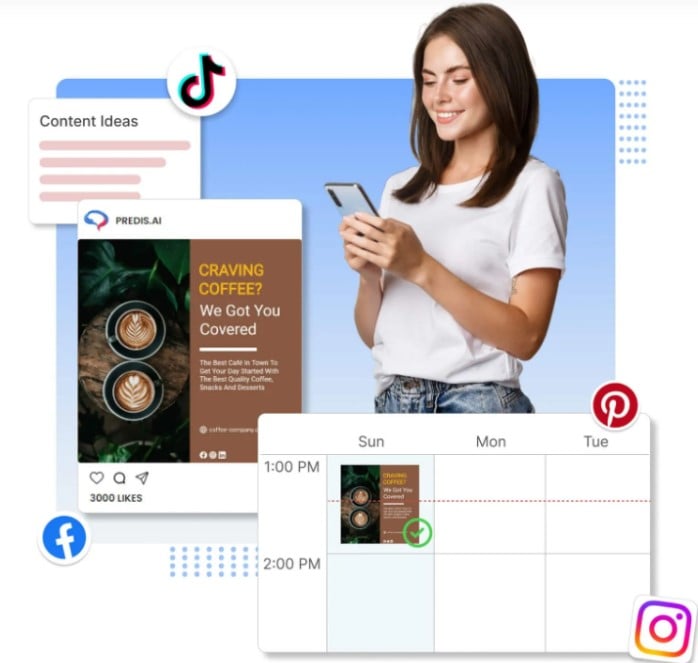
Comprendre ces tendances vous permet d'optimiser votre calendrier de publication pour atteindre les périodes de forte activité en ligne et d'identifier les contenus spécifiques qui parviennent à convertir les visiteurs occasionnels en membres actifs de la communauté sur le long terme.
Vous pouvez utiliser des outils comme Predis IA à publier du contenu régulièrementEn fonction des taux d'engagement, l'IA analysera et suggérera des plages horaires d'activité adaptées à votre audience. Ainsi, vous éliminez les approximations.
3. Analyse de la marque (Sentiment et Voix)
Il s'agit d'évaluer l'impact émotionnel de votre marque. L'analyse des sentiments permet de déterminer si les conversations autour de votre marque sont positives, neutres ou négatives. Elle vous permet de vérifier si le message que vous souhaitez transmettre est bien perçu par le public, et vous offre ainsi un aperçu clair de l'impact émotionnel de vos messages.
4. Analyse concurrentielle (analyse comparative du marché)
Vous n'évoluez pas en vase clos. L'analyse concurrentielle vous permet de comparer votre croissance à celle de vos concurrents afin de déterminer si votre « ralentissement » est dû à un problème d'image de marque ou à une tendance générale de votre plateforme.
En analysant leurs publications les plus enregistrées ou partagées, vous pouvez identifier les opportunités sur le marché — les lacunes en matière de contenu — que votre marque peut combler.
Avec Predis L'IA permet d'automatiser analyse de la concurrence De plus, au lieu de collecter des données provenant de sources multiples et de les vérifier manuellement, vous pouvez simplement saisir les identifiants de réseaux sociaux de vos concurrents et obtenir toutes les données sur un seul tableau de bord en quelques minutes.
De même, si vous développez un produit d'analyse SaaS, un outil de reporting interne ou une plateforme de performance marketing, l'utilisation d'un tableau de bord d'administration Shadcn vous permettra de créer plus rapidement une interface soignée avec des graphiques, des tableaux, des filtres et des mises en page adaptatives. Vous pourrez également utiliser un générateur de graphiques circulaires pour visualiser des données complexes issues des réseaux sociaux et faciliter la compréhension des indicateurs de performance.
5. Analyse des médias sociaux payants (Précision budgétaire)
Quand il s'agit d'argent réel, l'approximation n'est pas envisageable. L'analyse des campagnes payantes vous permet de calculer précisément le coût par acquisition (CPA) et le retour sur investissement publicitaire (ROAS) . En testant différentes créations publicitaires grâce aux données (A/B testing), vous pouvez rapidement éliminer les publicités les moins performantes et amplifier les plus efficaces, garantissant ainsi que votre budget publicitaire devienne un véritable levier de croissance.
6. Analyse des influenceurs (Vérification et validité)
À l'ère des abonnés « achetés », l'analyse des données joue un rôle crucial. Avant de collaborer avec des créateurs, vous pouvez analyser l'authenticité de leur audience et leurs performances passées. Après une campagne, ces indicateurs vous permettent de déterminer si un influenceur a réellement généré du trafic ou s'il s'est contenté d'accroître sa notoriété, ce qui facilite des décisions de partenariat plus éclairées.
Pour les marques qui n'ont pas le budget pour une campagne d'influenceurs, faire appel à des créateurs de vidéos UGC basés sur l'IA est la meilleure solution. Ces outils sont rapides, permettent des modifications faciles et sont bien moins coûteux que de recruter un influenceur.

Indicateurs : choisir les bons
La hiérarchie des indicateurs
Toutes les données ne se valent pas. Elles peuvent être classées en trois catégories, et vous devez choisir la métrique appropriée en fonction des objectifs de votre campagne :
| Catégories | Métriques principales | Pourquoi ça compte |
| Conscience et rigueur. | Portée, part de voix | Détermine si vous êtes même « dans la conversation ». |
| Engagement des équipes | Enregistrements, partages, temps de visionnage | Sauvegardes et partages Elles constituent désormais la « référence absolue ». Elles signalent une valeur élevée à l'algorithme. |
| Conversion | Taux de clics (CTR), ventes, génération de prospects | La preuve ultime de la valeur commerciale des médias sociaux. |
Le test décisif « Vanité contre valeur »
Une publication avec un million de vues mais un taux de conversion de 0 % est un indicateur de vanité . À l'inverse, une publication B2B à fort potentiel avec seulement 100 vues mais 5 prospects qualifiés est un indicateur de valeur . Il faut privilégier ce dernier, car c'est grâce aux conversions que se trouvent les profits.
Le rôle de l'IA dans l'analyse des médias sociaux
L'IA n'est plus un simple outil, elle est devenue le moteur du service analytique. En déléguant les tâches chiffrées à l'IA, vous pouvez vous concentrer sur les aspects créatifs qui requièrent davantage de temps.
- La reconnaissance de formes: L'IA peut scanner des milliers de Reels en quelques minutes pour identifier les éléments visuels (par exemple, une disposition spécifique sur fond vert) qui retiennent actuellement l'attention le plus longtemps.
- Analyse des sentiments: Le traitement automatique du langage naturel (TALN) moderne peut faire la distinction entre un utilisateur véritablement enthousiaste et un utilisateur sarcastique dans ses commentaires.
- Intelligence visuelle : Les plateformes utilisent désormais la vision par ordinateur pour « lire » votre contenu vidéo sans avoir besoin de hashtags. Les outils d'analyse utilisent cette même technologie pour vous indiquer quels éléments ou paramètres de vos vidéos génèrent le plus d'engagement.
- Analyses prédictives et suggestions de contenu : Des outils d'IA comme Predis.ai Anticipez les performances de vos publications avant même de les publier, en générant des idées de contenu et des créations sur mesure qui comblent le fossé entre les données brutes et une exécution prête à devenir virale.
- Fenêtres de publication optimales : En analysant les habitudes d'activité en temps réel de vos abonnés, l'IA élimine les conjectures de planification génériques pour identifier la minute exacte à laquelle votre contenu atteindra une portée organique maximale.
Comment suivre et utiliser les statistiques des médias sociaux
La boucle de rétroaction
Les marques les plus performantes fonctionnent selon un cycle continu :
- Piste (Collecte de données) > Analyser (Trouver des modèles) > Optimiser (Modifier le contenu créatif) > Repeat.
En améliorant progressivement votre stratégie sur les réseaux sociaux grâce à l'analyse, vous parvenez à fidéliser vos clients, à assurer la vitalité de votre contenu et à alimenter vos pipelines de vente.
L'utilisation de Predis.ai pour des analyses approfondies
Des outils comme Predis.ai ont révolutionné l'analyse « post-niveau ». Au lieu de simplement observer how un article l'a fait, vous pouvez voir une analyse détaillée de why Cela a fonctionné par rapport à vos concurrents.
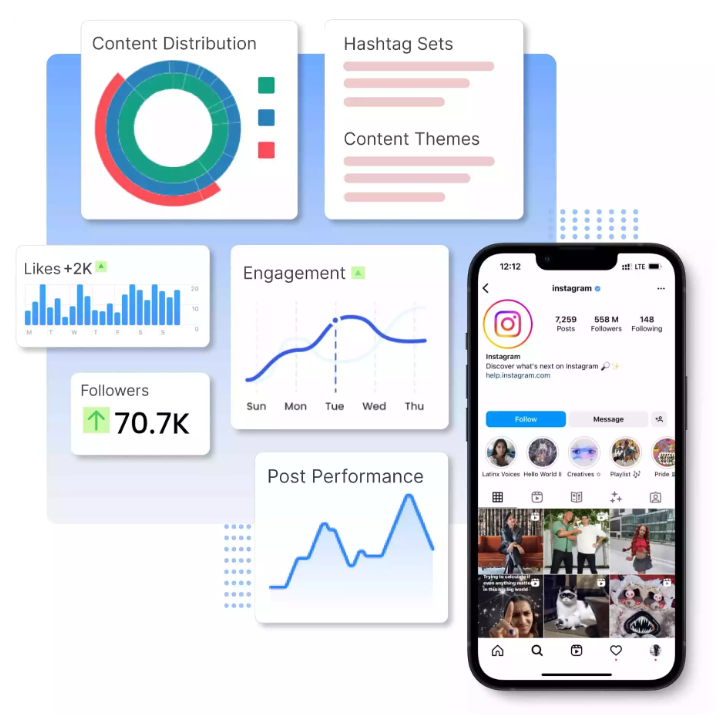
- Analyse de la concurrence: Vous pouvez « espionner » les piliers de contenu les plus performants d'un concurrent, et voir précisément quels sujets génèrent leurs pics d'engagement les plus élevés.
- Audit de contenu : Utilisez l'IA pour identifier les « lacunes en matière de contenu » — les sujets que votre public recherche et que ni vous ni vos concurrents n'avez encore abordés.
Intégrez l'IA à vos analyses pour améliorer l'optimisation et déceler des tendances qui auraient pu vous échapper.
Outils essentiels pour l'analyse des médias sociaux
Obtenir des chiffres pour étayer votre publication est plus facile que vous ne le pensez, grâce à ces plateformes :
- Analyse native : Instagram Insights et TikTok Creator Center restent les meilleures plateformes pour obtenir des données d'engagement en temps réel et spécifiques à chaque plateforme. Sans quitter la plateforme, vous pouvez accéder à une mine d'informations exploitables.
- Predis.ai: Leader en matière d'analyse comparative de la concurrence et d'analyse visuelle des tendances grâce à l'IA. Son principal atout : la collecte de données provenant de multiples plateformes et leur compilation sur un tableau de bord unique, simplifiant ainsi l'analyse.
- Google Analytics 4 (GA4) : Indispensable pour suivre le parcours client « Social-to-Web » et calculer la valeur vie client (CLV). Son utilisation correcte facilite également l’attribution des résultats.
- Hootsuite/Sprout Social : Idéal pour l'agrégation de haut niveau à travers plusieurs marques et plateformes.
Créez rapidement des publications époustouflantes !
Faites évoluer votre création de contenu sur les réseaux sociaux grâce à l'IA
ESSAYEZ MAINTENANT
Meilleures pratiques pour une réussite fondée sur les données
- Rapports cohérents : Vérifiez quotidiennement l'engagement, mais ne modifiez que votre stratégie Cette stratégie repose sur les tendances mensuelles et nécessite un échantillon de taille significative.
- Le contexte est primordial : Une large audience n'est pas toujours un avantage si le sentiment est négatif. Il est essentiel d'associer systématiquement données quantitatives (chiffres) et données qualitatives (sentiment).
- Test A / B: Cessez de vous disputer pour savoir quel titre est le meilleur. Diffusez les deux pendant 24 heures, analysez le taux de clics et laissez le public désigner le vainqueur.
Conclusion : L'écoute est le nouveau leadership
L'analyse des médias sociaux ne se résume pas à de simples chiffres sur un écran ; il s'agit de la forme d'« écoute » la plus sophistiquée de l'histoire de l'humanité. Les marques qui réussissent ne se contentent pas de diffuser du contenu : elles observent, s'adaptent et réagissent aux données.
Si vous ne consultez pas vos statistiques, vous ne faites pas de marketing ; vous ne faites que du bruit. Ne commettez pas cette erreur.
Prêt à découvrir ce que vos données vous révèlent réellement ? Lancez dès aujourd’hui votre premier audit concurrentiel basé sur l’IA et révélez les opportunités cachées de votre secteur.
QFP
Les partages et les enregistrements sont désormais les principaux indicateurs. Ils signalent une « forte valeur » et une « utilité » au sein de l’algorithme, ce qui déclenche une diffusion plus large que les mentions « J’aime » ou les commentaires.
Oui. Toutes les grandes plateformes proposent des informations natives pour les « Professionnels » ou les « Créateurs ». freeGoogle Analytics pour le Web est également un free plateforme que vous pouvez exploiter.
Vérifiez quotidiennement pour repérer les anomalies ou interagir avec les fans, mais effectuez un audit stratégique approfondi une fois par mois.